







Question: Purpose: Demonstrate the ability to understand and apply software requirements engineering techniques. Question 1 (100 POINTS ): Assume that UTD Student Union Food Court is
Purpose: Demonstrate the ability to understand and apply software requirements engineering techniques. Question 1 (100 POINTS ): Assume that UTD Student Union Food Court is unable to handle the high volume of student / faculty / staff requests during peak dining times of the day. Think of a software system that will relieve the current overload of this system and provide the following: 1.A.) (20 POINTS) Apply requirements elicitation to collect user requirements. Describe how you will use techniques as interview and ethnography. 1.B.) (20 POINTS) Write scenarios for the system. Scenarios should include: o A description of the starting situation; o A description of the normal flow of events; o A description of what can go wrong; o Information about other concurrent activities; o A description of the state when the scenario finishes. 1.C.) (20 POINTS) From the scenarios, extract a list of min. 5 functional requirements 1.D.) (20 POINTS) From the scenarios, extract a list of min. 6 non-functional requirements (select 2 from each of the non-functional requirement categories as product requirements, organizational requirements, and external requirements). Use Figure 4.3 of textbook for help. 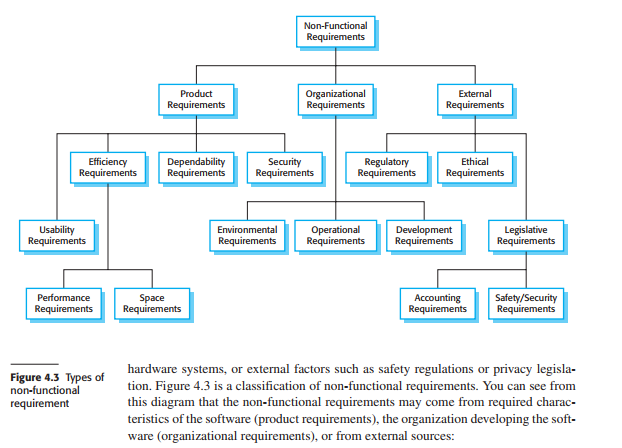
1.E.) (20 POINTS) List the domain requirements for the software system you will design. Hint: You can use the examples at URL: http://iansommerville.com/software-engineeringbook/web/domain-requirements/ to get improvised about the domain requirements to list as required in this question. This URL is also full of material to help you review the software design examples introduced in Chapter 1 (Mentalcare system, Insulin pump system, wilderness weather station system, etc.) from various aspects that we will be studying throughout the semester.
Non-Functional Requirements Product Requirements Organizational Requirements External Requirements Efficiency Requirements Dependability Requirements Security Requirements Regulatory Requirements Ethical Enioomental Operational Usability Requirements Development Legislative Requirements Requirements Performance RequirementsRequirements Space Accounting Requirements Req Safety/Security hardware systems, or external factors such as safety regulations or privacy legisla- tion. Figure 4.3 is a classification of non-functional requirements. You can see from this diagram that the non-functional requirements may come from required charac- teristics of the software (product requirements), the organization developing the soft- ware (organizational requirements), or from external sources Figure 4.3 Types of non-functional requirement Non-Functional Requirements Product Requirements Organizational Requirements External Requirements Efficiency Requirements Dependability Requirements Security Requirements Regulatory Requirements Ethical Enioomental Operational Usability Requirements Development Legislative Requirements Requirements Performance RequirementsRequirements Space Accounting Requirements Req Safety/Security hardware systems, or external factors such as safety regulations or privacy legisla- tion. Figure 4.3 is a classification of non-functional requirements. You can see from this diagram that the non-functional requirements may come from required charac- teristics of the software (product requirements), the organization developing the soft- ware (organizational requirements), or from external sources Figure 4.3 Types of non-functional requirement
Step by Step Solution
There are 3 Steps involved in it

Get step-by-step solutions from verified subject matter experts
 Study Help