







Question: Purpose This assignment is intended to help you learn to plan succession management strategies. Overview Successful succession management creates a plan to minimize the impact
Purpose
This assignment is intended to help you learn to plan succession management strategies.
Overview
Successful succession management creates a plan to minimize the impact of a key executive leaving the company. Failure to plan can have disastrous consequences for a company, including plummeting stock prices amidst shareholder concern. A prime example of this is Disney's Inadequate Succession Planning,Links to an external site. which resulted in its stock price dropping 2% overnight.
Succession management is not just about planning for the next CEO; it's important that all critical roles in the organization be identified so that possible successors can be developed.
Address the following:
- Why is succession planning important for this plant in light of the four "storms" they have experienced? How can you have a successful succession plan when corporate is initiating their plans simultaneously?
- Analyze the four "storms" and their impacts both positively and negatively, specifically addressing recruitment, hiring, retention, and talent development.
- Discuss and debate the effectiveness of a succession plan at this plant. How can Linda ensure that managers and employees follow through on the individual development plans (IDPs) established to prepare people for advancement opportunities?
- What can you suggest to Linda for a succession management process (steps) for the future, especially addressing IDPs and their value or unimportance to the process? Is employee trust an issue? How can it be addressed, if at all?
- To ensure the success of any succession planning effort, the organization must have primary objectives to be met. List and discuss your objectives for Linda. What are the strengths of your plan, and discuss its effectiveness. How will you know if it is successful?
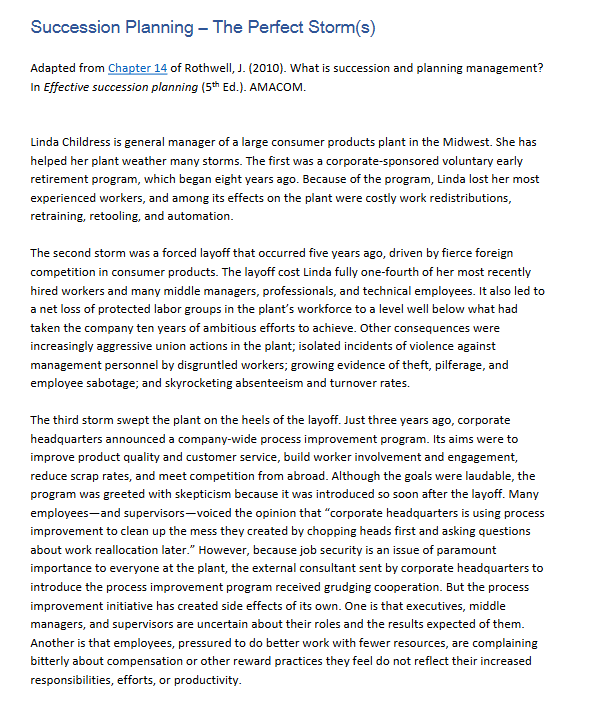
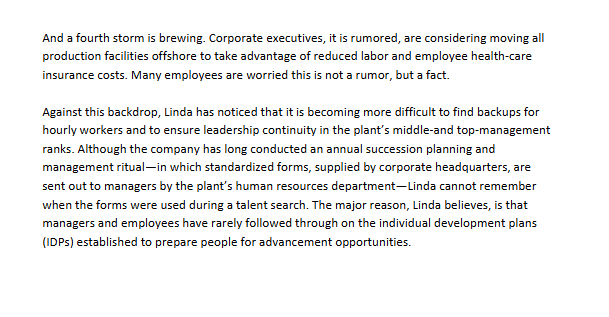
Succession Planning The Perfect Storm(s) Adapted from Chapter 14 of Rothwell, 1. {2010}). What is succession and planning management? In Effective succession planning (5% Ed.). AMACONM. Linda Childress is general manager of a large consumer products plant in the Midwest. She has helped her plant weather many storms. The first was a corporate-sponsored voluntary early retirement program, which began eight years ago. Because of the program, Linda lost her maost experienced workers, and among its effects on the plant were costly work redistributions, retraining, retooling, and automation. The second storm was a forced layoff that occurred five years ago, driven by fierce foreign competition in consumer products. The layoff cost Linda fully one-fourth of her maost recently hired workers and many middle managers, professionals, and technical employees. It also led to a net loss of protected labor groups in the plant's workforce to a level well below what had taken the company ten years of ambitious efforts to achieve. Other consequences were increasingly aggressive union actions in the plant; isolated incidents of violence against management personnel by disgruntled workers; growing evidence of theft, pilferage, and employee sabotage; and skyrocketing absenteeizm and turnover rates. The third storm swept the plant on the heels of the layoff. Just three years ago, corporate headguarters announced a company-wide process improvement program. Its aims were to improve product quality and customer service, build worker involvement and engagement, reduce scrap rates, and meet competition from abroad. Although the goals were laudable, the program was greeted with skepticism because it was introduced so soon after the layoff. Many employeesand supervisorsvoiced the opinion that \"corporate headquarters is using process improvement to clean up the mess they created by chopping heads first and asking questions about work reallocation later.\" However, because job security is an issue of paramount importance to everyone at the plant, the external consultant sent by corporate headgquarters to introduce the process improvement program received grudging cooperation. But the process improvement initiative has created side effects of its own. One is that executives, middle managers, and supervisors are uncertain about their roles and the results expected of them. Another is that employees, pressured to do better work with fewer resources, are complaining bitterly about compensation or other reward practices they feel do not reflect their increased responsibilities, effarts, or productivity. And a fourth storm is brewing. Corporate executives, it is rumored, are considering moving all production facilities offshore to take advantage of reduced labor and employee health-care insurance costs. Many employees are worried this is not a rumor, but a fact. Against this backdrop, Linda has noticed that it is becoming more difficult to find backups for hourly workers and to ensure leadership continuity in the plant's middle-and top-management ranks. Although the company has long conducted an annual succession planning and management ritualin which standardized forms, supplied by corporate headquarters, are sent out to managers by the plant's human resources departmentLinda cannot remember when the forms were used during a talent search. The major reason, Linda believes, is that managers and employees have rarely followed through an the individual development plans {IDPs) established to prepare people for advancement opportunities
Step by Step Solution
There are 3 Steps involved in it

Get step-by-step solutions from verified subject matter experts
 Study Help