







Question: Python 1. Building up (14 pts) Here will we revisit and build upon past concepts including lists, dictionaries, forloops, and if statements. A useful resource
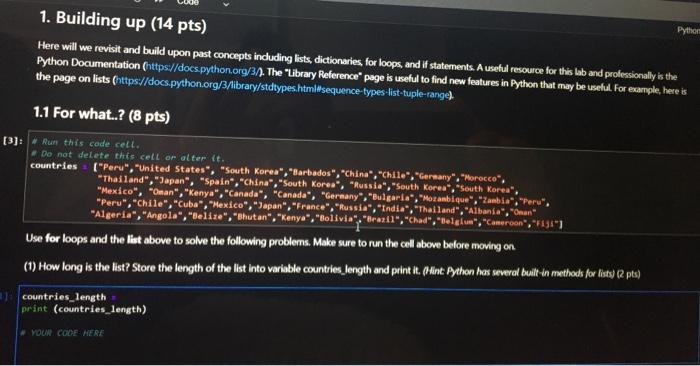
Python 1. Building up (14 pts) Here will we revisit and build upon past concepts including lists, dictionaries, forloops, and if statements. A useful resource for this lab and professionally is the Python Documentation (ttps://docs.python.org/39. The library Reference page is useful to find new features in Python that may be useful. For example, here is the page on lists (https://docs.python.org/3/library/stdtypes.html#sequence-types-list-tuple-range). 1.1 For what..? (8 pts) D3D: Run this cade cett. # Do not delete this cell or alter (t. countries ("Peru", "United States", "South Korea", "Barbados","China", "Chile", Germany". "Morecco, "Thailand", "Japan", "Spain", "China", "South Korea", "Russia", "South Korea, South Korea", "Mexico", "Oman", "Kenya", "Canada", "Canada", "Germany","Bulgaria", "Mozambique", "Zambia, "Peru". "Peru", "Chile", "Cuba", "Mexico","Japan", "France","Russia", "India", "Thailand", "Albania", "Onan" "Algeria", "Angola","Belize","Bhutan", "Kenya", "Bolivia, Brasil", "Chad","Belgium", "Cameroon", "F131") Use for loops and the list above to solve the following problems. Make sure to run the cell above before moving on (1) How long is the list? Store the length of the list into variable countries length and print it. (Hint: Python heas several built-in methods for lists) (2 pts) 31 countries_length print (countries_length) - YOUR CODE HERE
Step by Step Solution
There are 3 Steps involved in it

Get step-by-step solutions from verified subject matter experts
 Study Help