







Question: python 1 . Game Flow: - The game starts by creating a Player character. - Players move through rooms by choosing directions ( e .
python
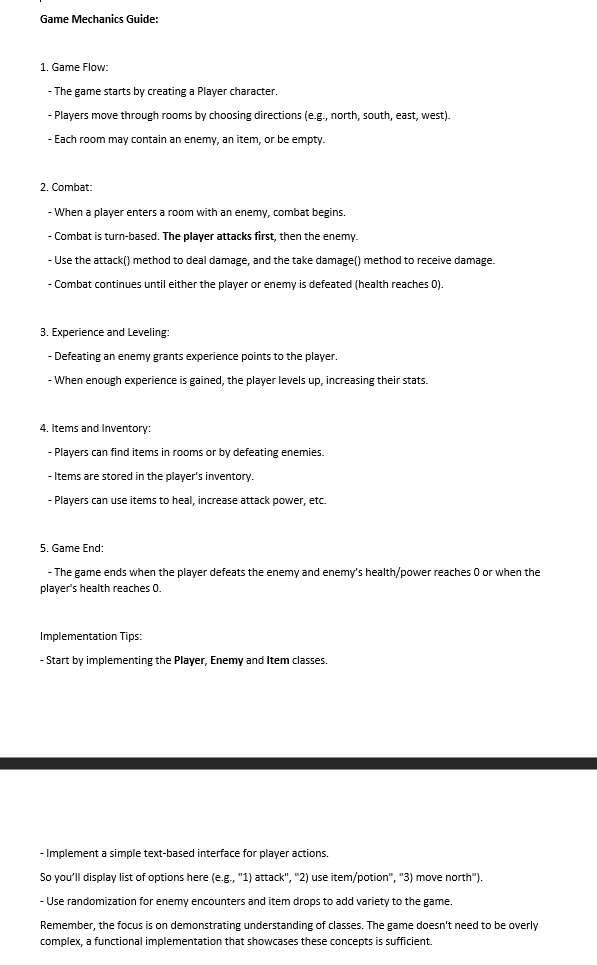
Game Flow:
The game starts by creating a Player character.
Players move through rooms by choosing directions eg north, south, east, west
Each room may contain an enemy, an item, or be empty.
Combat:
When a player enters a room with an enemy, combat begins.
Combat is turnbased. The player attacks first, then the enemy.
Use the attack method to deal damage, and the take damage method to receive damage.
Combat continues until either the player or enemy is defeated health reaches
Experience and Leveling:
Defeating an enemy grants experience points to the player.
When enough experience is gained, the player levels up increasing their stats.
Items and Inventory:
Players can find items in rooms or by defeating enemies.
Items are stored in the player's inventory.
Players can use items to heal, increase attack power, etc.
Game End:
The game ends when the player defeats the enemy and enemy's healthpower reaches or when the player's health reaches
Implementation Tips:
Start by implementing the Player, Enemy and Item classes.
Implement a simple textbased interface for player actions.
So you'll display list of options here eg attack", use itempotion move north"
Use randomization for enemy encounters and item drops to add variety to the game.
Remember, the focus is on demonstrating understanding of classes. The game doesn't need to be overly complex, a functional implementation that showcases these concepts is sufficient.
Step by Step Solution
There are 3 Steps involved in it
1 Expert Approved Answer
Step: 1 Unlock

Question Has Been Solved by an Expert!
Get step-by-step solutions from verified subject matter experts
Step: 2 Unlock
Step: 3 Unlock
 Study Help