







Question: Python (15 pts) Problem 3: Computation (Streaming Means) Data science is often divided into two categories: questions of what the best value might be to
Python
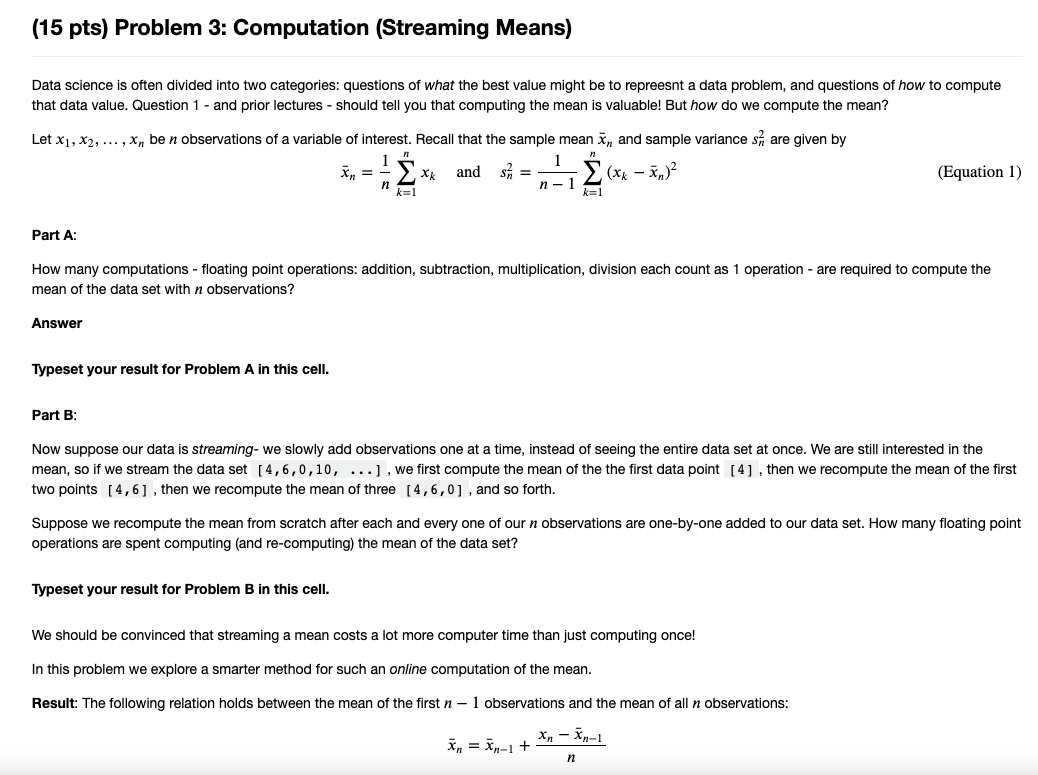
(15 pts) Problem 3: Computation (Streaming Means) Data science is often divided into two categories: questions of what the best value might be to repreesnt a data problem, and questions of how to compute that data value. Question 1 - and prior lectures - should tell you that computing the mean is valuable! But how do we compute the mean? Let X1, X2, ..., xn ben observations of a variable of interest. Recall that the sample mean n and sample variance s are given by 1 1 XX and s2 = (x2 #m] (Equation 1) n k=1 Part A: How many computations - floating point operations: addition, subtraction, multiplication, division each count as 1 operation - are required to compute the mean of the data set with n observations? Answer Typeset your result for Problem A in this cell. Part B: Now suppose our data is streaming- we slowly add observations one at a time, instead of seeing the entire data set at once. We are still interested in the mean, so if we stream the data set [4,6,0,10, ...), we first compute the mean of the the first data point [4] , then we recompute the mean of the first two points [4,6], then we recompute the mean of three [4,6,0], and so forth. Suppose we recompute the mean from scratch after each and every one of our n observations are one-by-one added to our data set. How many floating point operations are spent computing (and re-computing) the mean of the data set? Typeset your result for Problem B in this cell. We should be convinced that streaming a mean costs a lot more computer time than just computing once! In this problem we explore a smarter method for such an online computation of the mean. Result: The following relation holds between the mean of the first n - 1 observations and the mean of all n observations: xn-in-1 in = in-1 + n (15 pts) Problem 3: Computation (Streaming Means) Data science is often divided into two categories: questions of what the best value might be to repreesnt a data problem, and questions of how to compute that data value. Question 1 - and prior lectures - should tell you that computing the mean is valuable! But how do we compute the mean? Let X1, X2, ..., xn ben observations of a variable of interest. Recall that the sample mean n and sample variance s are given by 1 1 XX and s2 = (x2 #m] (Equation 1) n k=1 Part A: How many computations - floating point operations: addition, subtraction, multiplication, division each count as 1 operation - are required to compute the mean of the data set with n observations? Answer Typeset your result for Problem A in this cell. Part B: Now suppose our data is streaming- we slowly add observations one at a time, instead of seeing the entire data set at once. We are still interested in the mean, so if we stream the data set [4,6,0,10, ...), we first compute the mean of the the first data point [4] , then we recompute the mean of the first two points [4,6], then we recompute the mean of three [4,6,0], and so forth. Suppose we recompute the mean from scratch after each and every one of our n observations are one-by-one added to our data set. How many floating point operations are spent computing (and re-computing) the mean of the data set? Typeset your result for Problem B in this cell. We should be convinced that streaming a mean costs a lot more computer time than just computing once! In this problem we explore a smarter method for such an online computation of the mean. Result: The following relation holds between the mean of the first n - 1 observations and the mean of all n observations: xn-in-1 in = in-1 + n
Step by Step Solution
There are 3 Steps involved in it

Get step-by-step solutions from verified subject matter experts
 Study Help