







Question: Python 3 Exercise 8. Triangles Write a function is_valid(s1, s2, s3) that takes three floating point numbers as arguments and returns a boolean indicating whether
Python 3
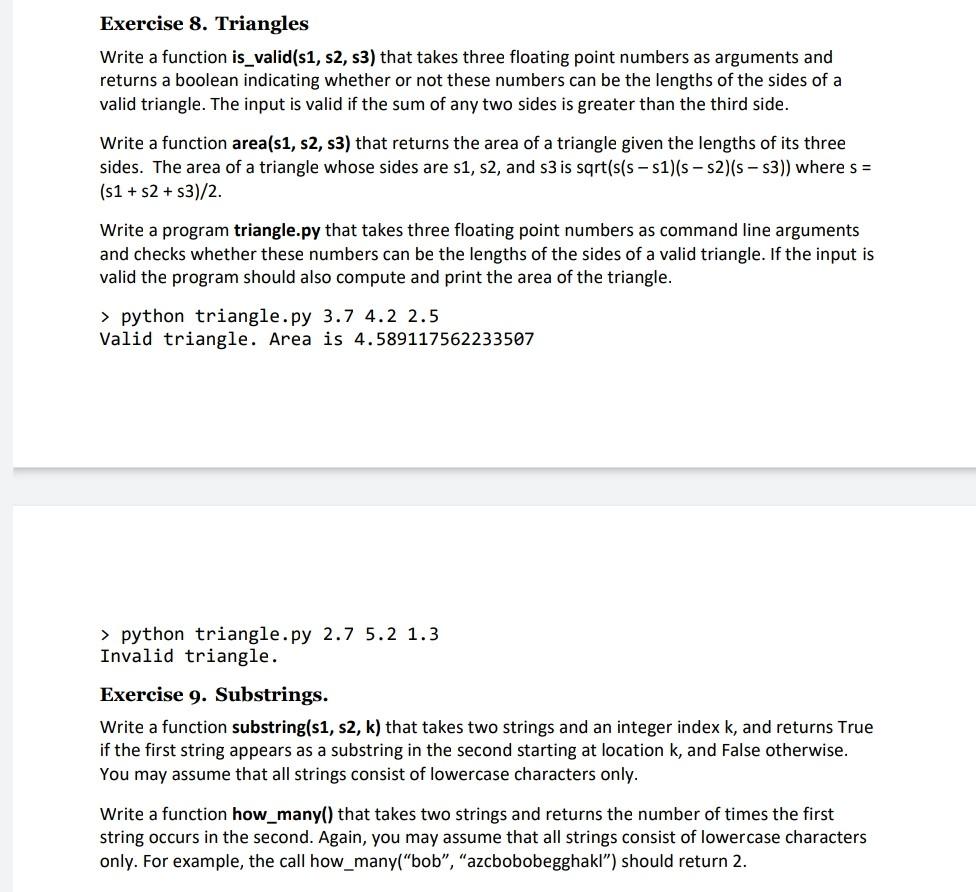
Exercise 8. Triangles Write a function is_valid(s1, s2, s3) that takes three floating point numbers as arguments and returns a boolean indicating whether or not these numbers can be the lengths of the sides of a valid triangle. The input is valid if the sum of any two sides is greater than the third side. Write a function area(s1, s2, 53) that returns the area of a triangle given the lengths of its three sides. The area of a triangle whose sides are s1, s2, and s3 is sqrt(s(s - 51)(s - s2)(s - s3)) where s = (51 +52 +53)/2. Write a program triangle.py that takes three floating point numbers as command line arguments and checks whether these numbers can be the lengths of the sides of a valid triangle. If the input is valid the program should also compute and print the area of the triangle. > python triangle.py 3.7 4.2 2.5 Valid triangle. Area is 4.589117562233507 > python triangle.py 2.7 5.2 1.3 Invalid triangle. Exercise 9. Substrings. Write a function substring(s1, s2, k) that takes two strings and an integer index k, and returns True if the first string appears as a substring in the second starting at location k, and False otherwise. You may assume that all strings consist of lowercase characters only. Write a function how many() that takes two strings and returns the number of times the first string occurs in the second. Again, you may assume that all strings consist of lowercase characters only. For example, the call how many("bob", "azcbobobegghaki") should return 2
Step by Step Solution
There are 3 Steps involved in it

Get step-by-step solutions from verified subject matter experts
 Study Help