Question: Python 3 Language Python 3 Autocomplete Ready 3. Triplets In python 3 Given an array of n distinct integers, d = (d[0], d[1]...., din-1), and
Python 3
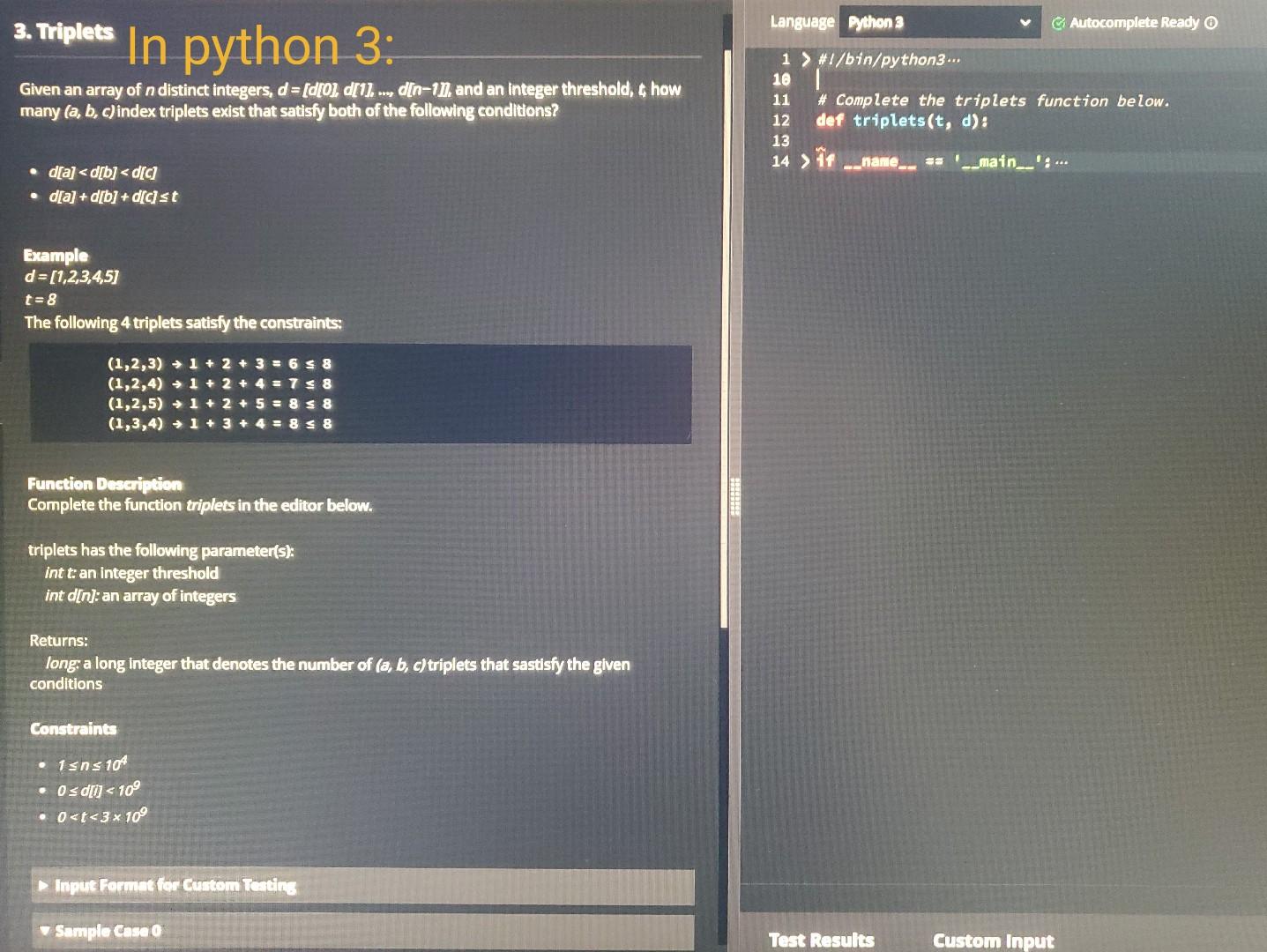
![Given an array of n distinct integers, d = (d[0], d[1]...., din-1),](https://dsd5zvtm8ll6.cloudfront.net/si.experts.images/questions/2024/09/66f50c084b53f_43166f50c07ae5a1.jpg)
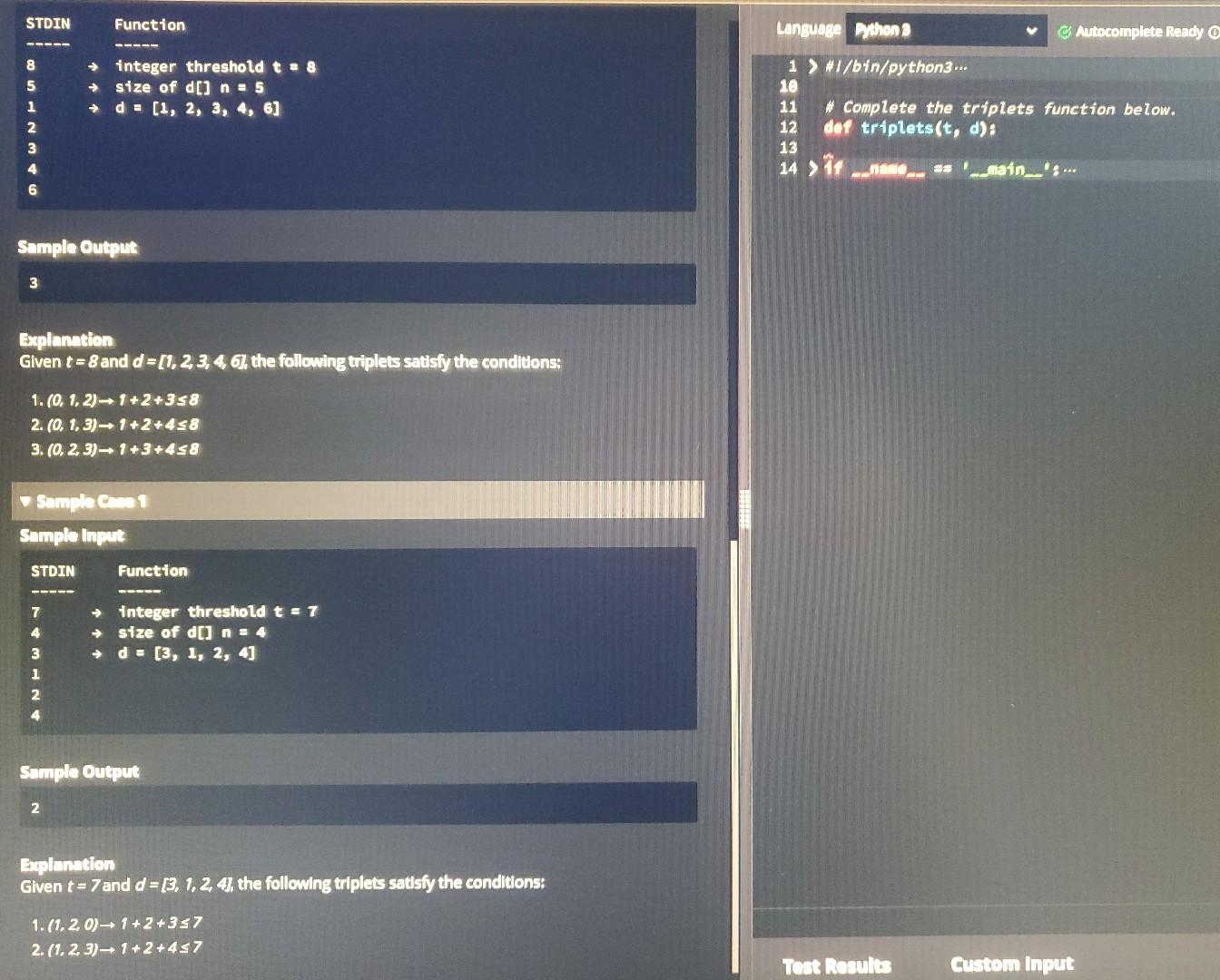
Language Python 3 Autocomplete Ready 3. Triplets In python 3 Given an array of n distinct integers, d = (d[0], d[1]...., din-1), and an integer threshold, how many (a, b, c) index triplets exist that satisfy both of the following conditions? 1 > #!/bin/python3... 10 1 11 # Complete the triplets function below. 12 def triplets(t, d): 13 14 > it -name.. =' _main__':... d[a] #1/bin/python3... 10 11 # Complete the triplets function below. 12 def triplets(t, d): 13 14 > if .name.. ='__main__':... Input Format for Custom Testing Input from stdin will be processed as follows and passed to the function. The first line contains an integer t the given integer threshold. The second line contains an integer n, the size of the array d. Each of the next n lines contains an integer d[i] where Osi #1/bin/python3... 10 11 # Complete the triplets function below. 12 def triplets(t, d): 13 name.. amain__.... 14 > Sample Output 3 Explanation Given t = 8 and d = [1,2,3,4, 6), the following triplets satisfy the conditions: 1.(0, 1, 2) 1+2+3 58 2. (0, 1, 3) - 1+2+4 58 3. (0, 2, 3)- 1+3+4 58 Sample Cece 1 Sample Input STDIN Function 7 4 Integer threshold t = 7 size of d[] n = 4 d =(3, 1, 2, 4) > 3 Sample Output 2 Explanation Given t = 7 and d = 13, 1, 2, 4), the following triplets satisfy the conditions: 1.(1, 2, 0) 1+2+3 5 7 2. (1,2,3)+1 +2 +457 Test Results Custom Input<.>









 Study Help