







Question: PYTHON 3; ONLY DO 2.2, THANK YOU 2. Random walk In this problem you will program a random walk and explore its properties. A two-dimensional
 PYTHON 3; ONLY DO 2.2, THANK YOU
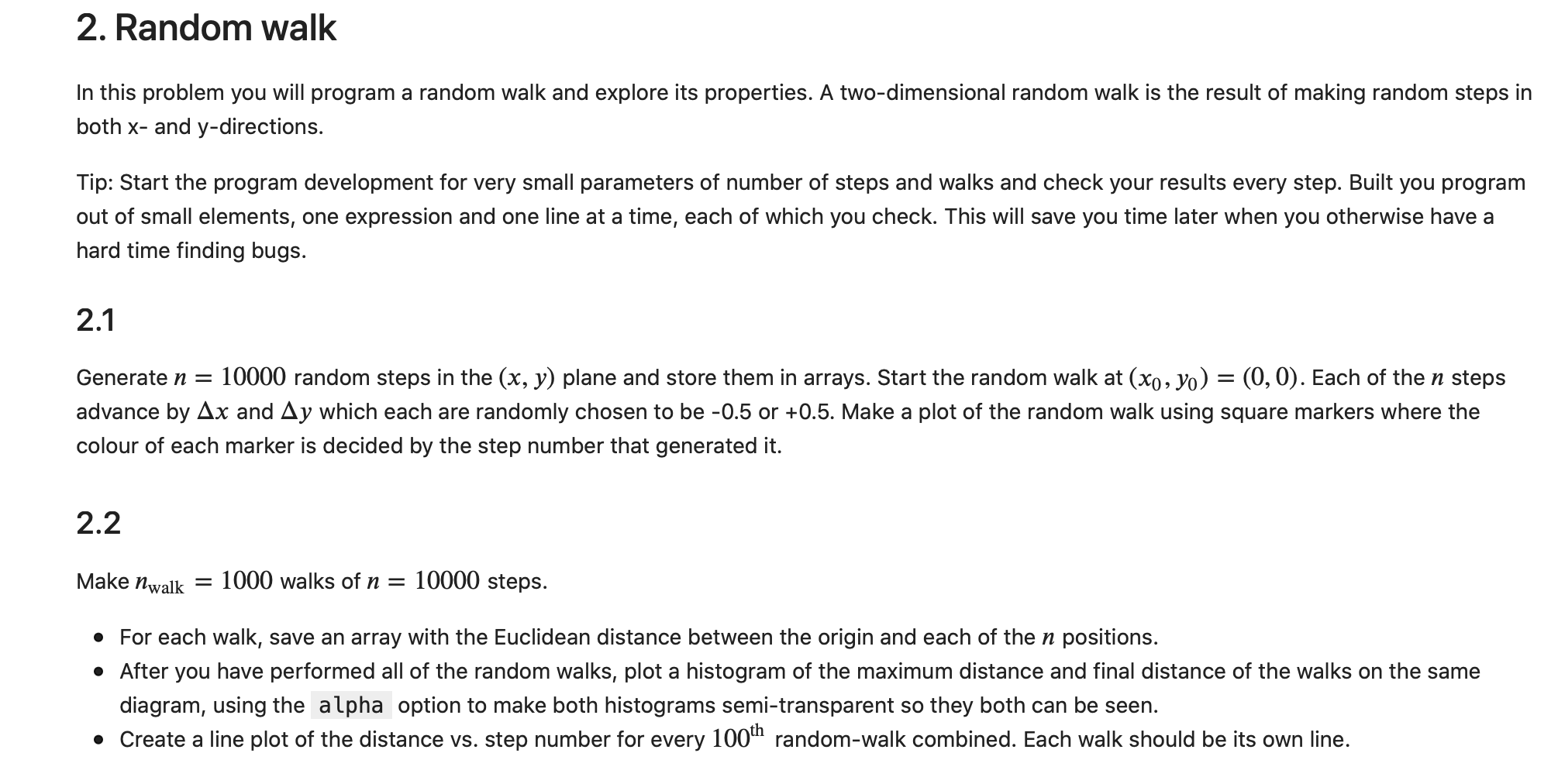
2. Random walk In this problem you will program a random walk and explore its properties. A two-dimensional random walk is the result of making random steps in both X- and y-directions. Tip: Start the program development for very small parameters of number of steps and walks and check your results every step. Built you program out of small elements, one expression and one line at a time, each of which you check. This will save you time later when you otherwise have a hard time finding bugs. 2.1 Generate n = 10000 random steps in the (x, y) plane and store them in arrays. Start the random walk at (xo, yo) = (0,0). Each of the n steps advance by Ax and Ay which each are randomly chosen to be -0.5 or +0.5. Make a plot of the random walk using square markers where the colour of each marker is decided by the step number that generated it. 2.2 Make nwalk = 1000 walks of n = 10000 steps. For each walk, save an array with the Euclidean distance between the origin and each of the n positions. After you have performed all of the random walks, plot a histogram of the maximum distance and final distance of the walks on the same diagram, using the alpha option to make both histograms semi-transparent so they both can be seen. Create a line plot of the distance vs. step number for every 100th random-walk combined. Each walk should be its own line. 2. Random walk In this problem you will program a random walk and explore its properties. A two-dimensional random walk is the result of making random steps in both X- and y-directions. Tip: Start the program development for very small parameters of number of steps and walks and check your results every step. Built you program out of small elements, one expression and one line at a time, each of which you check. This will save you time later when you otherwise have a hard time finding bugs. 2.1 Generate n = 10000 random steps in the (x, y) plane and store them in arrays. Start the random walk at (xo, yo) = (0,0). Each of the n steps advance by Ax and Ay which each are randomly chosen to be -0.5 or +0.5. Make a plot of the random walk using square markers where the colour of each marker is decided by the step number that generated it. 2.2 Make nwalk = 1000 walks of n = 10000 steps. For each walk, save an array with the Euclidean distance between the origin and each of the n positions. After you have performed all of the random walks, plot a histogram of the maximum distance and final distance of the walks on the same diagram, using the alpha option to make both histograms semi-transparent so they both can be seen. Create a line plot of the distance vs. step number for every 100th random-walk combined. Each walk should be its own line
Step by Step Solution
There are 3 Steps involved in it

Get step-by-step solutions from verified subject matter experts
 Study Help