







Question: Python 3.6 count_1iving(grid): Given a Grid, count how many live cells there are; return that number o Assume: grid is a Grid o count-living([ [True,
Python 3.6
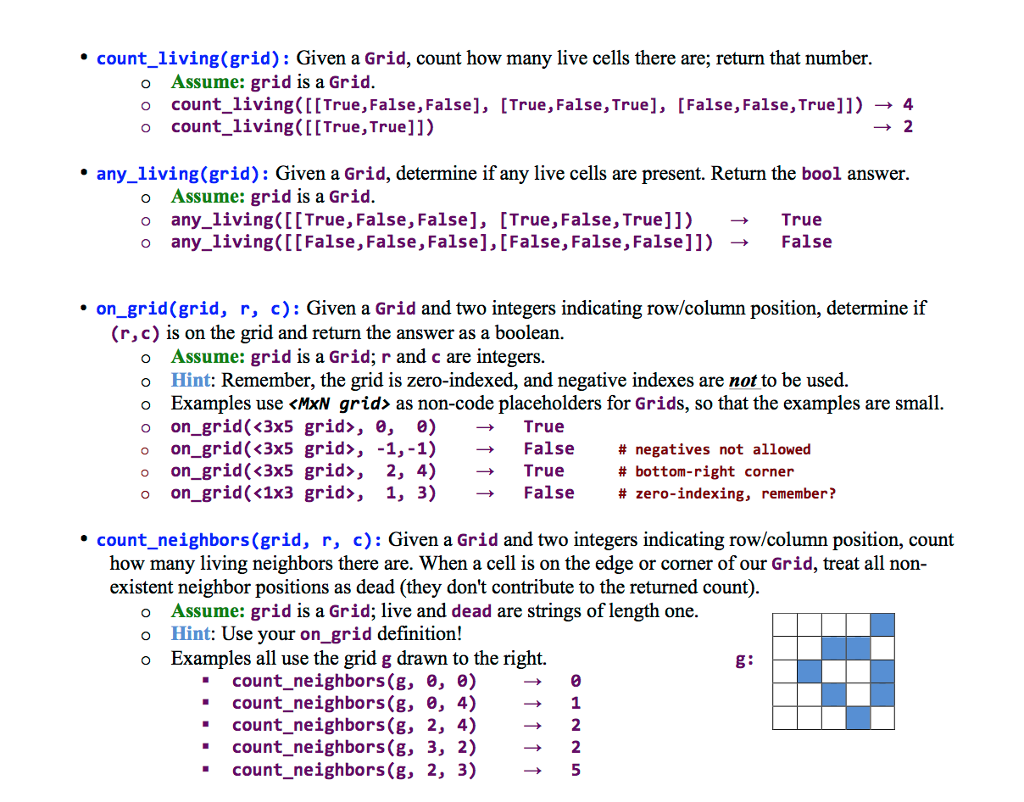
count_1iving(grid): Given a Grid, count how many live cells there are; return that number o Assume: grid is a Grid o count-living([ [True, False,False], o count_living(True, True]]) [True,False,True], [False,False, True]]) 4 any_living(grid): Given a Grid, determine if any live cells are present. Return the bool answer o o o Assume: grid is a Grid any-living([[True, False, False], [True, False, True]]) any-living([[False,False, False],[False, False,False]]) True False on_grid(grid, r, c): Given a Grid and two integers indicating row/column position, determine if (r,c) is on the grid and return the answer as a boolean. o Assume: grid is a Grid; r and c are integers. o Hint: Remember, the grid is zero-indexed, and negative indexes are not to be used. o Examples use MxN on-grid 3x5 on-grid(c3x5 on-grid 3x5 on-grid(1x3 grid> as non-code placeholders for Grids, so that the examples are small grid, grid, grid>, grid>, ) -1,-1) 4) 1,3) True False True False , o # negatives not allowed 2, # bottom-right corner # o zero-indexing, remember? count_neighbors(grid, r, c): Given a Grid and two integers indicating row/column position, count how many living neighbors there are. When a cell is on the edge or corner of our Grid, treat all non- existent neighbor positions as dead (they don't contribute to the returned count) o Assume: grid is a Grid; live and dead are strings of length one. o Hint: Use your on grid definition! o Examples all use the grid g drawn to the right. . count-neighbors(g, , ) . count-neighbors(g,e, 4) count neighbors(g, 2,4) count_neighbors (g, count-neighbors(g, 3, 2, 2) 3)
Step by Step Solution
There are 3 Steps involved in it

Get step-by-step solutions from verified subject matter experts
 Study Help