







Question: PYTHON 4b. (2 pts) Define the summary function, which takes as arguments a database (dict) and a dict of current stock prices. It returns a


PYTHON
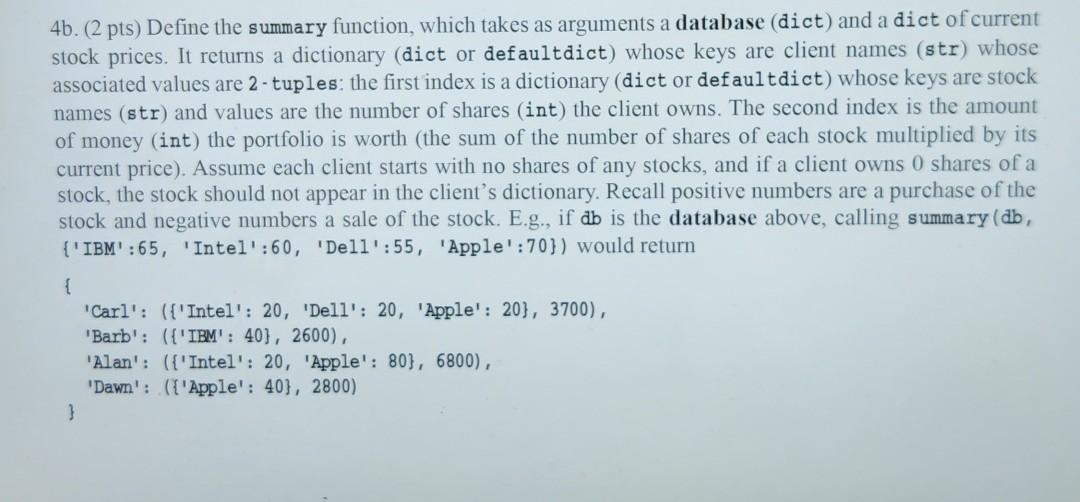
4b. (2 pts) Define the summary function, which takes as arguments a database (dict) and a dict of current stock prices. It returns a dictionary (dict or defaultdict) whose keys are client names (str) whose associated values are 2-tuples: the first index is a dictionary (dict or defaultdict) whose keys are stock names (str) and values are the number of shares (int) the client owns. The second index is the amount of money (int) the portfolio is worth (the sum of the number of shares of each stock multiplied by its current price). Assume each client starts with no shares of any stocks, and if a client owns 0 shares of a stock, the stock should not appear in the client's dictionary. Recall positive numbers are a purchase of the stock and negative numbers a sale of the stock. E.g., if db is the database above, calling summary(db, {'IBM':65, 'Intel':60, 'Dell':55, 'Apple':70}) would return { Carl': ({'Intel': 20, 'Dell': 20, 'Apple': 20), 3700), "Barb': (('IBM': 40), 2600), 'Alan': [{'Intel': 20, 'Apple': 80), 6800), "Dawn': (l'Apple': 40), 2800) } # Note: the keys in this dicts are not specified in alphabetical order db1 = { "Carl': (('Intel', 50, 40), ('Dell', 20, 50), ('Intel', -10, 60), ('Apple', 20, 55)], Barb': [C'Intel', 20, 40), ('Intel', -10, 45), ('IBM', 40, 30), ('Intel', -10, 35)], Alan': [('Intel', 20, 10), ('Dell', 10, 50), ('Apple', 80, 80), ('Dell', -10, 55)], "Dawn': (('Apple', 40, 80), ('Apple', 40, 85), ('Apple', -40, 90)] } db2 = { "Hope': (('Intel', 30, 40), ('Dell', 20, 50), ('IBM', 10, 80), ('Apple', 20, 50), ('QlCom', 20, 20)], *Carl': [('QlCom', 30, 22), ('QLCom', 20, 23), ('QlCom', -20, 25), ('QlCom', -30, 28)], *Barb': [('Intel', 80, 42), ('Intel', -80, 45), ('Intel', 90, 28)], Fran': [('BrCom', 210, 62), ('BrCom', -20, 64), ('BrCom', -10, 66), ('BrCom', 10, 55)], Alan': (('Intel', 20, 10), ('Dell', 10, 50), ('Apple', 80, 80), ('Dell', -16, 55)), Gabe': (('IBM, 40, 82), ('QLCom', 80, 25), ('IBM", -20, 84), ('BrCom', 50, 65), ('QlCom', -40, 28)), "Dawn': (Apple', 40, 92), ('Apple', 40, 98), ('Apple', -40, 92)], 'Evan': (('Apple', 50, 92), ('Dell', 20, 50), ('Apple', -10,95), ('Apple', 20, 95), ('Dell', -20, 90)] e def summary(db: {str: [(str, int, int)]}; prices: {str: int}) -> {str: ({str: int), int)}: pass
Step by Step Solution
There are 3 Steps involved in it

Get step-by-step solutions from verified subject matter experts
 Study Help