







Question: PYTHON CODE Instructions: Write a Python Program. You may import functions from the math, copy, matplotlib.plot and numpy , but you may NOT use numpy.linalg.lstsq.
PYTHON CODE
Instructions: Write a Python Program. You may import functions from the math, copy, matplotlib.plot and numpy, but you may NOT use numpy.linalg.lstsq. You may NOT import any other modules. Review of Cramers Rule, Determinants using the Rule of Minors, and the Least Squares method. Add comments to each line that requires explanation. Do not use any advanced code, try to make it simple as for beginners and well explained.
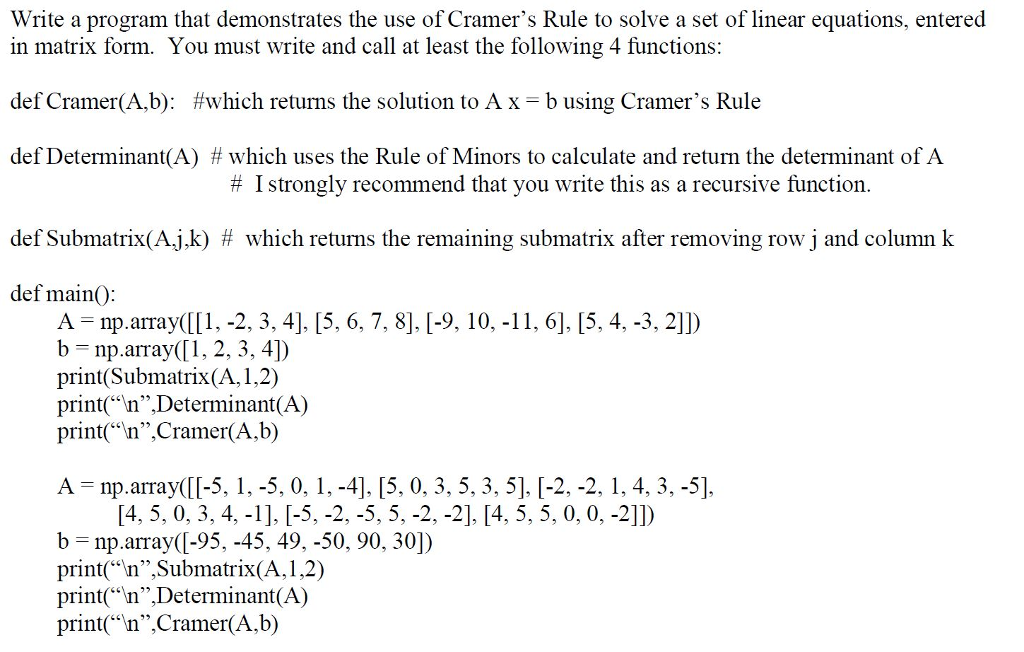
Write a program that demonstrates the use of Cramer's Rule to solve a set of linear equations, entered in matrix form. You must write and call at least the following 4 functions: def Cramer(A,b): #which returns the solution to A x-b using Cramer's Rule def Determinant(A) # which uses the Rule of Minors to calculate and return the determinant of A # I strongly recommend that you write this as a recursive function def Submatrix(A k) # which returns the remaining submatrix after removing row and column k def main() b-np.array([1, 2, 3, 4]) print(Submatrix(A,1,2) print("In".,Determinant(A) print("n",Cramer(A,b) A np.array([[-5, 1, -5, 0, 1, -4], [5, 0, 3, 5, 3, 51, [-2, -2, 1, 4, 3, -5], b np.array([-95, -45, 49, -50, 90, 30]) print("n",Submatrix(A,1,2) print("n",Determinant(A) print("n",Cramer(A,b) Write a program that demonstrates the use of Cramer's Rule to solve a set of linear equations, entered in matrix form. You must write and call at least the following 4 functions: def Cramer(A,b): #which returns the solution to A x-b using Cramer's Rule def Determinant(A) # which uses the Rule of Minors to calculate and return the determinant of A # I strongly recommend that you write this as a recursive function def Submatrix(A k) # which returns the remaining submatrix after removing row and column k def main() b-np.array([1, 2, 3, 4]) print(Submatrix(A,1,2) print("In".,Determinant(A) print("n",Cramer(A,b) A np.array([[-5, 1, -5, 0, 1, -4], [5, 0, 3, 5, 3, 51, [-2, -2, 1, 4, 3, -5], b np.array([-95, -45, 49, -50, 90, 30]) print("n",Submatrix(A,1,2) print("n",Determinant(A) print("n",Cramer(A,b)
Step by Step Solution
There are 3 Steps involved in it

Get step-by-step solutions from verified subject matter experts
 Study Help