







Question: PYTHON for reference: In electromagnetism, there are rules for manually calculating the effective resistance between two nodes for relatively simple graphs. However, this is infeasible
PYTHON
for reference:
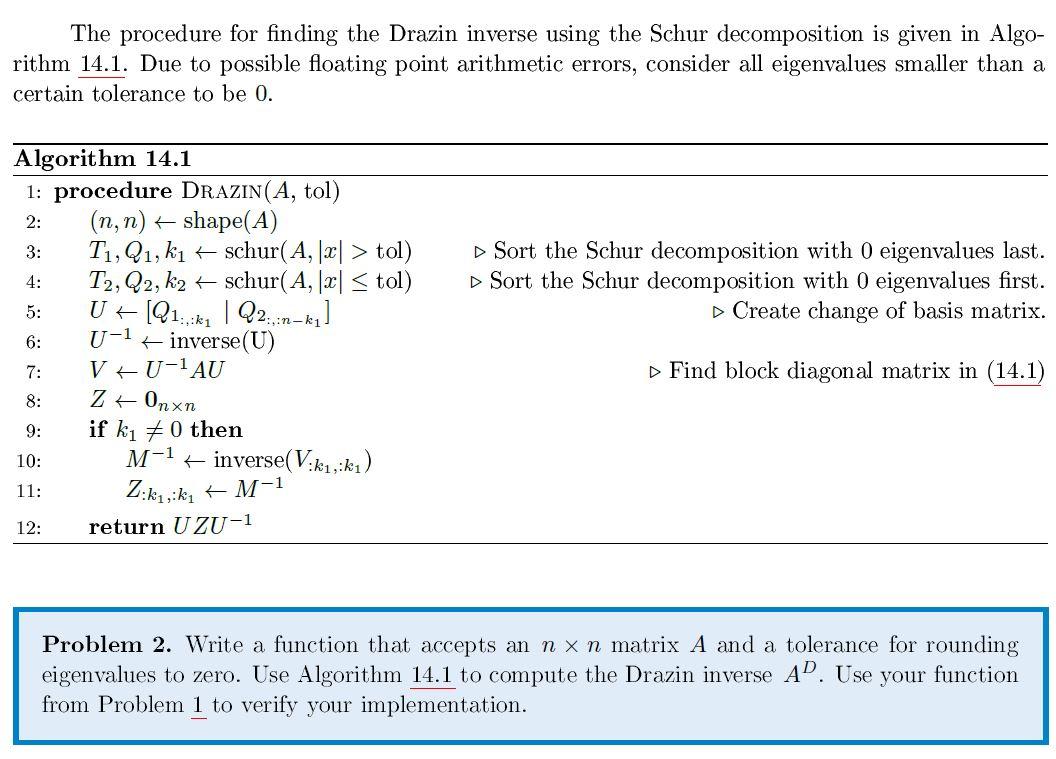
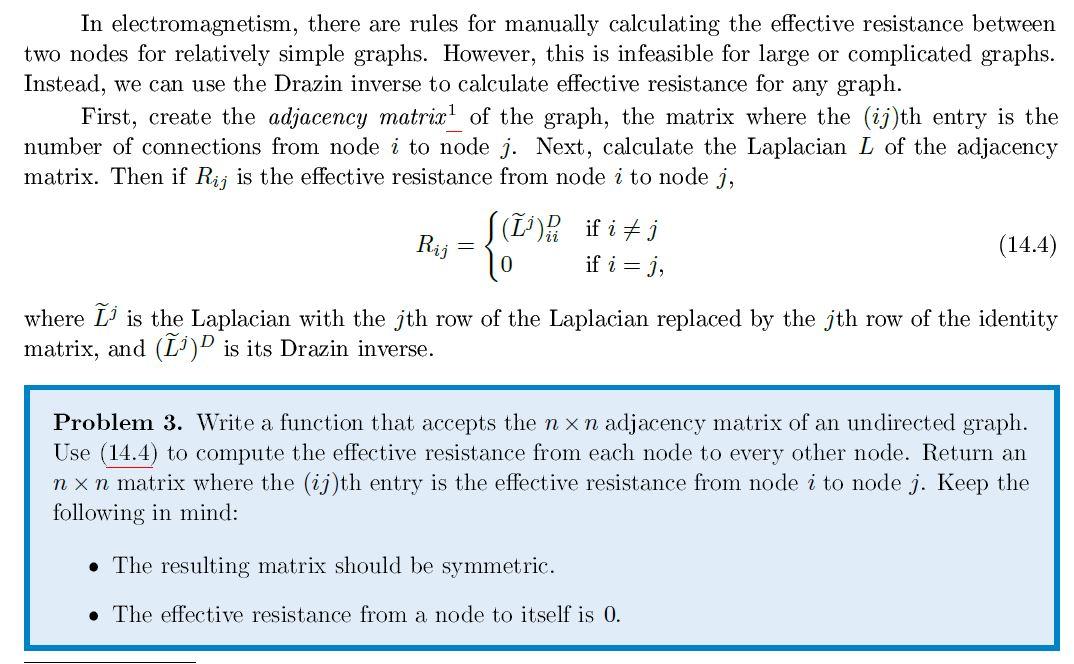
In electromagnetism, there are rules for manually calculating the effective resistance between two nodes for relatively simple graphs. However, this is infeasible for large or complicated graphs. Instead, we can use the Drazin inverse to calculate effective resistance for any graph. First, create the adjacency matrixt of the graph, the matrix where the (ij)th entry is the number of connections from node i to node j. Next, calculate the Laplacian L of the adjacency matrix. Then if Rij is the effective resistance from node i to nodej, S ()if i ti Rij (14.4) if i = j, where Ti is the Laplacian with the jth row of the Laplacian replaced by the jth row of the identity matrix, and ())P is its Drazin inverse. Problem 3. Write a function that accepts the nxn adjacency matrix of an undirected graph. Use (14.4) to compute the effective resistance from each node to every other node. Return an nxn matrix where the (ij)th entry is the effective resistance from node i to node j. Keep the following in mind: The resulting matrix should be symmetric. The effective resistance from a node to itself is 0. The procedure for finding the Drazin inverse using the Schur decomposition is given in Algo- rithm 14.1. Due to possible floating point arithmetic errors, consider all eigenvalues smaller than a certain tolerance to be 0. 2: 3: Algorithm 14.1 1: procedure DRAZIN(A, tol) (n,n) + shape(A) T1, Q1, ki + schur(A, |2| > tol) T2, Q2, k2 + schur(A,|2| tol) T2, Q2, k2 + schur(A,|2|
Step by Step Solution
There are 3 Steps involved in it

Get step-by-step solutions from verified subject matter experts
 Study Help