







Question: Python - Implementing Radial Basis Function Collocation Method RBFCM Kindly use Python to implement the Radial Basis Function Collocation Method RBFCM to approximate the differential
Python - Implementing Radial Basis Function Collocation Method RBFCM
Kindly use Python to implement the Radial Basis Function Collocation Method RBFCM to approximate the differential equation. Please do not just give the exact solution using a python library.
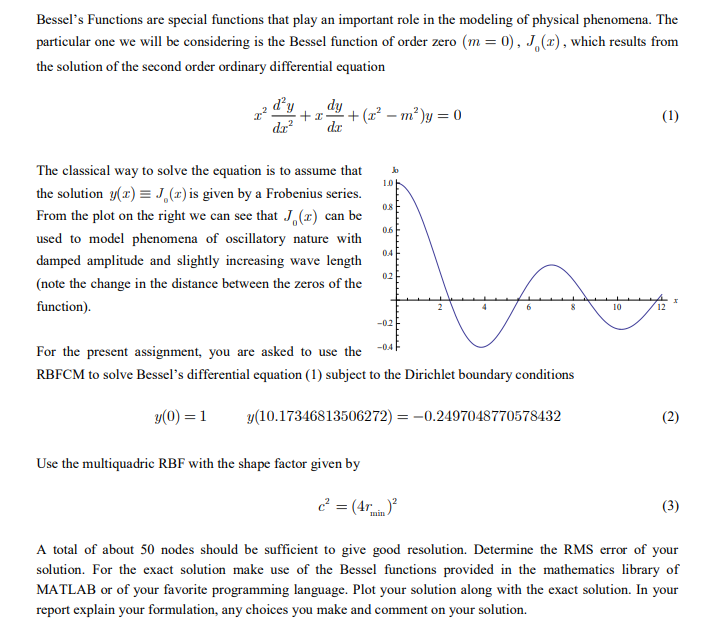
Bessel's Functions are special functions that play an important role in the modeling of physical phenomena. The particular one we will be considering is the Bessel function of order zero (m=0),J0(x), which results from the solution of the second order ordinary differential equation x2dx2d2y+xdxdy+(x2m2)y=0 The classical way to solve the equation is to assume that the solution y(x)J0(x) is given by a Frobenius series. From the plot on the right we can see that J0(x) can be used to model phenomena of oscillatory nature with damped amplitude and slightly increasing wave length (note the change in the distance between the zeros of the function). For the present assignment, you are asked to use the RBFCM to solve Bessel's differential equation (1) subject to the Dirichlet boundary conditions y(0)=1y(10.17346813506272)=0.2497048770578432 Use the multiquadric RBF with the shape factor given by c2=(4rmin)2 A total of about 50 nodes should be sufficient to give good resolution. Determine the RMS error of your solution. For the exact solution make use of the Bessel functions provided in the mathematics library of MATLAB or of your favorite programming language. Plot your solution along with the exact solution. In your report explain your formulation, any choices you make and comment on your solution
Step by Step Solution
There are 3 Steps involved in it

Get step-by-step solutions from verified subject matter experts
 Study Help