







Question: Python recursive function: Given an ordered list L. A permutation of L is a rearrangement of its elements in some order. For example (1,3, 2)
Python recursive function:
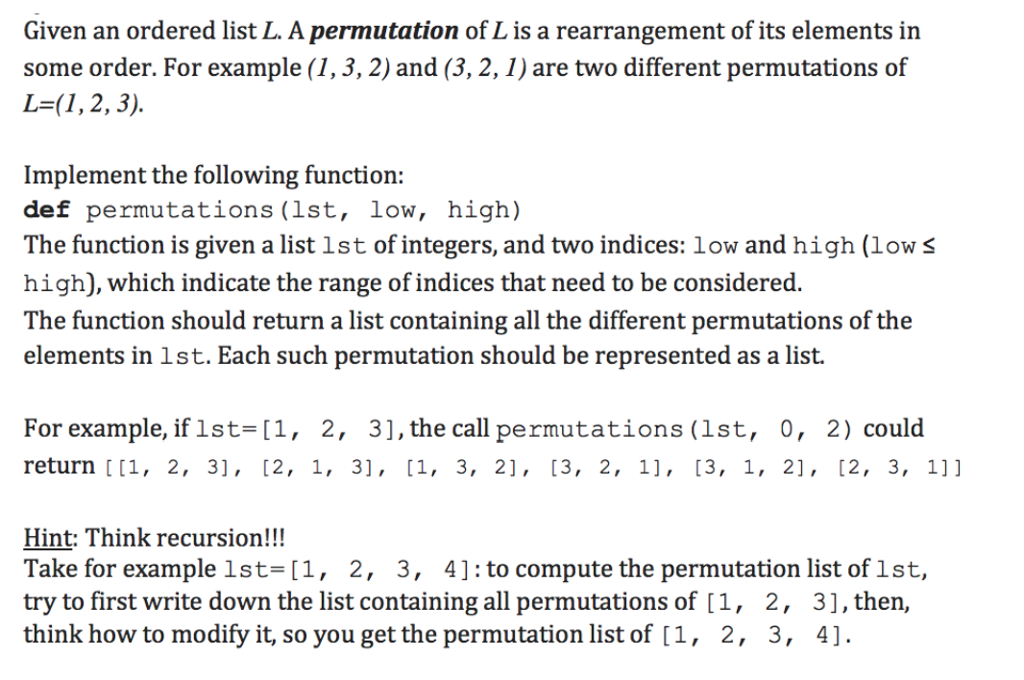
Given an ordered list L. A permutation of L is a rearrangement of its elements in some order. For example (1,3, 2) and (3, 2, 1) are two different permutations of L=(1,2,3). Implement the following function: def permutations (lst, low, high) The function is given a list 1st of integers, and two indices: low and high (lows high), which indicate the range of indices that need to be considered The function should return a list containing all the different permutations of the elements in 1st. Each such permutation should be represented as a list. For example, if lst= [ 1, 2, 3],the call permutations (1st, 0, 2) could return t1, 2, 3], [2, 1, 3], [1, 3, 2], [3, 2, 1], [3, 1, 2], [2, 3, 1]] Hint: Think recursion!!! Take for example 1st-[i, 2, 3, 4]:to compute the permutation list of lst, try to first write down the list containing all permutations of 1, 2, 3], then, think how to modify it, so you get the permutation list of[1, 2, 3, 4
Step by Step Solution
There are 3 Steps involved in it

Get step-by-step solutions from verified subject matter experts
 Study Help