



Question: Q . 1 . Use the following linked list and node pointers p 1 , p 2 , p 3 , and p 4 .
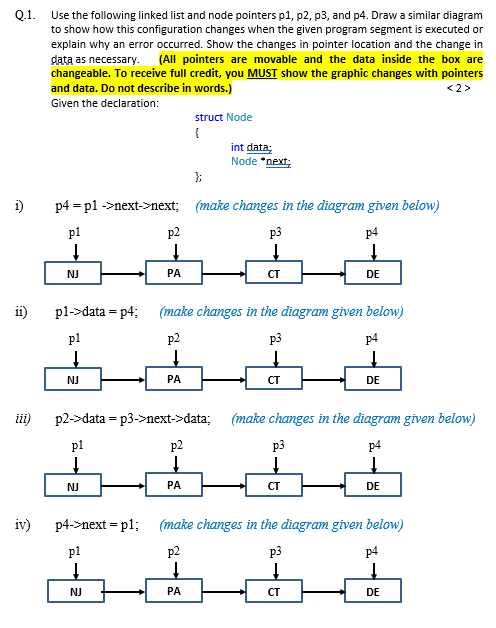
Q Use the following linked list and node pointers p p p and p Draw a similar diagram to show how this configuration changes when the given program segment is executed or explain why an error occurred. Show the changes in pointer location and the change in data as necessary. All pointers are movable and the data inside the box are changeable. To receive full credit, you MUST show the graphic changes with pointers and data. Do not describe in words.
Given the declaration:
struct Node
int data;
Node ext;
;
make changes in the diagram given below
imathrmpmathrmplnextnext;
iimathrmpmathrm data mathrmp;quad make changes in the diagram given below
iiiquad mathrmpmathrmdatamathrmpnextdata; quad make changes in the diagram given below
iv pnext mathrmp;quad make changes in the diagram given below Q An ordered linked list of characters has been constructed using the arraybased implementation. The following diagram shows the current contents of the array that stores the elements in an alphabetical order in the linked list and an available pool of nodes. Show the changes in the data and next members of the array and the values of first and free after the letter mathbfE is inserted in the linked list pointed to by first so that the resulting list is still in alphabetical order and the deleted node is adjusted in the available pool of nodes.
I Write in order the contents data of the nodes of the linked list pointed by first. Before inserting the letter mathbfE
II Show the changes in the above figure after the letter mathbfE is inserted in the linked list pointed to by first.
Step by Step Solution
There are 3 Steps involved in it
1 Expert Approved Answer
Step: 1 Unlock

Question Has Been Solved by an Expert!
Get step-by-step solutions from verified subject matter experts
Step: 2 Unlock
Step: 3 Unlock