



Question: Q# 10. An inventory system answers three important questions: When to order? How much to order? How much Safety Stock? Which one of the following
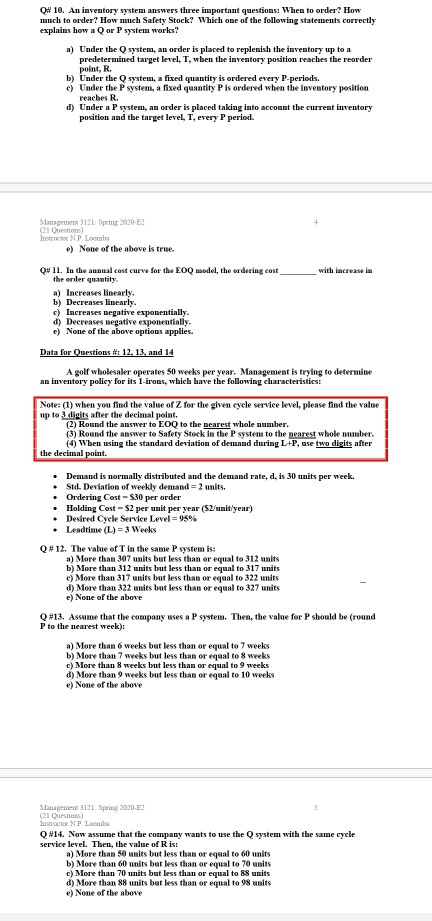
Q# 10. An inventory system answers three important questions: When to order? How much to order? How much Safety Stock? Which one of the following statements correctly explains how a Q or P system works? a) Under the Q system, an order is placed to replenish the inventory up to a predetermined target level, T, when the inventory position reaches the reorder point, R. b) Under the Q system, a fixed quantity is ordered every P-periods. c) Under the P system, a fixed quantity P is ordered when the inventory position reaches R. d) Under a P system, an order is placed taking into account the current inventory position and the target level, T, every P period. e) None of the above is true. Q# 11. In the annual cost curve for the EOQ model, the ordering cost _________ with increase in the order quantity. a) Increases linearly. b) Decreases linearly. c) Increases negative exponentially. d) Decreases negative exponentially. e) None of the above options applies. Data for Questions #: 12, 13, and 14 A golf wholesaler operates 50 weeks per year. Management is trying to determine an inventory policy for its 1-irons, which have the following characteristics: Note: (1) when you find the value of Z for the given cycle service level, please find the value up to 3 digits after the decimal point. (2) Round the answer to EOQ to the nearest whole number. (3) Round the answer to Safety Stock in the P system to the nearest whole number. (4) When using the standard deviation of demand during L+P, use two digits after the decimal point. Demand is normally distributed and the demand rate, d, is 30 units per week. Std. Deviation of weekly demand = 2 units. Ordering Cost = $30 per order Holding Cost = $2 per unit per year ($2/unit/year) Desired Cycle Service Level = 95% Leadtime (L) = 3 Weeks Q # 12. The value of T in the same P system is: a) More than 307 units but less than or equal to 312 units b) More than 312 units but less than or equal to 317 units c) More than 317 units but less than or equal to 322 units d) More than 322 units but less than or equal to 327 units e) None of the above Q #13. Assume that the company uses a P system. Then, the value for P should be (round P to the nearest week): a) More than 6 weeks but less than or equal to 7 weeks b) More than 7 weeks but less than or equal to 8 weeks c) More than 8 weeks but less than or equal to 9 weeks d) More than 9 weeks but less than or equal to 10 weeks e) None of the above Q #14. Now assume that the company wants to use the Q system with the same cycle service level. Then, the value of R is: a) More than 50 units but less than or equal to 60 units b) More than 60 units but less than or equal to 70 units c) More than 70 units but less than or equal to 88 units d) More than 88 units but less than or equal to 98 units e) None of the above
Q# 10. An inventory system answers three important questions: When to order? How much to order? How much Safety Stock? Which one of the following statements correctly explains how a Qor P system works? a) Under the system, an order is placed to replenish the inventory up to a predetermined target level, T, when the inventory position reaches the reorder point, R. b) Under the Q system, a fixed quantity is ordered every P-periods. c) Under the system, a fixed quantity P is ordered when the inventory position reaches R. d) Under a P system, an order is placed taking into account the current inventory position and the target level, T, every P period. + Management 3121: Spring 2000- (21 Questions) Instructor NP Lonto e) None of the above is true. Q# 11. In the annual cost curve for the EOQ model, the ordering cost with increase in the order quantity a) Increases linearly b) Decreases linearly. c) Increases negative exponentially. d) Decreases negative exponentially. e) None of the above options applies. Data for Questions #: 12, 13, and 14 A golf wholesaler operates 50 weeks per year. Management is trying to determine an inventory policy for its 1-irons, which have the following characteristics: Note: (1) when you find the value of Z for the given cycle service level, please find the value up to 3 digits after the decimal point. (2) Round the answer to EOQ to the nearest whole number. (3) Round the answer to Safety Stock in the system to the nearest whole number. ( When using the standard deviation of demand during L+P, use two digits after the decimal point. Demand is normally distributed and the demand rate, d, is 30 units per week. Std. Deviation of weekly demand = 2 units. Ordering Cost - 530 per order Holding Cost - $2 per unit per year ($2/unit/year) Desired Cyele Service Level = 95% Leadrime (L) = 3 Weeks Q#12. The value of T in the same system is: a) More than 307 units but less than or equal to 312 units b) More than 312 units but less than or equal to 317 units c) More than 317 units but less than or equal to 322 units d) More than 322 units but less than or equal to 327 units e) None of the above Q#13. Assume that the company uses a P system. Then, the value for P should be (round P to the nearest week) a) More than 6 weeks but less than or equal to 7 weeks b) More than 7 weeks but less than or equal to 8 weeks c) More than 8 weeks but less than or equal to 9 weeks d) More than 9 weeks but less than or equal to 10 weeks e) None of the above Management 3121: Sprint 2020 (21 Questio) lam NP Lomba Q#14. Now assume that the company wants to use the Q system with the same cycle service level. Then, the value of Ris: a) More than 50 units but less than or equal to 60 units b) More than 60 units but less than or equal to 70 units c) More than 70 units but less than or equal to 88 units d) More than 88 units but less than or equal to 98 units e) None of the aboveStep by Step Solution
There are 3 Steps involved in it

Get step-by-step solutions from verified subject matter experts