







Question: Q 2 . ( 3 p ) Use depth - first search to solve the classic river crossing problem. In the missionaries and cannibals problem,
Qp Use depthfirst search to solve the classic river crossing problem. In the missionaries and cannibals
problem, three missionaries and three cannibals must cross a river using a boat which can carry at most
two people, under the constraint that, for both banks, if there are missionaries present on the bank,
they cannot be outnumbered by cannibals if they were, the cannibals would eat the missionaries
The boat cannot cross the river by itself with no people on board. How many crossings are needed to
carry all missionaries and all cannibals across the river. Qp A simple slidingtile puzzle consists of numbered tiles and an empty space. The puzzle has two
legal moves with associate costs: i A tile may move into an adjacent empty location. This has a cost
of ii A tile can move over one other tile into the empty position. This has a cost of The start
and goal positions are given below. Set up a statespace search formulation for this puzzle:
a Specify the form of state descriptions, the starting state, and the goal state for this problem.
b Name the operators on states and describe what each operator does to a state description.
c Propose a heuristic function hat for solving this problem.
d Use the algorithm to find a solution path using your heuristic function. You can either show
the search tree or the state of the priority queue as progresses.
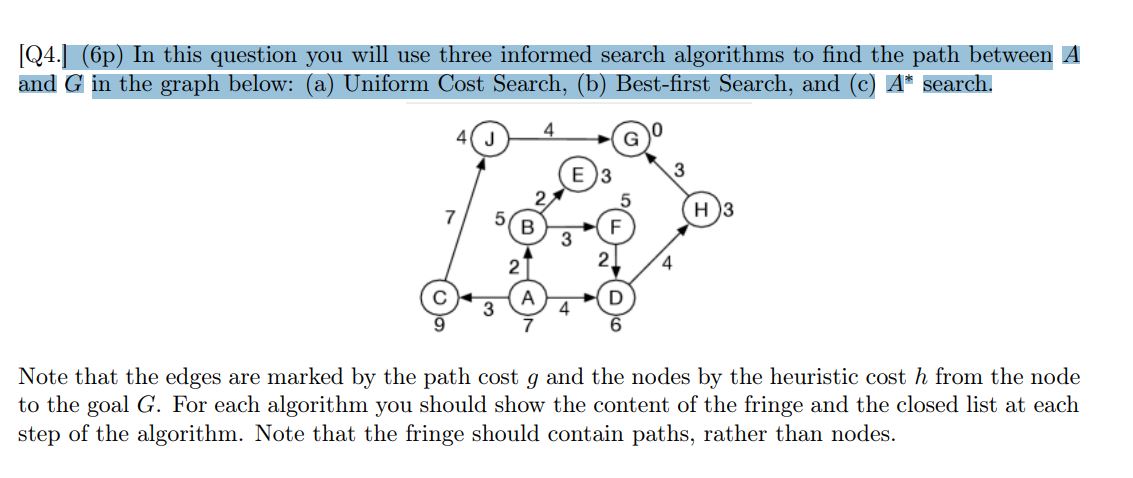
e Is your solution path optimal? Give a formal argument.Qp In this question you will use three informed search algorithms to find the path between
and in the graph below: a Uniform Cost Search, b Bestfirst Search, and c search.
Note that the edges are marked by the path cost and the nodes by the heuristic cost from the node
to the goal For each algorithm you should show the content of the fringe and the closed list at each
step of the algorithm. Note that the fringe should contain paths, rather than nodes.
Step by Step Solution
There are 3 Steps involved in it
1 Expert Approved Answer
Step: 1 Unlock

Question Has Been Solved by an Expert!
Get step-by-step solutions from verified subject matter experts
Step: 2 Unlock
Step: 3 Unlock
 Study Help