







Question: Q 2 . ( a ) Suppose that we have a multi - programming uni - processor computer in which each job has identical characteristics.
Qa Suppose that we have a multiprogramming uniprocessor computer in which
each job has identical characteristics. In one computation period, for a job,
the first and third quarters of the time are spent in processor and the second
quarter and fourth quarter in IO activity, respectively. Each job runs for a total
of four periods. Assume that simple roundrobin scheduling is used, and that
IO operations can overlap with processor operation. Assume there are three
concurrent jobs arrive at
i Compute the turnaround time of each job.
marks
ii Compute the average throughput of three jobs.
marks
iii Compute the percentage of processor utilization.
marks
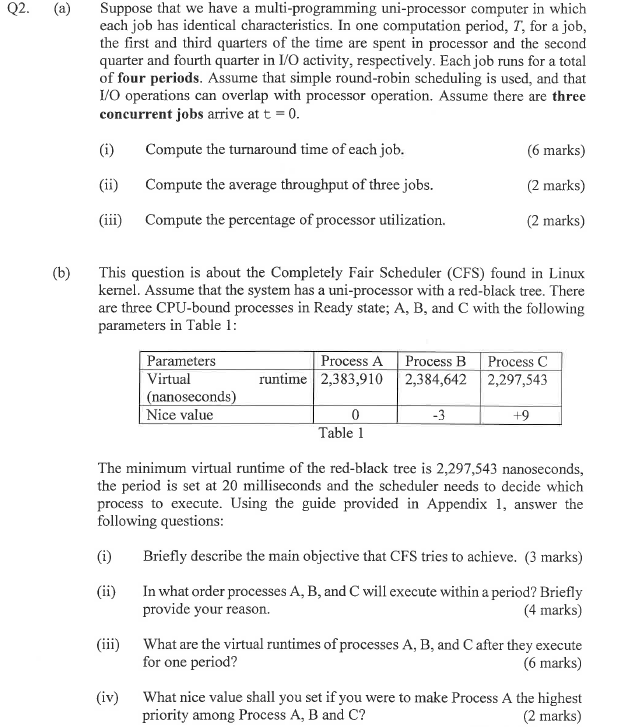
b This question is about the Completely Fair Scheduler CFS found in Linux
kernel. Assume that the system has a uniprocessor with a redblack tree. There
are three CPUbound processes in Ready state; and with the following
parameters in Table :
Table
The minimum virtual runtime of the redblack tree is nanoseconds,
the period is set at milliseconds and the scheduler needs to decide which
process to execute. Using the guide provided in Appendix answer the
following questions:
i Briefly describe the main objective that CFS tries to achieve. marks
ii In what order processes and will execute within a period? Briefly
provide your reason.
marks
iii What are the virtual runtimes of processes and after they execute
for one period?
marks
iv What nice value shall you set if you were to make Process A the highest
priority among Process and
markshelp
Step by Step Solution
There are 3 Steps involved in it
1 Expert Approved Answer
Step: 1 Unlock

Question Has Been Solved by an Expert!
Get step-by-step solutions from verified subject matter experts
Step: 2 Unlock
Step: 3 Unlock
 Study Help