







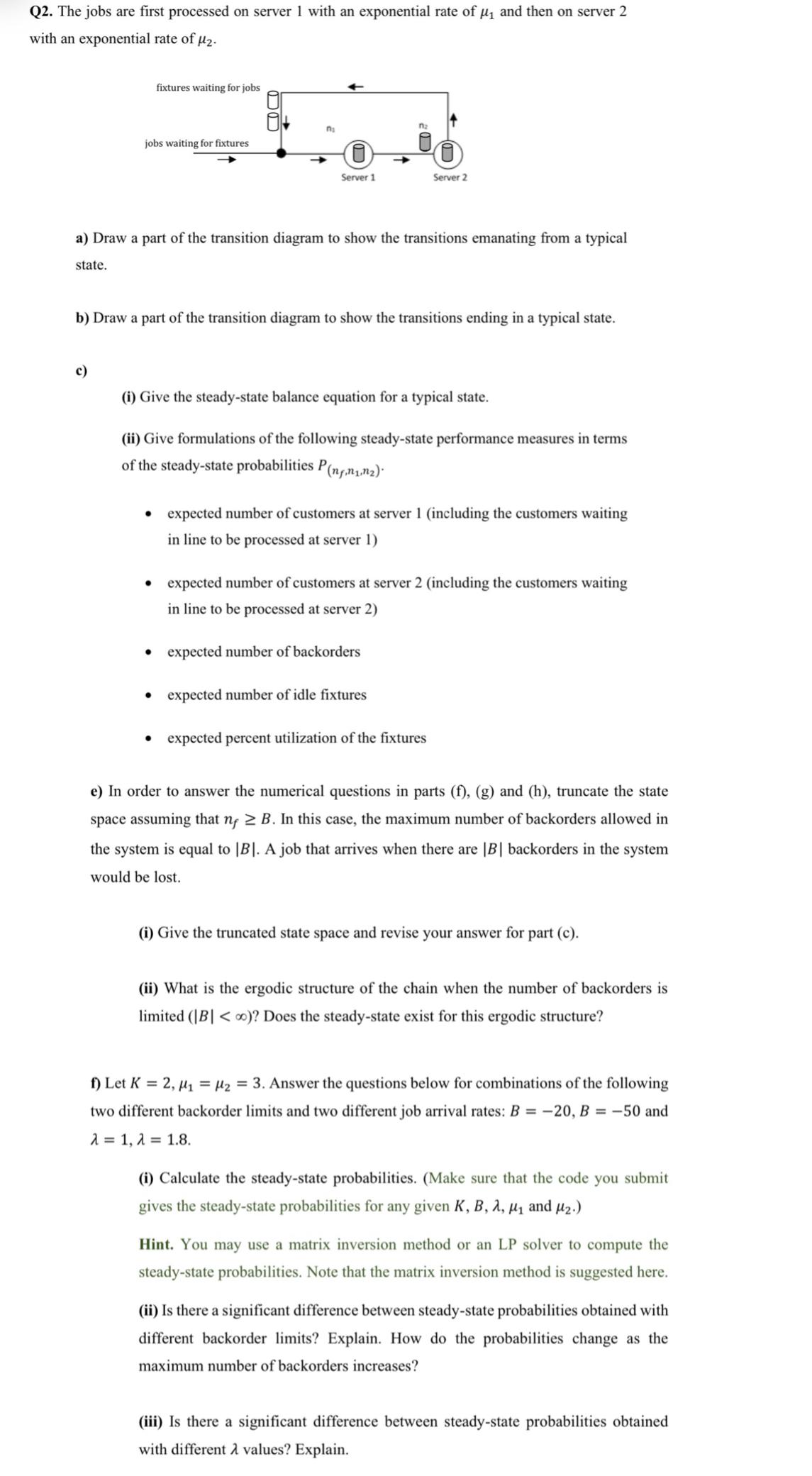
Question: Q 2 . The jobs are first processed on server 1 with an exponential rate of 1 and then on server 2 with an exponential
Q The jobs are first processed on server with an exponential rate of and then on server with an exponential rate of
a Draw a part of the transition diagram to show the transitions emanating from a typical state.
b Draw a part of the transition diagram to show the transitions ending in a typical state.
c
i Give the steadystate balance equation for a typical state.
ii Give formulations of the following steadystate performance measures in terms of the steadystate probabilities
expected number of customers at server including the customers waiting in line to be processed at server
expected number of customers at server including the customers waiting in line to be processed at server
expected number of backorders
expected number of idle fixtures
expected percent utilization of the fixtures
e In order to answer the numerical questions in parts fg and h truncate the state space assuming that In this case, the maximum number of backorders allowed in the system is equal to A job that arrives when there are backorders in the system would be lost.
i Give the truncated state space and revise your answer for part c
ii What is the ergodic structure of the chain when the number of backorders is limited Does the steadystate exist for this ergodic structure?
f Let Answer the questions below for combinations of the following two different backorder limits and two different job arrival rates: and
i Calculate the steadystate probabilities. Make sure that the code you submit gives the steadystate probabilities for any given and
Hint. You may use a matrix inversion method or an LP solver to compute the steadystate probabilities. Note that the matrix inversion method is suggested here.
ii Is there a significant difference between steadystate probabilities obtained with different backorder limits Explain. How do the probabilities change as the maximum number of backorders increases?
iii Is there a significant difference between steadystate probabilities obtained with different values? Explain.
Step by Step Solution
There are 3 Steps involved in it
1 Expert Approved Answer
Step: 1 Unlock

Question Has Been Solved by an Expert!
Get step-by-step solutions from verified subject matter experts
Step: 2 Unlock
Step: 3 Unlock
 Study Help