







Question: Q 5 ( 2 0 pts ) . We have solved the question below in the classroom ( Note: The question and its solution is
Q pts We have solved the question below in the classroom Note: The question and
its solution is provided below:
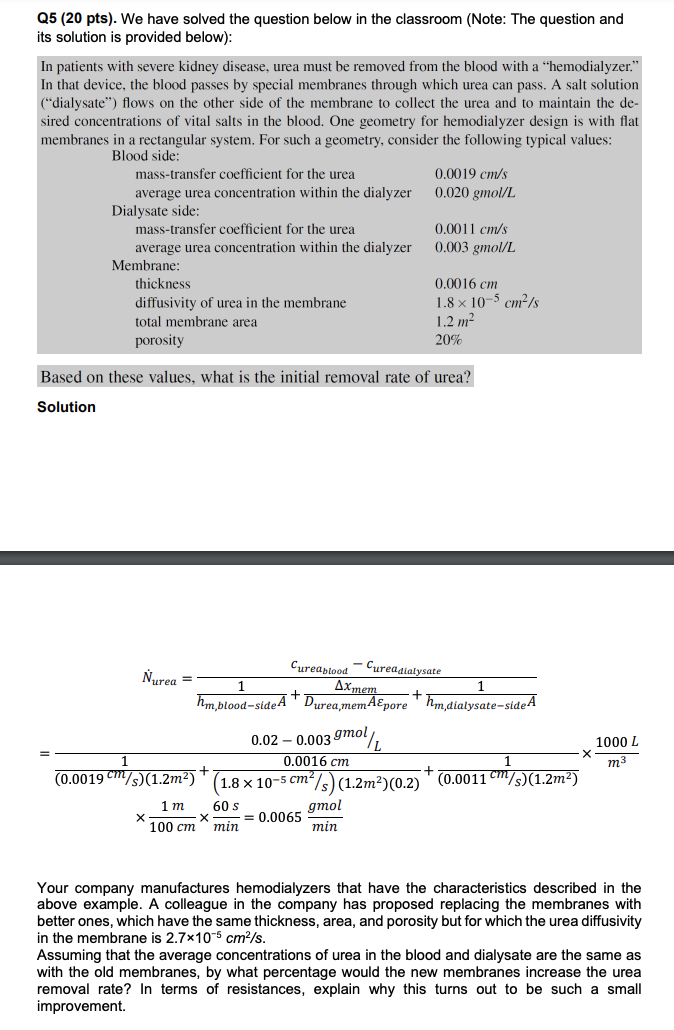
In patients with severe kidney disease, urea must be removed from the blood with a "hemodialyzer."
In that device, the blood passes by special membranes through which urea can pass. A salt solution
dialysate flows on the other side of the membrane to collect the urea and to maintain the de
sired concentrations of vital salts in the blood. One geometry for hemodialyzer design is with flat
membranes in a rectangular system. For such a geometry, consider the following typical values:
Blood side:
masstransfer coefficient for the urea
average urea concentration within the dialyzer
Dialysate side:
masstransfer coefficient for the urea
average urea concentration within the dialyzer
Membrane:
thickness
diffusivity of urea in the membrane
total membrane area
porosity
gmo
gmo
Based on these values, what is the initial removal rate of urea?
Solution
Your company manufactures hemodialyzers that have the characteristics described in the
above example. A colleague in the company has proposed replacing the membranes with
better ones, which have the same thickness, area, and porosity but for which the urea diffusivity
in the membrane is
Assuming that the average concentrations of urea in the blood and dialysate are the same as
with the old membranes, by what percentage would the new membranes increase the urea
removal rate? In terms of resistances, explain why this turns out to be such a small
improvement.
Step by Step Solution
There are 3 Steps involved in it
1 Expert Approved Answer
Step: 1 Unlock

Question Has Been Solved by an Expert!
Get step-by-step solutions from verified subject matter experts
Step: 2 Unlock
Step: 3 Unlock
 Study Help