







Question: Q 6 ) . A loaded van has a total mass of 2 . 5 tonne and a wheel - base width of 1 .
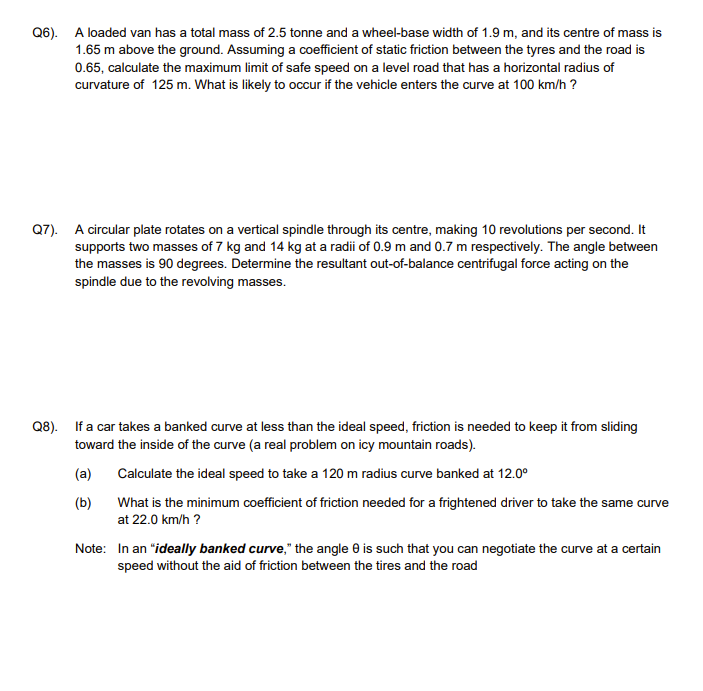
Q A loaded van has a total mass of tonne and a wheelbase width of m and its centre of mass is m above the ground. Assuming a coefficient of static friction between the tyres and the road is calculate the maximum limit of safe speed on a level road that has a horizontal radius of curvature of m What is likely to occur if the vehicle enters the curve at mathrm~kmmathrmh
Q A circular plate rotates on a vertical spindle through its centre, making revolutions per second. It supports two masses of kg and kg at a radii of m and m respectively. The angle between the masses is degrees. Determine the resultant outofbalance centrifugal force acting on the spindle due to the revolving masses.
Q If a car takes a banked curve at less than the ideal speed, friction is needed to keep it from sliding toward the inside of the curve a real problem on icy mountain roads
a Calculate the ideal speed to take a m radius curve banked at circ
b What is the minimum coefficient of friction needed for a frightened driver to take the same curve at mathrm~kmmathrmh
Note: In an "ideally banked curve," the angle theta is such that you can negotiate the curve at a certain speed without the aid of friction between the tires and the road
Step by Step Solution
There are 3 Steps involved in it
1 Expert Approved Answer
Step: 1 Unlock

Question Has Been Solved by an Expert!
Get step-by-step solutions from verified subject matter experts
Step: 2 Unlock
Step: 3 Unlock
 Study Help