







Question: Q6: Consider the figure below, Arrivals Packet in service Departures a. Assume a priority service, with packets 1, 4, 5, 6, and 11 being
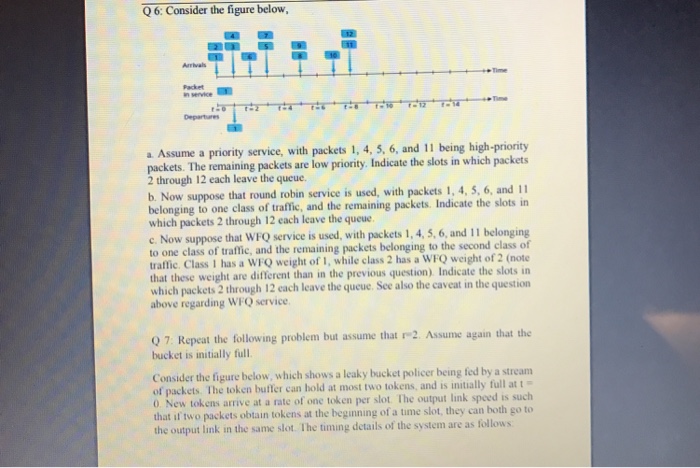
Q6: Consider the figure below, Arrivals Packet in service Departures a. Assume a priority service, with packets 1, 4, 5, 6, and 11 being high-priority packets. The remaining packets are low priority. Indicate the slots in which packets 2 through 12 each leave the queue. b. Now suppose that round robin service is used, with packets 1, 4, 5, 6, and 11 belonging to one class of traffic, and the remaining packets. Indicate the slots in which packets 2 through 12 each leave the queue. c. Now suppose that WFQ service is used, with packets 1, 4, 5, 6, and 11 belonging to one class of traffic, and the remaining packets belonging to the second class of traffic. Class 1 has a WFQ weight of 1, while class 2 has a WFQ weight of 2 (note that these weight are different than in the previous question). Indicate the slots in which packets 2 through 12 each leave the queue. See also the caveat in the question above regarding WFQ service. Q7: Repeat the following problem but assume that r-2. Assume again that the bucket is initially full. Consider the figure below, which shows a leaky bucket policer being fed by a stream of packets. The token buffer can hold at most two tokens, and is initially full att 0. New tokens arrive at a rate of one token per slot. The output link speed is such that if two packets obtain tokens at the beginning of a time slot, they can both go to the output link in the same slot. The timing details of the system are as follows:
Step by Step Solution
There are 3 Steps involved in it
To solve these questions follow these steps for each scheduling discipline Q6 a Priority Service Hig... View full answer

Get step-by-step solutions from verified subject matter experts
 Study Help