







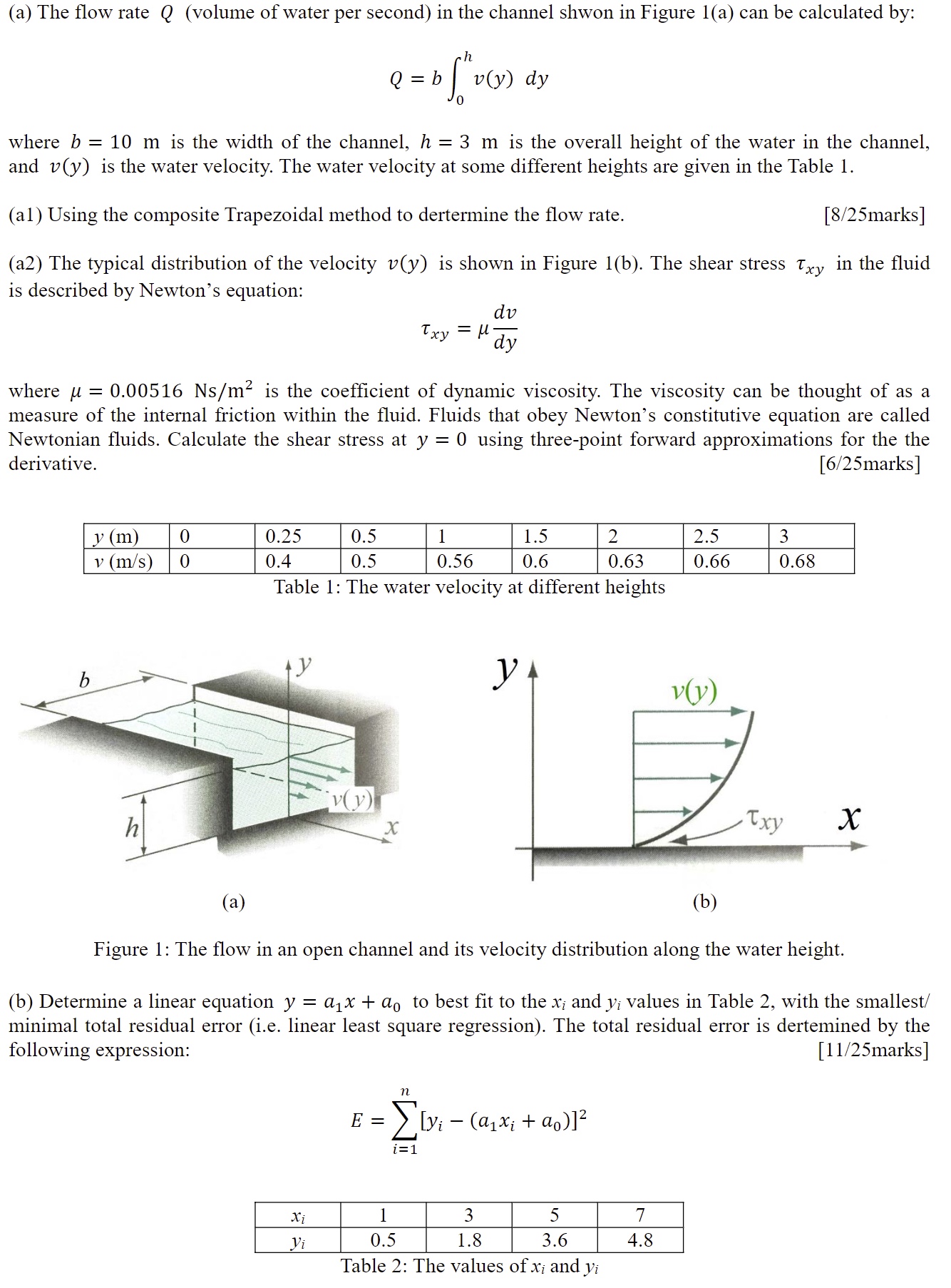
Question: Q = b 0 h v ( y ) d y where b = 1 0 m is the width of the channel, h =
where is the width of the channel, is the overall height of the water in the channel,
and is the water velocity. The water velocity at some different heights are given in the Table
a Using the composite Trapezoidal method to dertermine the flow rate.
a The typical distribution of the velocity is shown in Figure b The shear stress in the fluid
is described by Newton's equation:
where is the coefficient of dynamic viscosity. The viscosity can be thought of as a
measure of the internal friction within the fluid. Fluids that obey Newton's constitutive equation are called
Newtonian fluids. Calculate the shear stress at using threepoint forward approximations for the the
derivative.
marks
where is the width of the channel, is the overall height of the water in the channel,
and is the water velocity. The water velocity at some different heights are given in the Table
a Using the composite Trapezoidal method to dertermine the flow rate.
a The typical distribution of the velocity is shown in Figure b The shear stress in the fluid
is described by Newton's equation:
where is the coefficient of dynamic viscosity. The viscosity can be thought of as a
measure of the internal friction within the fluid. Fluids that obey Newton's constitutive equation are called
Newtonian fluids. Calculate the shear stress at using threepoint forward approximations for the the
derivative.
marks
Step by Step Solution
There are 3 Steps involved in it
1 Expert Approved Answer
Step: 1 Unlock

Question Has Been Solved by an Expert!
Get step-by-step solutions from verified subject matter experts
Step: 2 Unlock
Step: 3 Unlock
 Study Help