







Question: Q . ( ( mathbf { 1 0 0 } mathrm { pts } ) ) The signal (
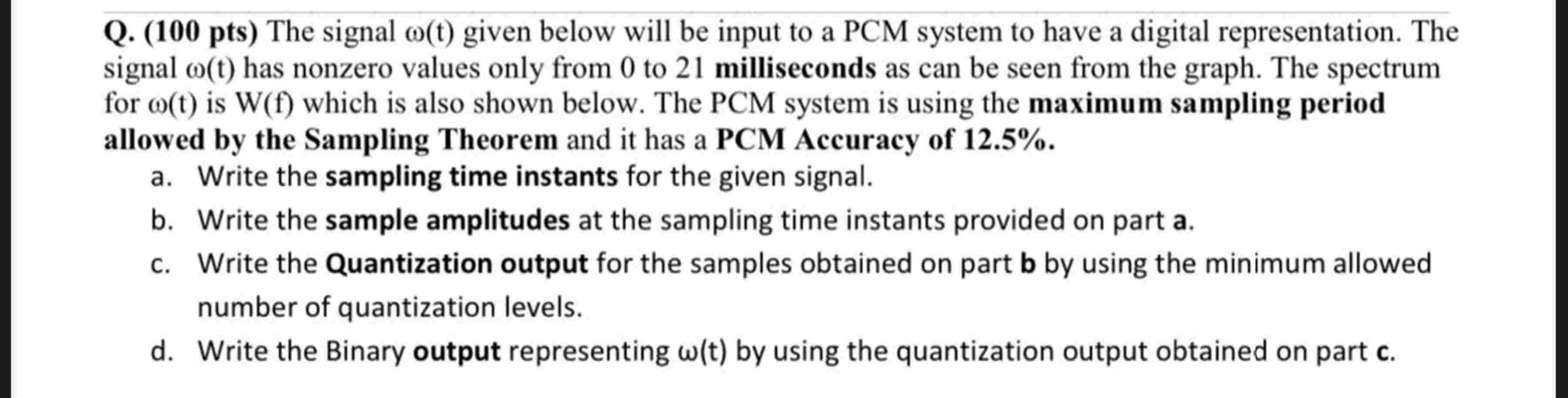
Qmathbfmathrmpts The signal omegamathrmt given below will be input to a PCM system to have a digital representation. The signal omegat has nonzero values only from to milliseconds as can be seen from the graph. The spectrum for omegat is mathrmWmathrmf which is also shown below. The PCM system is using the maximum sampling period allowed by the Sampling Theorem and it has a PCM Accuracy of
a Write the sampling time instants for the given signal.
b Write the sample amplitudes at the sampling time instants provided on part a
c Write the Quantization output for the samples obtained on part b by using the minimum allowed number of quantization levels.
d Write the Binary output representing omegamathrmt by using the quantization output obtained on part mathbfc
Step by Step Solution
There are 3 Steps involved in it
1 Expert Approved Answer
Step: 1 Unlock

Question Has Been Solved by an Expert!
Get step-by-step solutions from verified subject matter experts
Step: 2 Unlock
Step: 3 Unlock
 Study Help