







Question: Q: What accounting issues does RTR face and resolutions? Q2: how to calculate the Internal Rate of Return? Q3: Which options is better for RTR
Q: What accounting issues does RTR face and resolutions? Q2: how to calculate the Internal Rate of Return? Q3: Which options is better for RTR ( through shares or net asset)
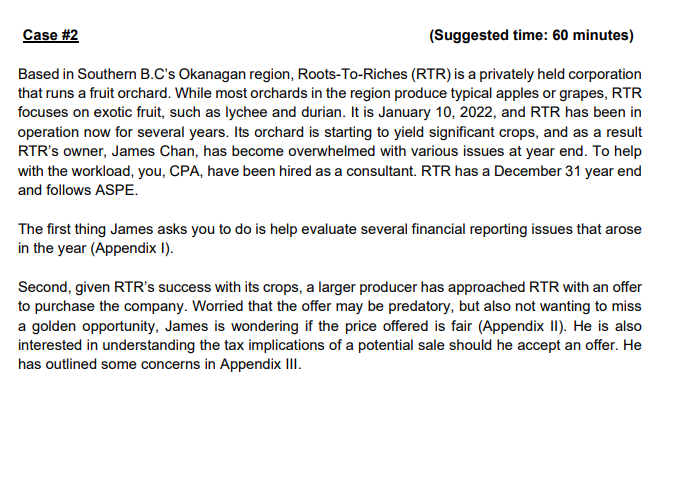
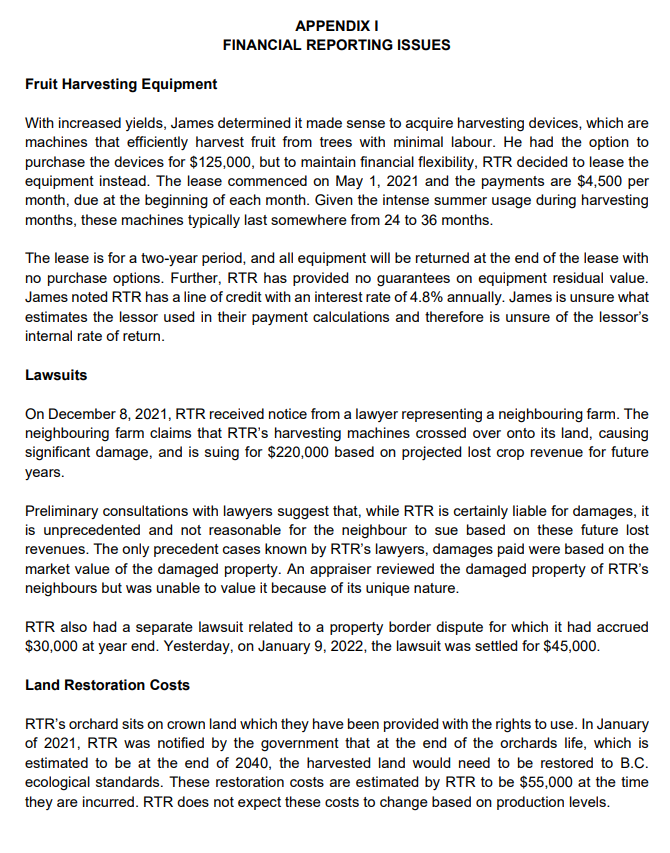
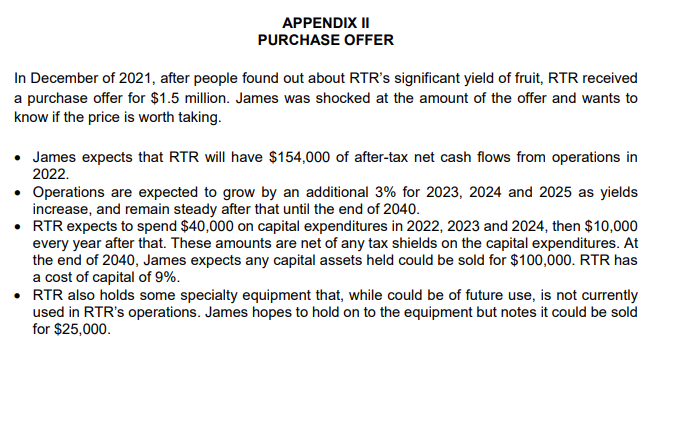
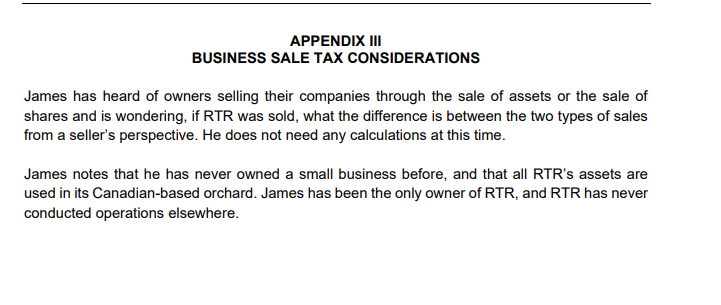
Case #2 (Suggested time: 60 minutes) Based in Southern B.C's Okanagan region, Roots-To-Riches (RTR) is a privately held corporation that runs a fruit orchard. While most orchards in the region produce typical apples or grapes, RTR focuses on exotic fruit, such as lychee and durian. It is January 10, 2022, and RTR has been in operation now for several years. Its orchard is starting to yield significant crops, and as a result RTR's owner, James Chan, has become overwhelmed with various issues at year end. To help with the workload, you, CPA, have been hired as a consultant. RTR has a December 31 year end and follows ASPE. The first thing James asks you to do is help evaluate several financial reporting issues that arose in the year (Appendix 1). Second, given RTR's success with its crops, a larger producer has approached RTR with an offer to purchase the company. Worried that the offer may be predatory, but also not wanting to miss a golden opportunity, James is wondering if the price offered is fair (Appendix II). He is also interested in understanding the tax implications of a potential sale should he accept an offer. He has outlined some concerns in Appendix III. APPENDIXI FINANCIAL REPORTING ISSUES Fruit Harvesting Equipment With increased yields, James determined it made sense to acquire harvesting devices, which are machines that efficiently harvest fruit from trees with minimal labour. He had the option to purchase the devices for $125,000, but to maintain financial flexibility, RTR decided to lease the equipment instead. The lease commenced on May 1, 2021 and the payments are $4,500 per month, due at the beginning of each month. Given the intense summer usage during harvesting months, these machines typically last somewhere from 24 to 36 months. The lease is for a two-year period, and all equipment will be returned at the end of the lease with no purchase options. Further, RTR has provided no guarantees on equipment residual value. James noted RTR has a line of credit with an interest rate of 4.8% annually. James is unsure what estimates the lessor used in their payment calculations and therefore is unsure of the lessor's internal rate of return. Lawsuits On December 8, 2021, RTR received notice from a lawyer representing a neighbouring farm. The neighbouring farm claims that RTR's harvesting machines crossed over onto its land, causing significant damage, and is suing for $220,000 based on projected lost crop revenue for future years. Preliminary consultations with lawyers suggest that, while RTR is certainly liable for damages, it is unprecedented and not reasonable for the neighbour to sue based on these future lost revenues. The only precedent cases known by RTR's lawyers, damages paid were based on the market value of the damaged property. An appraiser reviewed the damaged property of RTR's neighbours but was unable to value it because of its unique nature. RTR also had a separate lawsuit related to a property border dispute for which it had accrued $30,000 at year end. Yesterday, on January 9, 2022, the lawsuit was settled for $45,000. Land Restoration Costs RTR's orchard sits on crown land which they have been provided with the rights to use. In January of 2021, RTR was notified by the government that at the end of the orchards life, which is estimated to be at the end of 2040, the harvested land would need to be restored to B.C. ecological standards. These restoration costs are estimated by RTR to be $55,000 at the time they are incurred. RTR does not expect these costs to change based on production levels. APPENDIX 11 PURCHASE OFFER In December of 2021, after people found out about RTR's significant yield of fruit, RTR received a purchase offer for $1.5 million. James was shocked at the amount of the offer and wants to know if the price is worth taking. James expects that RTR will have $154,000 of after-tax net cash flows from operations in 2022 Operations are expected to grow by an additional 3% for 2023, 2024 and 2025 as yields increase, and remain steady after that until the end of 2040. RTR expects to spend $40,000 on capital expenditures in 2022, 2023 and 2024, then $10,000 every year after that. These amounts are net of any tax shields on the capital expenditures. At the end of 2040, James expects any capital assets held could be sold for $100,000. RTR has a cost of capital of 9%. RTR also holds some specialty equipment that, while could be of future use, is not currently used in RTR's operations. James hopes to hold on to the equipment but notes it could be sold for $25,000. APPENDIX III BUSINESS SALE TAX CONSIDERATIONS James has heard of owners selling their companies through the sale of assets or the sale of shares and is wondering, if RTR was sold, what the difference is between the two types of sales from a seller's perspective. He does not need any calculations at this time. James notes that he has never owned a small business before, and that all RTR's assets are used in its Canadian-based orchard. James has been the only owner of RTR, and RTR has never conducted operations elsewhereStep by Step Solution
There are 3 Steps involved in it
1 Expert Approved Answer
Step: 1 Unlock

Question Has Been Solved by an Expert!
Get step-by-step solutions from verified subject matter experts
Step: 2 Unlock
Step: 3 Unlock
 Study Help