



Question: Q1 (5 points) Suppose you add two vectors A and B. What relative direction between them produces the resultant with the greatest magnitude? What is


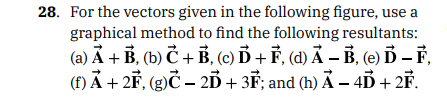
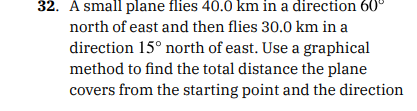
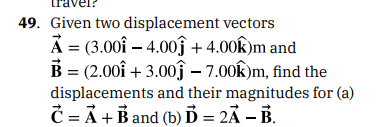
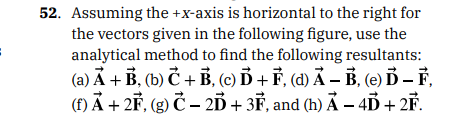


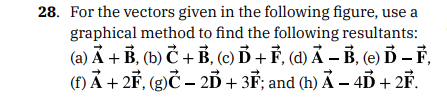
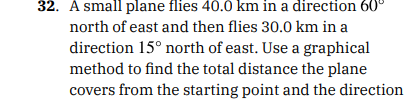
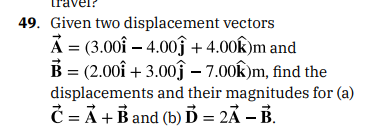
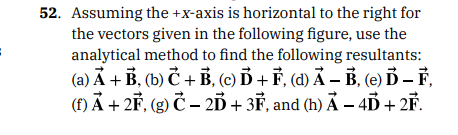
Q1 (5 points) Suppose you add two vectors A and B. What relative direction between them produces the resultant with the greatest magnitude? What is the maximum magnitude? What relative direction between them produces the resultant with the smallest magnitude? What is the minimum magnitude? Q2 (5 points) Is it possible for two vectors of different magnitudes to add to zero? Is it possible for three vectors of different magnitudes to add to zero? Explain.28. For the vectors given in the following figure, use a graphical method to find the following resultants: (a) A + B, (b) C + B, (C) D + F, (d) A - B, (e) D - F, (f) A + 2F, (@)C - 2D + 3F; and (h) A - 4D + 2F.32. A small plane flies 40.0 km in a direction 60" north of east and then flies 30.0 km in a direction 15' north of east. Use a graphical method to find the total distance the plane covers from the starting point and the directionLidVeIF 49. Given two displacement vectors A = (3.001 - 4.00j + 4.00k)m and B = (2.001 + 3.00j - 7.00k)m, find the displacements and their magnitudes for (a) C = A + Band (b) D = 2A - B.52. Assuming the +x-axis is horizontal to the right for the vectors given in the following figure, use the analytical method to find the following resultants: (a) A + B, (b) C + B, (c) D + F, (d) A - B, (e) D - F. (f) A + 2F, (@) C - 2D + 3F, and (h) A - 4D + 2F
Step by Step Solution
There are 3 Steps involved in it

Get step-by-step solutions from verified subject matter experts