







Question: Q1 (50 points) Consider the three following preemptive scheduling algorithms: - rate monotonic (RM), which assigns fixed priority to tasks according to their periods; -
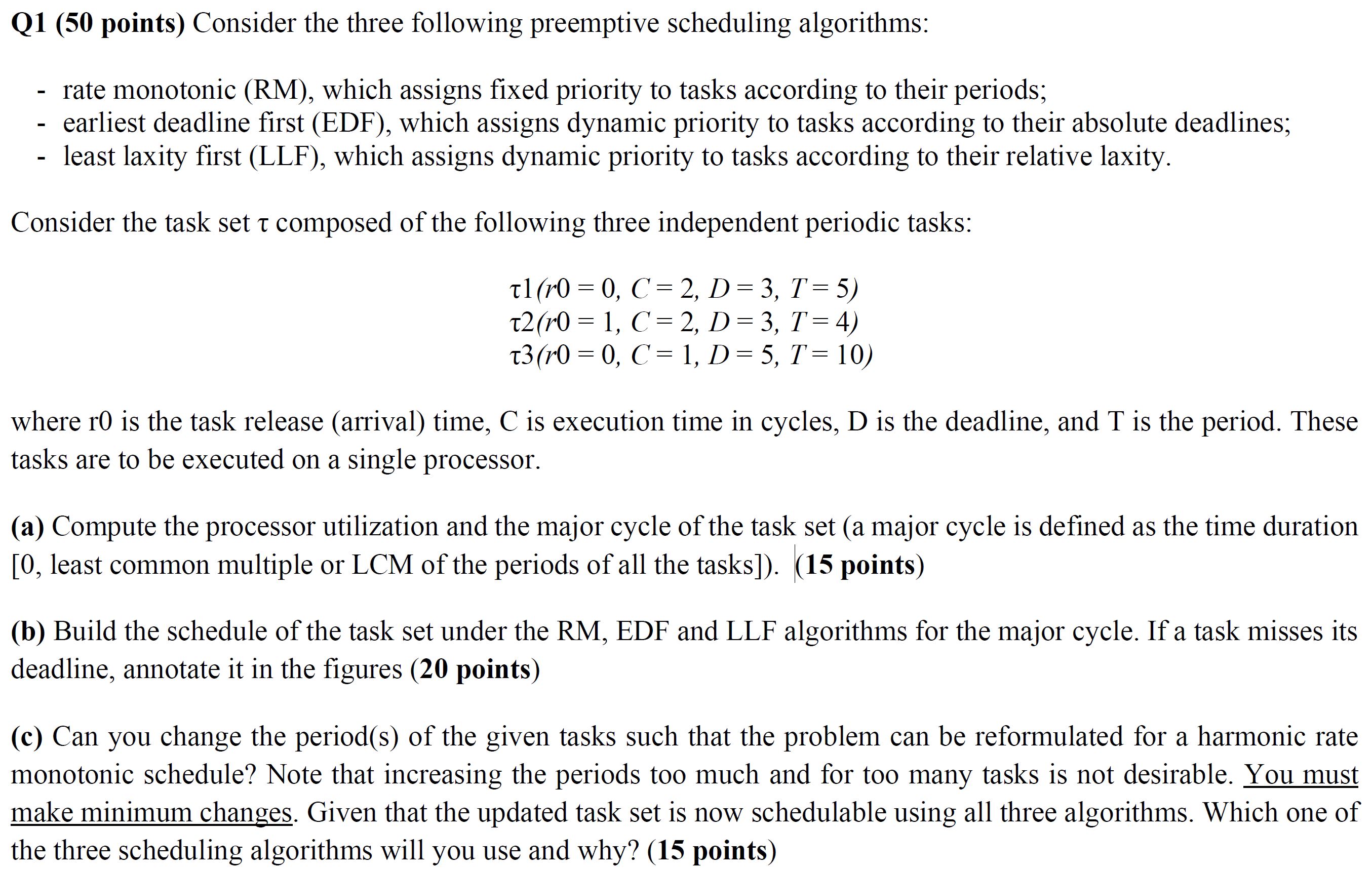
Q1 (50 points) Consider the three following preemptive scheduling algorithms: - rate monotonic (RM), which assigns fixed priority to tasks according to their periods; - earliest deadline first (EDF), which assigns dynamic priority to tasks according to their absolute deadlines; - least laxity first (LLF), which assigns dynamic priority to tasks according to their relative laxity. Consider the task set composed of the following three independent periodic tasks: 1(r0=0,C=2,D=3,T=5)2(r0=1,C=2,D=3,T=4)3(r0=0,C=1,D=5,T=10) where r0 is the task release (arrival) time, C is execution time in cycles, D is the deadline, and T is the period. These tasks are to be executed on a single processor. (a) Compute the processor utilization and the major cycle of the task set (a major cycle is defined as the time duration [0, least common multiple or LCM of the periods of all the tasks]). (15 points) (b) Build the schedule of the task set under the RM, EDF and LLF algorithms for the major cycle. If a task misses its deadline, annotate it in the figures (20 points) (c) Can you change the period(s) of the given tasks such that the problem can be reformulated for a harmonic rate monotonic schedule? Note that increasing the periods too much and for too many tasks is not desirable. You must make minimum changes. Given that the updated task set is now schedulable using all three algorithms. Which one of the three scheduling algorithms will you use and why? (15 points)
Step by Step Solution
There are 3 Steps involved in it

Get step-by-step solutions from verified subject matter experts
 Study Help