







Question: Q1 a 8 Describe the method for calculation of source entropy H(X) from a 1* order Markov source where outputs symbols belong to GF(2). b
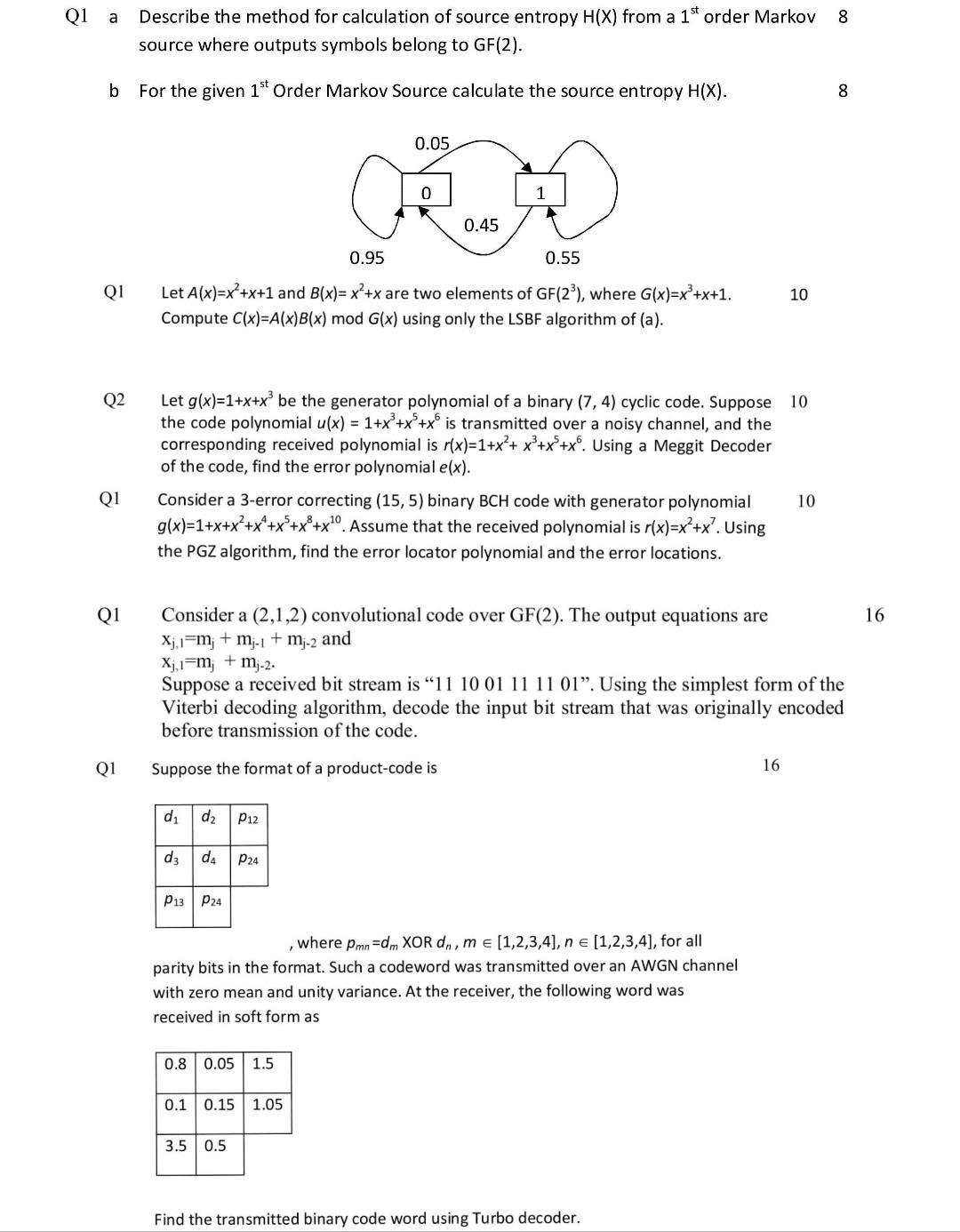
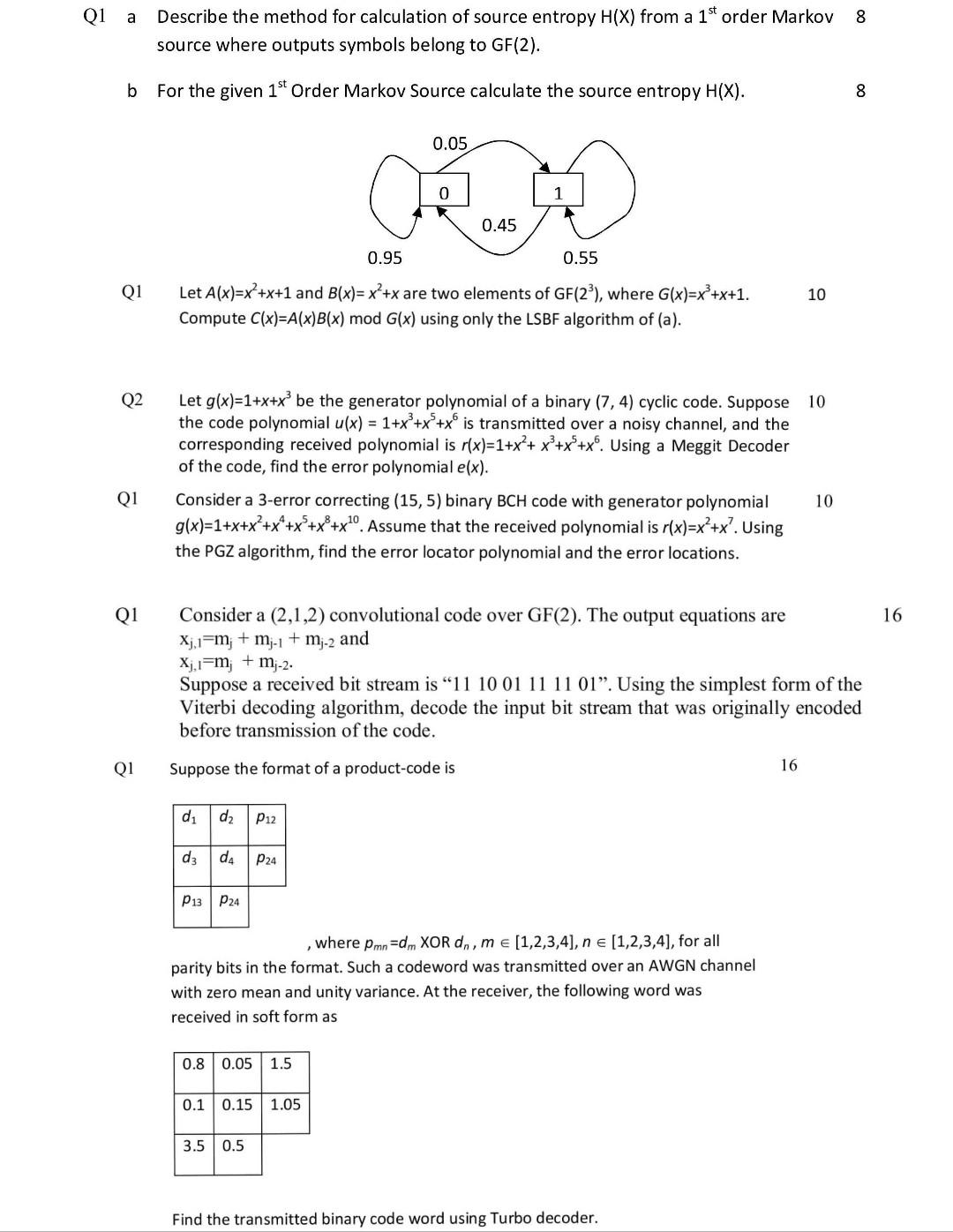
Q1 a 8 Describe the method for calculation of source entropy H(X) from a 1* order Markov source where outputs symbols belong to GF(2). b For the given 1* Order Markov Source calculate the source entropy H(X). 8 0.05 0 1 0.45 0.95 0.55 Q1 10 Let A(x)=x++x+1 and B(x)= x++x are two elements of GF(2%), where G(x)=x+x+1. Compute C(x)=A(x)B(x) mod G(x) using only the LSBF algorithm of (a). Q2 Let g(x)=1+x+x be the generator polynomial of a binary (7,4) cyclic code. Suppose 10 the code polynomial u(x) = 1+x+x+x is transmitted over a noisy channel, and the corresponding received polynomial is r(x)=1+x+ x+x+x. Using a Meggit Decoder of the code, find the error polynomial e(x). Consider a 3-error correcting (15,5) binary BCH code with generator polynomial 10 g(x)=1+x+x+x*+x?+x+x0. Assume that the received polynomial is r(x)=x+x'. Using the PGZ algorithm, find the error locator polynomial and the error locations. Q1 Q1 16 Consider a (2,1,2) convolutional code over GF(2). The output equations are Xj,1 m + m-1 + m-2 and Xj, 1=m; + m -2. Suppose a received bit stream is 11 10 01 11 11 01. Using the simplest form of the Viterbi decoding algorithm, decode the input bit stream that was originally encoded before transmission of the code. Q1 Suppose the format of a product-code is 16 di d2 P12 dz d4 P24 P13 P24 , where Pmn=dm XOR dn, me (1,2,3,4], n = [1,2,3,4], for all parity bits in the format. Such a codeword was transmitted over an AWGN channel with zero mean and unity variance. At the receiver, the following word was received in soft form as 0.8 0.05 1.5 0.1 0.15 1.05 3.5 0.5 Find the transmitted binary code word using Turbo decoder. Q1 a 8 Describe the method for calculation of source entropy H(X) from a 1st order Markov source where outputs symbols belong to GF(2). b For the given 1st Order Markov Source calculate the source entropy H(X). 8 0.05 che 1 0.45 0.95 0.55 Q1 10 Let A(x)=x+x+1 and B(x)=x+x are two elements of GF(22), where G(x)=x2+x+1. Compute C(x)=A(x)B(x) mod G(x) using only the LSBF algorithm of (a). Q2 Let g(x)=1+x+xbe the generator polynomial of a binary (7,4) cyclic code. Suppose 10 the code polynomial u(x) = 1+x+x+x is transmitted over a noisy channel, and the corresponding received polynomial is r(x)=1+x?+ x+x+x. Using a Meggit Decoder of the code, find the error polynomial e(x). Consider a 3-error correcting (15,5) binary BCH code with generator polynomial 10 g(x)=1+x+x+x*+x+ +x+x10. Assume that the received polynomial is r(x)=x+x. Using the PGZ algorithm, find the error locator polynomial and the error locations. Q1 Q1 16 + Consider a (2,1,2) convolutional code over GF(2). The output equations are Xj, 1=m; + mj-1 + mj-2 and + Xj,i=m+m-2. Suppose a received bit stream is 11 10 01 11 11 01". Using the simplest form of the Viterbi decoding algorithm, decode the input bit stream that was originally encoded before transmission of the code. Q1 Suppose the format of a product-code is 16 di dz P12 dz de P24 P13 P24 where pmn=d, XOR d., m (1,2,3,4), n e [1,2,3,4], for all parity bits in the format. Such a codeword was transmitted over an AWGN channel with zero mean and unity variance. At the receiver, the following word was received in soft form as 0.8 0.05 1.5 0.10.15 1.05 3.5 0.5 Find the transmitted binary code word using Turbo decoder
Step by Step Solution
There are 3 Steps involved in it

Get step-by-step solutions from verified subject matter experts
 Study Help