



Question: Q1. A television station is interested in predicting whether or not voters are in favor of an increase in the state sales tax. It asks
Q1. A television station is interested in predicting whether or not voters are in favor of an increase in the state sales tax. It asks its viewers to phone in and indicate whether they support or are opposed to an increase in the state sales tax in order to generate additional revenue for education. Of the 2633 viewers who phone in, 1474 (55.98%) are opposed to the increase.
(a) In this case, the sample obtained is
A.a stratified random sample.
B.a simple random sample.
C.probably biased.
D.a probability sample in which each person in the population has the same chance of being in the sample.
(b) The sample is
A.the 2633 viewers who phoned in.
B.all people who will vote on the sales tax increase on the data of the vote.
C.all regular viewers of the television station who own a phone and have participated in similar phone surveys in the past.
D.the 1474 viewers were opposed to the increase.
(c) The population of interest is
A.all regular viewers of the television station who own a phone and have participated in similar phone surveys in the past.
B.the 2633 viewers who phoned in.
C.all people who will vote on the sales tax increase on the date of the vote.
D.the 1474 viewers who were opposed.
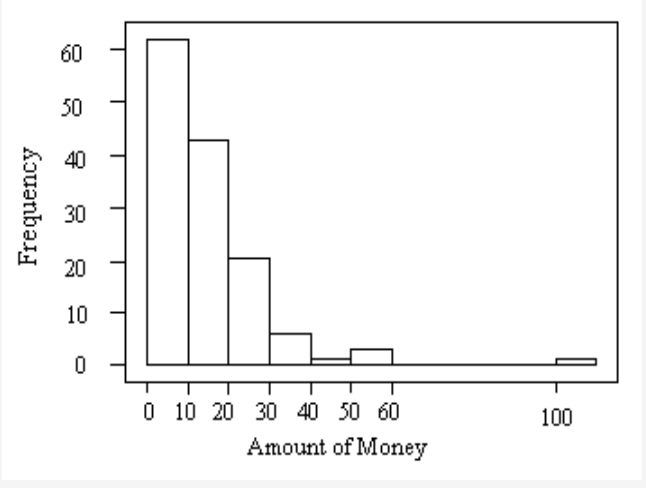
Q2. In a statistics class with 136 students, the professor records how much money each student has in their possession during the first class of the semester. The histogram below is of the data collected.

\f\f\f\f
Step by Step Solution
There are 3 Steps involved in it

Get step-by-step solutions from verified subject matter experts