Question: Q1. After reading the case study, list recommendations for approval or endorsement. Barilla Case Study Giorgio Maggiali was becoming increasingly frustrated. As director of logistics
Q1. After reading the case study, list recommendations for approval or endorsement.
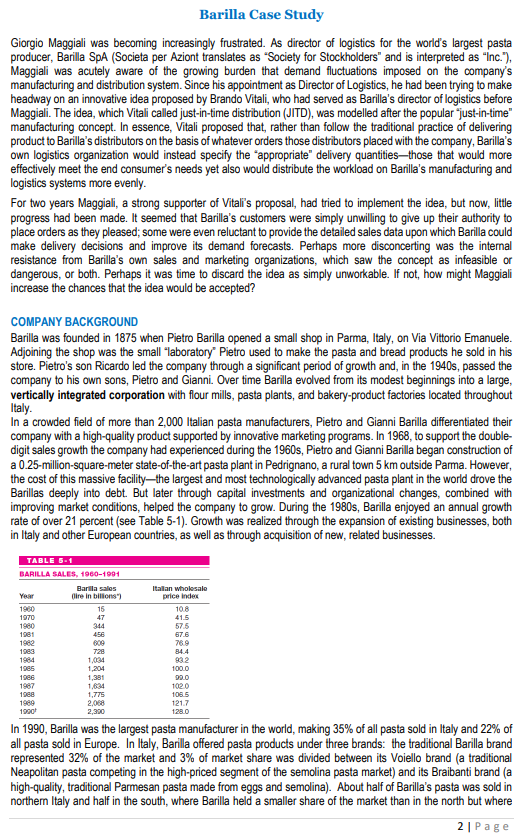
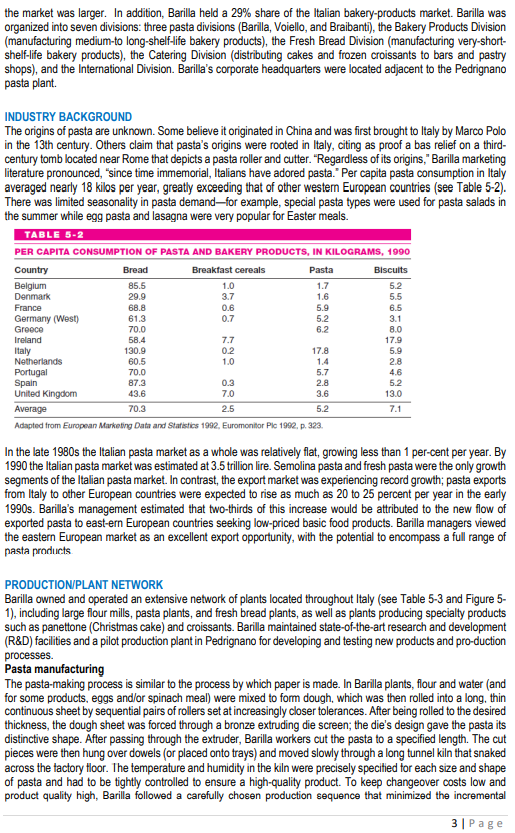
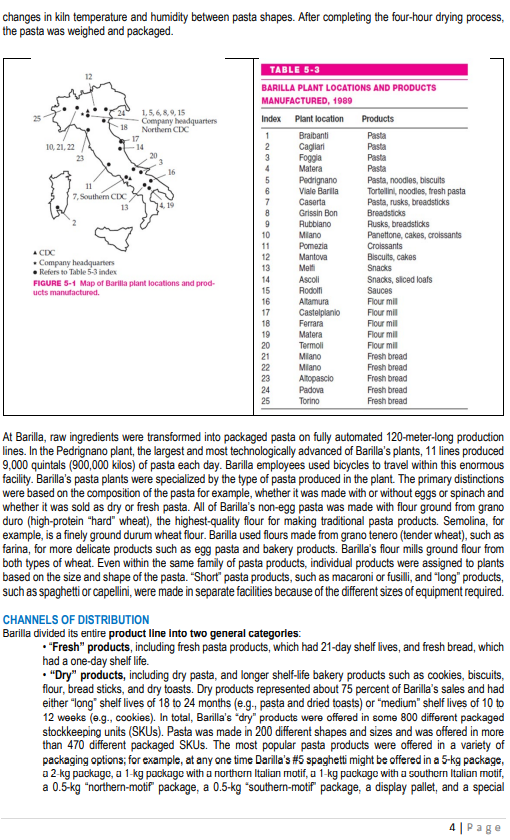
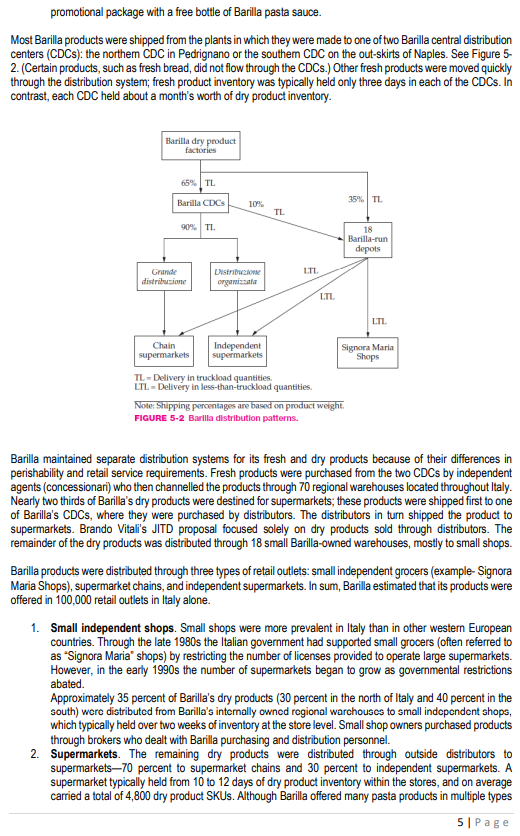
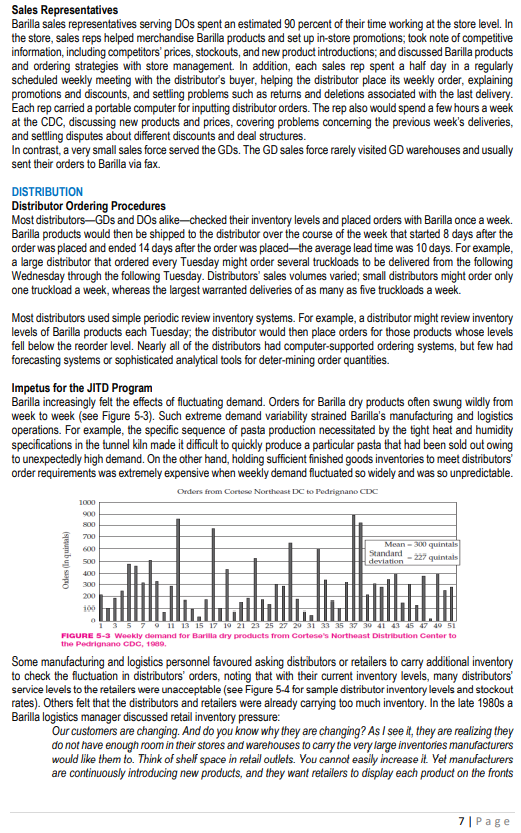
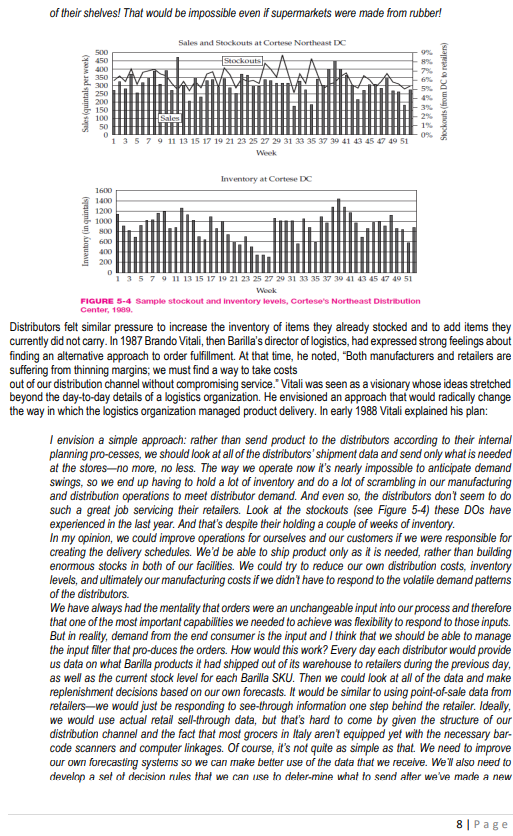
Barilla Case Study Giorgio Maggiali was becoming increasingly frustrated. As director of logistics for the world's largest pasta producer, Barilla SpA (Societa per Aziont translates as "Society for Stockholders" and is interpreted as "Inc."), Maggiali was acutely aware of the growing burden that demand fluctuations imposed on the company's manufacturing and distribution system. Since his appointment as Director of Logistics, he had been trying to make headway on an innovative idea proposed by Brando Vitali, who had served as Barilla's director of logistics before Maggiali. The idea, which Vitali called just-in-time distribution (JITD), was modelled after the popular "just-in-time' manufacturing concept. In essence, Vitali proposed that, rather than follow the traditional practice of delivering product to Barilla's distributors on the basis of whatever orders those distributors placed with the company, Barilla's own logistics organization would instead specify the "appropriate" delivery quantities-those that would more effectively meet the end consumer's needs yet also would distribute the workload on Barilla's manufacturing and logistics systems more evenly. For two years Maggiali, a strong supporter of Vitali's proposal, had tried to implement the idea, but now, little progress had been made. It seemed that Barilla's customers were simply unwilling to give up their authority to place orders as they pleased; some were even reluctant to provide the detailed sales data upon which Barilla could make delivery decisions and improve its demand forecasts. Perhaps more disconcerting was the internal resistance from Barilla's own sales and marketing organizations, which saw the concept as infeasible or dangerous, or both. Perhaps it was time to discard the idea as simply unworkable. If not, how might Maggiali increase the chances that the idea would be accepted? COMPANY BACKGROUND Barilla was founded in 1875 when Pietro Barilla opened a small shop in Parma, Italy, on Via Vittorio Emanuele. Adjoining the shop was the small "laboratory" Pietro used to make the pasta and bread products he sold in his store. Pietro's son Ricardo led the company through a significant period of growth and, in the 1940s, passed the company to his own sons, Pietro and Gianni. Over time Barilla evolved from its modest beginnings into a large, vertically integrated corporation with flour mills, pasta plants, and bakery-product factories located throughout Italy. In a crowded field of more than 2,000 Italian pasta manufacturers, Pietro and Gianni Barilla differentiated their company with a high-quality product supported by innovative marketing programs. In 1968, to support the double- digit sales growth the company had experienced during the 1960s, Pietro and Gianni Barilla began construction of a 0.25-million-square-meter state-of-the-art pasta plant in Pedrignano, a rural town 5 km outside Parma. However, the cost of this massive facility-the largest and most technologically advanced pasta plant in the world drove the Barillas deeply into debt. But later through capital investments and organizational changes, combined with improving market conditions, helped the company to grow. During the 1980s, Barilla enjoyed an annual growth rate of over 21 percent (see Table 5-1). Growth was realized through the expansion of existing businesses, both in Italy and other European countries, as well as through acquisition of new, related businesses TABLE 6-1 BARILLA SALES, 1960-1901 Barilla solos tallan wholesale Wire in bilions") price Index 1980 15 19.8 1970 47 41.5 1980 344 57 5 1981 456 87.8 1982 609 76 9 1982 728 84 4 1984 1.034 1986 1,204 1086 1,381 1867 102 0 1988 103 5 1889 21068 121.7 1980 2,300 128 0 In 1990, Barilla was the largest pasta manufacturer in the world, making 35% of all pasta sold in Italy and 22% of all pasta sold in Europe. In Italy, Barilla offered pasta products under three brands: the traditional Barilla brand represented 32% of the market and 3% of market share was divided between its Voiello brand (a traditional Neapolitan pasta competing in the high-priced segment of the semolina pasta market) and its Braibanti brand (a high-quality, traditional Parmesan pasta made from eggs and semolina). About half of Barilla's pasta was sold in northern Italy and half in the south, where Barilla held a smaller share of the market than in the north but where 2|Pagethe market was larger. In addition, Barilla held a 29% share of the Italian bakery-products market. Barilla was organized into seven divisions: three pasta divisions (Barilla, Voiello, and Braibanti), the Bakery Products Division (manufacturing medium-to long-shelf-life bakery products), the Fresh Bread Division (manufacturing very-short- shelf-life bakery products), the Catering Division (distributing cakes and frozen croissants to bars and pastry shops), and the International Division. Barilla's corporate headquarters were located adjacent to the Pedrignano pasta plant. INDUSTRY BACKGROUND The origins of pasta are unknown. Some believe it originated in China and was first brought to Italy by Marco Polo in the 13th century. Others claim that pasta's origins were rooted in Italy, citing as proof a bas relief on a third- century tomb located near Rome that depicts a pasta roller and cutter. "Regardless of its origins," Barilla marketing literature pronounced, "since time immemorial, Italians have adored pasta." Per capita pasta consumption in Italy averaged nearly 18 kilos per year, greatly exceeding that of other western European countries (see Table 5-2). There was limited seasonality in pasta demand-for example, special pasta types were used for pasta salads in the summer while egg pasta and lasagna were very popular for Easter meals. TABLE 5-2 PER CAPITA CONSUMPTION OF PASTA AND BAKERY PRODUCTS, IN KILOGRAMS, 1990 Country Bread Breakfast cereals Pasta Biscuits Belgium 85.5 1.0 1.7 5.2 Denmark 29.9 3.7 1.6 5.5 France 68.8 0.6 5.9 6.5 Germany (West) 61.3 0.7 5.2 3.1 Greece 70.0 6.2 810 Ireland 68.4 7.7 17.9 Italy 130.9 0.2 17.8 5.9 Netherlands 60.5 1.0 1.4 Portugal 70.0 5.7 4.6 Spain 87.3 0.3 2.8 5.2 United Kingdom 13.6 7.0 3.6 13.0 Average 70.3 2.5 5.2 7.1 Adapted from European Marketing Data and Statistics 1992, Euromonitor Pic 1992, p. 323. In the late 1980s the Italian pasta market as a whole was relatively flat, growing less than 1 per-cent per year. By 1990 the Italian pasta market was estimated at 3.5 trillion lire. Semolina pasta and fresh pasta were the only growth segments of the Italian pasta market. In contrast, the export market was experiencing record growth; pasta exports from Italy to other European countries were expected to rise as much as 20 to 25 percent per year in the early 1990s. Barilla's management estimated that two-thirds of this increase would be attributed to the new flow of exported pasta to east-er European countries seeking low-priced basic food products. Barilla managers viewed the eastern European market as an excellent export opportunity, with the potential to encompass a full range of pasta products PRODUCTION/PLANT NETWORK Barilla owned and operated an extensive network of plants located throughout Italy (see Table 5-3 and Figure 5- 1), including large flour mills, pasta plants, and fresh bread plants, as well as plants producing specialty products such as panettone (Christmas cake) and croissants. Barilla maintained state-of-the-art research and development (R&D) facilities and a pilot production plant in Pedrignano for developing and testing new products and pro-duction processes. Pasta manufacturing The pasta-making process is similar to the process by which paper is made. In Barilla plants, flour and water (and for some products, eggs and/or spinach meal) were mixed to form dough, which was then rolled into a long, thin continuous sheet by sequential pairs of rollers set at increasingly closer tolerances. After being rolled to the desired thickness, the dough sheet was forced through a bronze extruding die screen; the die's design gave the pasta its distinctive shape. After passing through the extruder, Barilla workers cut the pasta to a specified length. The cut pieces were then hung over dowels (or placed onto trays) and moved slowly through a long tunnel kiln that snaked across the factory floor. The temperature and humidity in the kiln were precisely specified for each size and shape of pasta and had to be tightly controlled to ensure a high-quality product. To keep changeover costs low and product quality high, Barilla followed a carefully chosen production sequence that minimized the incremental 3|Pagechanges in kiln temperature and humidity between pasta shapes. After completing the four-hour drying process, the pasta was weighed and packaged. TABLE 5-3 BARILLA PLANT LOCATIONS AND PRODUCTS MANUFACTURED, 1989 1,5, 6. 8, 9, 15 Company headquarters Index Plant location Products 18 Northam CDC Braibanti Pasta 10, 21, 22 Cagliari Pasta Foggia Pasta Matera Pasta Pedrignano Pasta, noodles, biscuits 11 Viale Barilla Tortellini, noodles, fresh pasta 7, Southom CDC Caserta Pasta, rusks, breadsticks B Grissin Bon Breadsticks Rubbiano Rusks, breadsticks 10 Miano Panettone, cakes, croissants 11 Pomezia Croissants & CDC 12 Mantova Biscuits, cakes Company headquarters 13 Melfi Snacks Refers to Table 5-3 index Ascoll Snacks, sliced loafs FIGURE 5-1 Map of Barilla plant locations and prod- 14 ucts manufactured. 15 Rodolfi Sauces 16 Attamura Flour mil 17 Castelplanio Flour mil 18 Ferrara Flour mil 19 Matera Flour mil 20 Termoll Flour mil 21 Milano Fresh bread 22 Milano Fresh broad 23 Attopasclo Fresh broad 24 Padova Fresh bread 25 Torino Fresh bread At Barilla, raw ingredients were transformed into packaged pasta on fully automated 120-meter-long production lines. In the Pedrignano plant, the largest and most technologically advanced of Barilla's plants, 11 lines produced 9,000 quintals (900,000 kilos) of pasta each day. Barilla employees used bicycles to travel within this enormous facility. Barilla's pasta plants were specialized by the type of pasta produced in the plant. The primary distinctions were based on the composition of the pasta for example, whether it was made with or without eggs or spinach and whether it was sold as dry or fresh pasta. All of Barilla's non-egg pasta was made with flour ground from grano duro (high-protein "hard" wheat), the highest-quality flour for making traditional pasta products. Semolina, for example, is a finely ground durum wheat flour. Barilla used flours made from grano tenero (tender wheat), such as farina, for more delicate products such as egg pasta and bakery products. Barilla's flour mills ground flour from both types of wheat. Even within the same family of pasta products, individual products were assigned to plants based on the size and shape of the pasta. "Short" pasta products, such as macaroni or fusilli, and "long" products such as spaghetti or capellini, were made in separate facilities because of the different sizes of equipment required. CHANNELS OF DISTRIBUTION Barilla divided its entire product line into two general categories: . "Fresh" products, including fresh pasta products, which had 21-day shelf lives, and fresh bread, which had a one-day shelf life. . "Dry" products, including dry pasta, and longer shelf-life bakery products such as cookies, biscuits, flour, bread sticks, and dry toasts. Dry products represented about 75 percent of Barilla's sales and had either "long" shelf lives of 18 to 24 months (e.g., pasta and dried toasts) or "medium" shelf lives of 10 to 12 weeks (e.g., cookies). In total, Barilla's "dry" products were offered in some 800 different packaged stockkeeping units (SKUs). Pasta was made in 200 different shapes and sizes and was offered in more than 470 different packaged SKUs. The most popular pasta products were offered in a variety of packaging options; for example, at any one time Darilla's #5 spaghetti might be offered in a 5-kg package, a 2-kg package, a 1-kg package with a northern Italian motif, a 1-kg package with a southern Italian motif, a 0.5-kg "northern-motif" package, a 0.5-kg "southern-motif" package, a display pallet, and a special 4 Pagepromotional package with a free bottle of Barilla pasta sauce. Most Barilla products were shipped from the plants in which they were made to one of two Barilla central distribution centers (CDCs): the northem CDC in Pedrignano or the southem CDC on the out-skirts of Naples. See Figure 5- 2. (Certain products, such as fresh bread, did not flow through the CDCs.) Other fresh products were moved quickly through the distribution system; fresh product inventory was typically held only three days in each of the CDCs. In contrast, each CDC held about a month's worth of dry product inventory. Barilla dry product factories TL Barilla CDC. 35% TI 10% TL TL 18 Barilla-run depois Grande LTI distribuzione LTI L.TL. Chain Independent Signora Maria supermarkets supermarkets Shops TL = Delivery in truckload quantities. LTL - Delivery in less-than-truckload quantities. Note: Shipping percentages are based on product weight. FIGURE 5-2 Barilla distribution patterns. Barilla maintained separate distribution systems for its fresh and dry products because of their differences in perishability and retail service requirements. Fresh products were purchased from the two CDCs by independent agents (concessionari) who then channelled the products through 70 regional warehouses located throughout Italy. Nearly two thirds of Barilla's dry products were destined for supermarkets; these products were shipped first to one of Barilla's CDCs, where they were purchased by distributors. The distributors in turn shipped the product to supermarkets. Brando Vitali's JITD proposal focused solely on dry products sold through distributors. The remainder of the dry products was distributed through 18 small Barilla-owned warehouses, mostly to small shops. Barilla products were distributed through three types of retail outlets: small independent grocers (example- Signora Maria Shops), supermarket chains, and independent supermarkets. In sum, Barilla estimated that its products were offered in 100,000 retail outlets in Italy alone. 1. Small independent shops. Small shops were more prevalent in Italy than in other western European countries. Through the late 1980s the Italian government had supported small grocers (often referred to as "Signora Maria" shops) by restricting the number of licenses provided to operate large supermarkets. However, in the early 1990s the number of supermarkets began to grow as governmental restrictions abated. Approximately 35 percent of Barilla's dry products (30 percent in the north of Italy and 40 percent in the south) were distributed from Barilla's internally owned regional warchouses to small independent shops, which typically held over two weeks of inventory at the store level. Small shop owners purchased products through brokers who dealt with Barilla purchasing and distribution personnel. 2. Supermarkets. The remaining dry products were distributed through outside distributors to supermarkets-70 percent to supermarket chains and 30 percent to independent supermarkets. A supermarket typically held from 10 to 12 days of dry product inventory within the stores, and on average carried a total of 4,800 dry product SKUs. Although Barilla offered many pasta products in multiple types 5|Pageof packages, most retailers would carry a product in only one (and at most two) packaging options. Dry products destined for a supermarket chain were distributed through the chain's own distribution organization, known as a grande distribuzione ("grand distributor"), or GD; those destined for independent supermarkets were channelled through a different set of distributors known as distribuzione organizzata ("organized distributors"), or DOs. A DO acted as a central buying organization for a large number of independent supermarkets. Most DOs had regional operations, and the retailers they served usually got their products from only a single DO. Due to regional preferences and differences in retail requirements, a typical distributor might distribute 150 of Barilla's 800 dry product SKUs. Most distributors handled products coming from about 200 different suppliers; of these, Barilla typically would be the largest in terms of the physical volume of products purchased. Distributors typically carried from 7,000 to 10,000 SKUs in total. However, their strategies varied. For example, one of Barilla's largest DOs, Cortese, carried only 100 of Barilla's dry products and carried a total of only 5,000 SKUs. Both GDs and DOs purchased products from the Barilla CDCs, maintained inventory in their own warehouses, and then filled supermarket orders from their warehouse inventory. A distributor's warehouse typically held a two-week supply of Barilla dry products in inventory. Many supermarkets placed daily orders with distributors; the store manager would walk up and down the store aisles and note each product that needed to be replenished and the number of boxes required (more sophisticated retailers used hand-held computers to record order quantities as they checked the shelves). The order would then be transmitted to the store's distributor; orders were typically received at the store 24 to 48 hours after receipt of the order at the distribution center. SALES, MARKETING, AND DEMAND PLANNING Barilla enjoyed a strong brand image in Italy. Its marketing and sales strategy was based upon a combination of advertising and promotions. Advertising Barilla brands were heavily advertised. Advertising copy differentiated Barilla pasta from basic commodity "noodles" by positioning the brand as the highest quality, most sophisticated pasta product available. One ad campaign was built on the phrase "Barilla: a great collection of premium Italian pasta." The "collection" dimension was illustrated by showing individual uncooked pasta shapes against a black background, as though they were jewels, evoking a sense of luxury and sophistication. Unlike other pasta manufacturers, Barilla avoided images of traditional Italian folklore, preferring modern, sophisticated settings in major Italian cities. Trade Promotions Barilla's sales strategy relied on the use of trade pro-motions to push its products into the grocery distribution network. A Barilla sales executive explained the logic of the promotion-based strategy: We sell to a very old-fashioned distribution system. The buyers expect frequent trade promotions, which they then pass along to their own customers. So a store will know right away if another store is buying Barilla pasta at a dis-count. You have to understand how important pasta is in Italy. Everyone knows the price of pasta. If a store is selling pasta at a discount one week, consumers notice the reduced price immediately. Barilla divided each year into 10 or 12 "canvass" periods, typically four to five weeks in length, each corresponding to a promotional program. During any canvass period, a Barilla distributor could buy as many products as desired to meet current and future needs. Incentives for Barilla sales representatives were based on achieving the sales targets set for each canvass period. Different product categories were offered during different canvass periods, with the discount depending on the margin structure of the category. Typical promotional discounts were 1.4 percent for semolina pasta, 4 percent for egg pasta, 4 percent for biscuits, 8 percent for sauces, and 10 percent for breadsticks. Barilla also offered volume discounts. For example, Barilla paid for transportation, thus providing incentives of 2 to 3 percent for orders in full truckload quantities. In addition, a sales representative might offer a buyer a 1,000 lire per carton discount (representing a 4 percent discount) if the buyer purchased a minimum of three truckloads of Barilla egg pasta. 6|PageSales Representatives Barilla sales representatives serving DOs spent an estimated 90 percent of their time working at the store level. In the store, sales reps helped merchandise Barilla products and set up in-store promotions; took note of competitive information, including competitors' prices, stockouts, and new product introductions; and discussed Barilla products and ordering strategies with store management. In addition, each sales rep spent a half day in a regularly scheduled weekly meeting with the distributor's buyer, helping the distributor place its weekly order, explaining promotions and discounts, and settling problems such as returns and deletions associated with the last delivery. Each rep carried a portable computer for inputting distributor orders. The rep also would spend a few hours a week at the CDC, discussing new products and prices, covering problems concerning the previous week's deliveries and settling disputes about different discounts and deal structures. In contrast, a very small sales force served the GDs. The GD sales force rarely visited GD warehouses and usually sent their orders to Barilla via fax. DISTRIBUTION Distributor Ordering Procedures Most distributors-GDs and DOs alike-checked their inventory levels and placed orders with Barilla once a week. Barilla products would then be shipped to the distributor over the course of the week that started 8 days after the order was placed and ended 14 days after the order was placed-the average lead time was 10 days. For example, a large distributor that ordered every Tuesday might order several truckloads to be delivered from the following Wednesday through the following Tuesday. Distributors' sales volumes varied; small distributors might order only one truckload a week, whereas the largest warranted deliveries of as many as five truckloads a week. Most distributors used simple periodic review inventory systems. For example, a distributor might review inventory levels of Barilla products each Tuesday; the distributor would then place orders for those products whose levels fell below the reorder level. Nearly all of the distributors had computer-supported ordering systems, but few had forecasting systems or sophisticated analytical tools for deter-mining order quantities. Impetus for the JITD Program Barilla increasingly felt the effects of fluctuating demand. Orders for Barilla dry products often swung wildly from week to week (see Figure 5-3). Such extreme demand variability strained Barilla's manufacturing and logistics operations. For example, the specific sequence of pasta production necessitated by the tight heat and humidity specifications in the tunnel kiln made it difficult to quickly produce a particular pasta that had been sold out owing to unexpectedly high demand. On the other hand, holding sufficient finished goods inventories to meet distributors' order requirements was extremely expensive when weekly demand fluctuated so widely and was so unpredictable. Orders from Cortese Northeast DC to Fedrignano CDC 1000 900 800 700 600 Mean - 300 quintals Standard - 227 quintals Orders (In quintals) 500 deviation 400 300 200 1 3 5 7 9 11 13 15 17 19 21 23 25 27 20 31 33 3 143 45 47 49 51 FIGURE 5-3 Weekly demand for Barilla dry products from Cortese's Northeast Distribution Center to the Pedrignano CDC, 1989, Some manufacturing and logistics personnel favoured asking distributors or retailers to carry additional inventory to check the fluctuation in distributors' orders, noting that with their current inventory levels, many distributors service levels to the retailers were unacceptable (see Figure 5-4 for sample distributor inventory levels and stockout rates). Others felt that the distributors and retailers were already carrying too much inventory. In the late 1980s a Barilla logistics manager discussed retail inventory pressure: Our customers are changing. And do you know why they are changing? As I see it, they are realizing they do not have enough room in their stores and warehouses to carry the very large inventories manufacturers would like them to. Think of shell space in retail outlets. You cannot easily increase it. Yet manufacturers are continuously introducing new products, and they want retailers to display each product on the fronts 7|Pageof their shelves! That would be impossible even if supermarkets were made from rubber! Sales and Stockouts at Cortese Northeast DC 500 450 Stockouts 400 350 300 250 Stockouts (from DC to retailers) Sales (quintals per week) 200 150 100 50 3 5 7 9 11 13 15 17 19 21 23 25 27 29 31 33 35 37 39 41 43 45 47 49 51 Week Inventory at Cortese DC 160 1400 1200 1000 Inventory (in quintals) 800 600 20 1357 27 20 31 33 35 3 49 51 Wook FIGURE 5-4 Sample stockout and inventory levels, Cortese's Northeast Distribution Center, 1989. Distributors felt similar pressure to increase the inventory of items they already stocked and to add items they currently did not carry. In 1987 Brando Vitali, then Barilla's director of logistics, had expressed strong feelings about finding an alternative approach to order fulfillment. At that time, he noted, "Both manufacturers and retailers are suffering from thinning margins; we must find a way to take costs out of our distribution channel without compromising service." Vitali was seen as a visionary whose ideas stretched beyond the day-to-day details of a logistics organization. He envisioned an approach that would radically change the way in which the logistics organization managed product delivery. In early 1988 Vitali explained his plan: I envision a simple approach: rather than send product to the distributors according to their internal planning pro-cesses, we should look at all of the distributors' shipment data and send only what is needed at the stores-no more, no less. The way we operate now it's nearly impossible to anticipate demand swings, so we end up having to hold a lot of inventory and do a lot of scrambling in our manufacturing and distribution operations to meet distributor demand. And even so, the distributors don't seem to do such a great job servicing their retailers. Look at the stockouts (see Figure 5-4) these DOs have experienced in the last year. And that's despite their holding a couple of weeks of inventory. In my opinion, we could improve operations for ourselves and our customers if we were responsible for creating the delivery schedules. We'd be able to ship product only as it is needed, rather than building enormous stocks in both of our facilities. We could try to reduce our own distribution costs, inventory levels, and ultimately our manufacturing costs if we didn't have to respond to the volatile demand patterns of the distributors. We have always had the mentality that orders were an unchangeable input into our process and therefore that one of the most important capabilities we needed to achieve was flexibility to respond to those inputs. But in reality, demand from the end consumer is the input and I think that we should be able to manage the input filter that pro-duces the orders. How would this work? Every day each distributor would provide us data on what Barilla products it had shipped out of its warehouse to retailers during the previous day as well as the current stock level for each Barilla SKU. Then we could look at all of the data and make replenishment decisions based on our own forecasts. It would be similar to using point-of-sale data from retailers-we would just be responding to see-through information one step behind the retailer. Ideally we would use actual retail sell-through data, but that's hard to come by given the structure of our distribution channel and the fact that most grocers in Italy aren't equipped yet with the necessary bar code scanners and computer linkages. Of course, it's not quite as simple as that. We need to improve our own forecasting systems so we can make better use of the data that we receive. We'll also need to develop a set of decision rules that we can use to deter-mine what to send after we've made a new 8|Pageforecast. Vitali's proposal, "just-in-time distribution (JITD)," met with significant resistance within Barilla. The sales and marketing organizations were particularly vocal in their opposition to the plan. A number of sales representatives felt their responsibilities would be diminished if such a program were put in place. A range of concerns was expressed from the bottom to the top of the sales organization. The following remarks were heard from Barilla sales and marketing personnel: -"Our sales levels would flatten if we put this program in place." -"We run the risk of not being able to adjust our shipments sufficiently quickly to changes in selling patterns or increased promotions." "It seems to me that a pretty good part of the distribution organization is not yet ready to handle such a sophisticated relationship." "If space is freed up in our distributors' warehouses when inventories of our own product decrease, we run the risk of giving our competitors more distributor shelf space. The distributors would then push our competitors' product more than our own, since once something is bought it must be sold." . "We increase the risk of having our customers stock out of our product if we have disruption in our supply process. What if we have a strike or some other disturbance?" - "We wouldn't be able to run trade promotions with JITD. How can we get the trade to push Barilla product to retailers if we don't offer some sort of incentive?" ."It's not clear that costs would even be reduced. If a DO decreases its stock, we at Barilla may have to increase our own inventory of those products for which we cannot change production schedules due to our lack of manufacturing flexibility." Vitali countered the concerns of the sales organization: I think JITD should be considered a selling tool, rather than a threat to sales. We're offering the customer additional service at no extra cost. In addition, the program will improve Barilla's visibility with the trade and make distributors more dependent on us-it should improve the relationships between Barilla and the distributors rather than harm them. And what's more, the information regarding the supply at the distributors' warehouses provides us with objective data that would permit us to improve our own planning procedures. Giorgio Maggiali, head of materials management for Barilla's fresh products group, was appointed director of logistics in late 1988 when Vitali was promoted to head one of the company's new divisions. Maggiali was a hands- on manager, known for his orientation to action. Shortly after his appointment, Maggiali appointed a recent college graduate, Vincenzo Battistini, to help him develop and implement the JITD program. Maggiali recounted his frustrations in implementing the JITD program: In 1988 we developed the basic ideas for the approach we wanted to use and tried to convince several of our distributors to sign on. They weren't even interested in talking about it; the manager of one of our largest distributors pretty much summed up a lot of the responses we had when he cut off a conversation saying, "Managing stock is my job; I don't need you to see my warehouse or my figures. I could improve my inventory and service levels myself if you would deliver my orders more quickly. I'll make you a proposal-I'll place the order and you deliver within 36 hours. " He didn't understand that we just can't respond to wildly changing orders without more notice than that. Another distributor expressed concerns about becoming too closely linked to Barilla. "We would be giving Barilla the power to push product into our warehouses just so Barilla can reduce its costs." Still another asked, "What makes you think that you could manage my inventories any better than I can?" We were finally able to convince a couple of our distributors to have in-depth discussions about the JITD proposal. Our first discussion was with Marconi, a large, fairly old-fashioned GD. First Battistini and I visited Marconi's logistics department and presented our plan. We made it clear that we planned to provide them with such good service that they could both decrease their inventories and improve their fill rate to their stores. The logistics group thought it sounded great and was interested in con-ducting an experimental run of the program. But as soon as Marconi's buyers heard about it. all hell broke loose. First the buyers started to voice their own concerns; then, after talking to their Barilla sales reps, they started to repeat some of our own sales department's objections as well. Marconi finally agreed to sell us the data we wanted, but otherwise things would continue as before with Marconi making decisions about replenishment quantities and timing This clearly wasn't the type of relationship we were Innking for, so we talked to other distributors, but they weren't much more responsive. 9|Page
Step by Step Solution
There are 3 Steps involved in it
1 Expert Approved Answer
Step: 1 Unlock
Question Has Been Solved by an Expert!
Get step-by-step solutions from verified subject matter experts
Step: 2 Unlock
Step: 3 Unlock
Students Have Also Explored These Related General Management Questions!









 Study Help