



Question: Q1 - Asymptotes and Extrema [5 points] To answer this question efficiently we observe that, if a function h(x) is continuous and strictly decreasing on
![Q1 - Asymptotes and Extrema [5 points] To answer this question](https://s3.amazonaws.com/si.experts.images/answers/2024/06/6677caa8cd92c_6966677caa8af349.jpg)
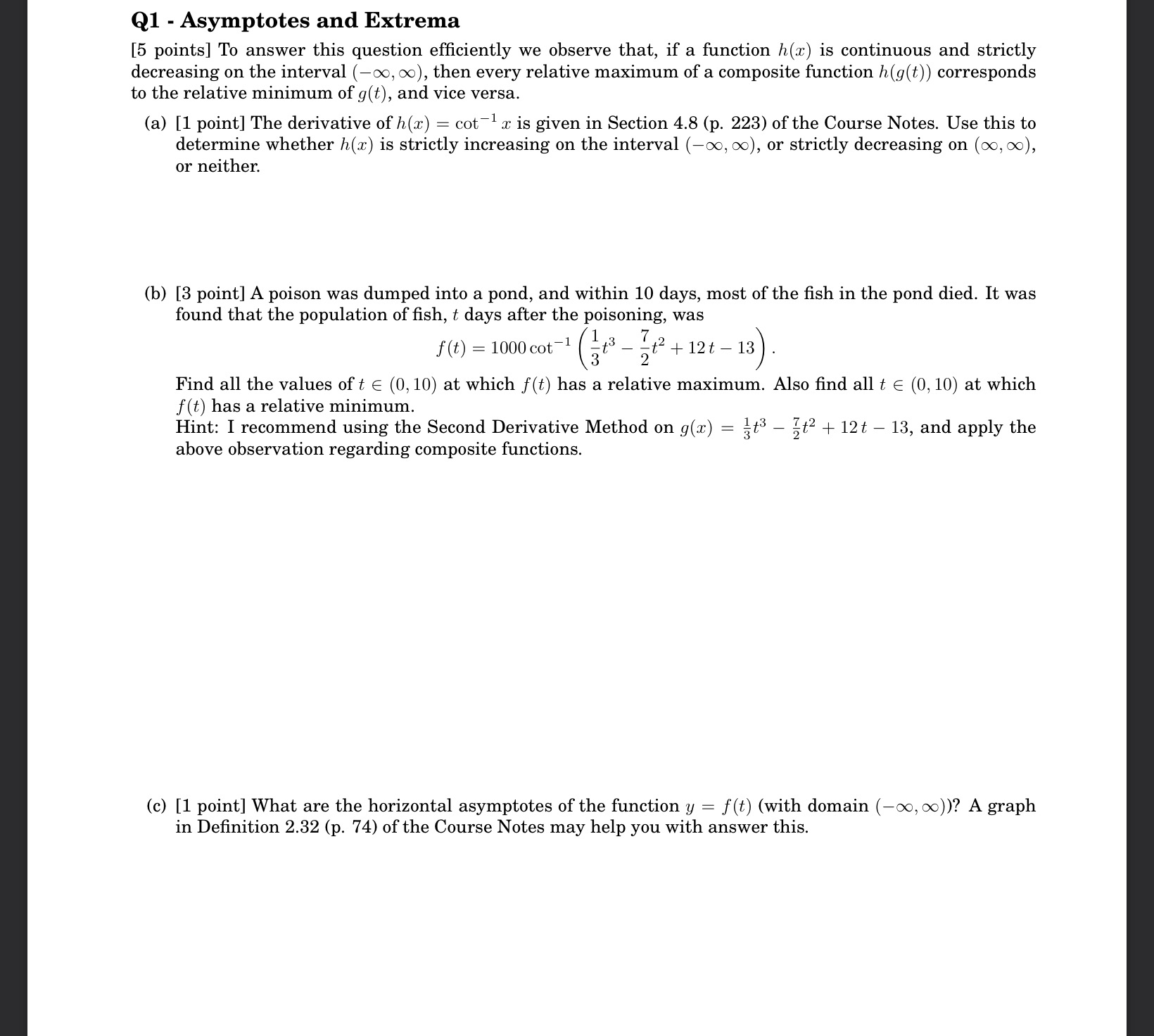
Q1 - Asymptotes and Extrema [5 points] To answer this question efficiently we observe that, if a function h(x) is continuous and strictly decreasing on the interval (-0o, co), then every relative maximum of a composite function h(g(t)) corresponds to the relative minimum of g(t), and vice versa. (a) [1 point] The derivative of h(x) = cot x is given in Section 4.8 (p. 223) of the Course Notes. Use this to determine whether h(x) is strictly increasing on the interval (-oo, co), or strictly decreasing on (0o, co), or neither. (b) [3 point] A poison was dumped into a pond, and within 10 days, most of the fish in the pond died. It was found that the population of fish, t days after the poisoning, was f(t) = 1000 cot ( #8 - 32 + 121-13). Find all the values of t E (0, 10) at which f(t) has a relative maximum. Also find all t E (0, 10) at which f (t) has a relative minimum. Hint: I recommend using the Second Derivative Method on g(x) = 3+3 - 2t2 + 12t - 13, and apply the above observation regarding composite functions. (c) [1 point] What are the horizontal asymptotes of the function y = f(t) (with domain (-oo, co))? A graph in Definition 2.32 (p. 74) of the Course Notes may help you with answer this
Step by Step Solution
There are 3 Steps involved in it

Get step-by-step solutions from verified subject matter experts