







Question: Q1. Based on the case facts, define the scope for the industry /strategic group to do competitive forces analysis. Identify the players for each force.
Q1. Based on the case facts, define the scope for the industry /strategic group to do competitive forces analysis. Identify the players for each force.
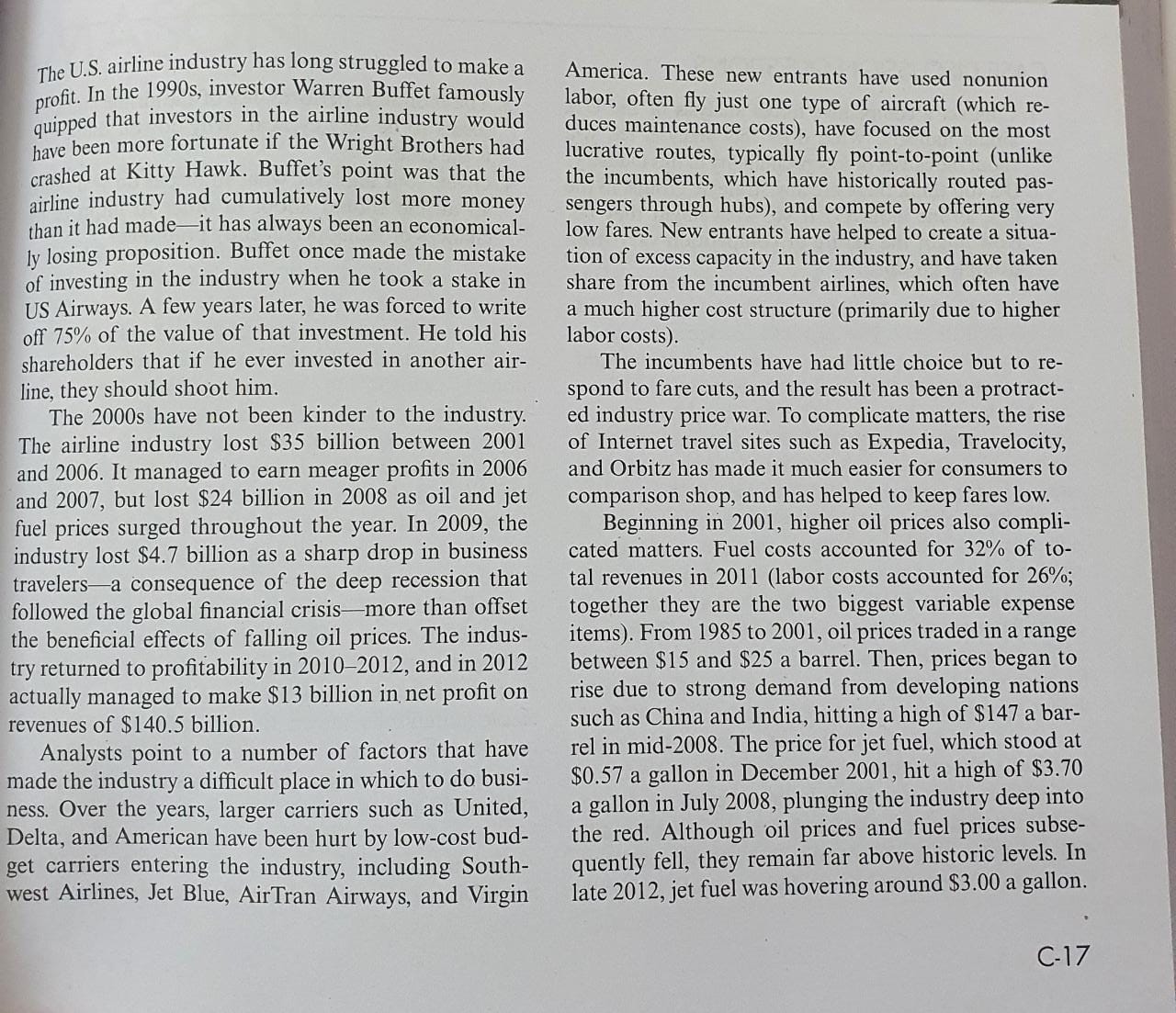
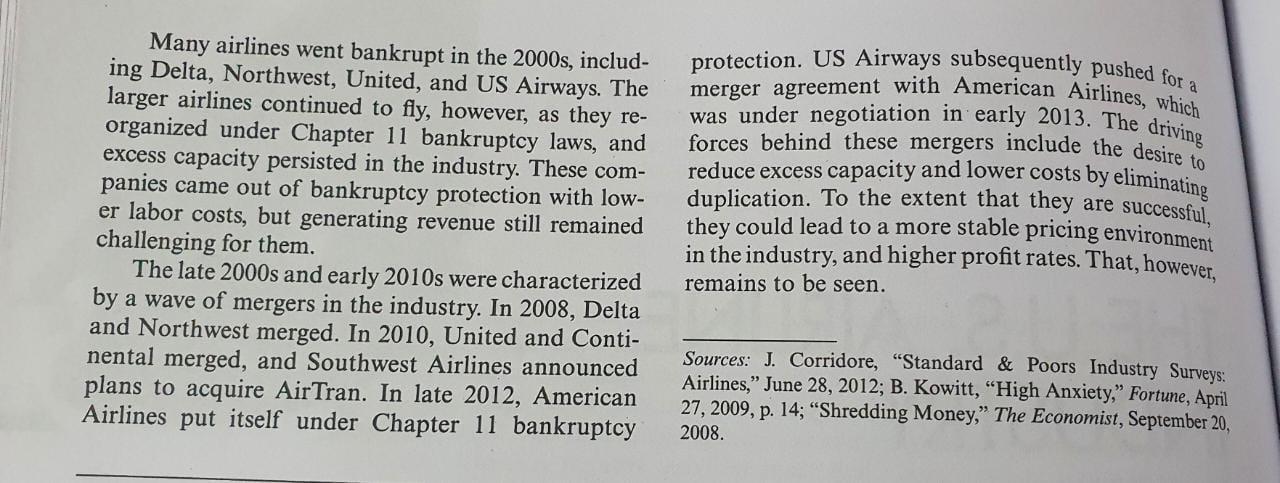
The U.S. airline industry has long struggled to make a profit. In the 1990s, investor Warren Buffet famously quipped that investors in the airline industry would have been more fortunate if the Wright Brothers had crashed at Kitty Hawk. Buffet's point was that the airline industry had cumulatively lost more money than it had madeit has always been an economical- ly losing proposition. Buffet once made the mistake of investing in the industry when he took a stake in US Airways. A few years later, he was forced to write off 75% of the value of that investment. He told his shareholders that if he ever invested in another air- line, they should shoot him. The 2000s have not been kinder to the industry. The airline industry lost $35 billion between 2001 and 2006. It managed to earn meager profits in 2006 and 2007, but lost $24 billion in 2008 as oil and jet fuel prices surged throughout the year. In 2009, the industry lost $4.7 billion as a sharp drop in business travelersa consequence of the deep recession that followed the global financial crisismore than offset the beneficial effects of falling oil prices. The indus- try returned to profitability in 2010-2012, and in 2012 actually managed to make $13 billion in net profit on revenues of $140.5 billion. Analysts point to a number of factors that have made the industry a difficult place in which to do busi- ness. Over the years, larger carriers such as United, Delta, and American have been hurt by low-cost bud- get carriers entering the industry, including South- west Airlines, Jet Blue, AirTran Airways, and Virgin America. These new entrants have used nonunion labor, often fly just one type of aircraft (which re- duces maintenance costs), have focused on the most lucrative routes, typically fly point-to-point (unlike the incumbents, which have historically routed pas- sengers through hubs), and compete by offering very low fares. New entrants have helped to create a situa- tion of excess capacity in the industry, and have taken share from the incumbent airlines, which often have a much higher cost structure (primarily due to higher labor costs) The incumbents have had little choice but to re- spond to fare cuts, and the result has been a protract- ed industry price war. To complicate matters, the rise of Internet travel sites such as Expedia, Travelocity, and Orbitz has made it much easier for consumers to comparison shop, and has helped to keep fares low. Beginning in 2001, higher oil prices also compli- cated matters. Fuel costs accounted for 32% of to- tal revenues in 2011 (labor costs accounted for 26%; together they are the two biggest variable expense items). From 1985 to 2001, oil prices traded in a range between $15 and $25 a barrel. Then, prices began to rise due to strong demand from developing nations such as China and India, hitting a high of $147 a bar- rel in mid-2008. The price for jet fuel, which stood at $0.57 a gallon in December 2001, hit a high of $3.70 a gallon in July 2008, plunging the industry deep into the red. Although oil prices and fuel prices subse- quently fell, they remain far above historic levels. In late 2012, jet fuel was hovering around $3.00 a gallon. C-17 Many airlines went bankrupt in the 2000s, includ- ing Delta, Northwest, United, and US Airways. The larger airlines continued to fly, however, as they re- organized under Chapter 11 bankruptcy laws, and excess capacity persisted in the industry. These com- panies came out of bankruptcy protection with low- er labor costs, but generating revenue still remained challenging for them. The late 2000s and early 2010s were characterized by a wave of mergers in the industry. In 2008, Delta and Northwest merged. In 2010, United and Conti- nental merged, and Southwest Airlines announced plans to acquire Air Tran. In late 2012, American Airlines put itself under Chapter 11 bankruptcy protection. US Airways subsequently pushed for a merger agreement with American Airlines, which was under negotiation in early 2013. The driving forces behind these mergers include the desire to reduce excess capacity and lower costs by eliminating duplication. To the extent that they are successful they could lead to a more stable pricing environment in the industry, and higher profit rates. That, however , remains to be seen. Sources: J. Corridore, Standard & Poors Industry Surveys: Airlines," June 28, 2012; B. Kowitt, High Anxiety," Fortune, April 27, 2009, p. 14; "Shredding Money," The Economist, September 20, 2008. The U.S. airline industry has long struggled to make a profit. In the 1990s, investor Warren Buffet famously quipped that investors in the airline industry would have been more fortunate if the Wright Brothers had crashed at Kitty Hawk. Buffet's point was that the airline industry had cumulatively lost more money than it had madeit has always been an economical- ly losing proposition. Buffet once made the mistake of investing in the industry when he took a stake in US Airways. A few years later, he was forced to write off 75% of the value of that investment. He told his shareholders that if he ever invested in another air- line, they should shoot him. The 2000s have not been kinder to the industry. The airline industry lost $35 billion between 2001 and 2006. It managed to earn meager profits in 2006 and 2007, but lost $24 billion in 2008 as oil and jet fuel prices surged throughout the year. In 2009, the industry lost $4.7 billion as a sharp drop in business travelersa consequence of the deep recession that followed the global financial crisismore than offset the beneficial effects of falling oil prices. The indus- try returned to profitability in 2010-2012, and in 2012 actually managed to make $13 billion in net profit on revenues of $140.5 billion. Analysts point to a number of factors that have made the industry a difficult place in which to do busi- ness. Over the years, larger carriers such as United, Delta, and American have been hurt by low-cost bud- get carriers entering the industry, including South- west Airlines, Jet Blue, AirTran Airways, and Virgin America. These new entrants have used nonunion labor, often fly just one type of aircraft (which re- duces maintenance costs), have focused on the most lucrative routes, typically fly point-to-point (unlike the incumbents, which have historically routed pas- sengers through hubs), and compete by offering very low fares. New entrants have helped to create a situa- tion of excess capacity in the industry, and have taken share from the incumbent airlines, which often have a much higher cost structure (primarily due to higher labor costs) The incumbents have had little choice but to re- spond to fare cuts, and the result has been a protract- ed industry price war. To complicate matters, the rise of Internet travel sites such as Expedia, Travelocity, and Orbitz has made it much easier for consumers to comparison shop, and has helped to keep fares low. Beginning in 2001, higher oil prices also compli- cated matters. Fuel costs accounted for 32% of to- tal revenues in 2011 (labor costs accounted for 26%; together they are the two biggest variable expense items). From 1985 to 2001, oil prices traded in a range between $15 and $25 a barrel. Then, prices began to rise due to strong demand from developing nations such as China and India, hitting a high of $147 a bar- rel in mid-2008. The price for jet fuel, which stood at $0.57 a gallon in December 2001, hit a high of $3.70 a gallon in July 2008, plunging the industry deep into the red. Although oil prices and fuel prices subse- quently fell, they remain far above historic levels. In late 2012, jet fuel was hovering around $3.00 a gallon. C-17 Many airlines went bankrupt in the 2000s, includ- ing Delta, Northwest, United, and US Airways. The larger airlines continued to fly, however, as they re- organized under Chapter 11 bankruptcy laws, and excess capacity persisted in the industry. These com- panies came out of bankruptcy protection with low- er labor costs, but generating revenue still remained challenging for them. The late 2000s and early 2010s were characterized by a wave of mergers in the industry. In 2008, Delta and Northwest merged. In 2010, United and Conti- nental merged, and Southwest Airlines announced plans to acquire Air Tran. In late 2012, American Airlines put itself under Chapter 11 bankruptcy protection. US Airways subsequently pushed for a merger agreement with American Airlines, which was under negotiation in early 2013. The driving forces behind these mergers include the desire to reduce excess capacity and lower costs by eliminating duplication. To the extent that they are successful they could lead to a more stable pricing environment in the industry, and higher profit rates. That, however , remains to be seen. Sources: J. Corridore, Standard & Poors Industry Surveys: Airlines," June 28, 2012; B. Kowitt, High Anxiety," Fortune, April 27, 2009, p. 14; "Shredding Money," The Economist, September 20, 2008Step by Step Solution
There are 3 Steps involved in it
1 Expert Approved Answer
Step: 1 Unlock

Question Has Been Solved by an Expert!
Get step-by-step solutions from verified subject matter experts
Step: 2 Unlock
Step: 3 Unlock
 Study Help