







Question: Q1) By convention, variable names in Java use camel case. Describe what this is 02) What is the difference between the style for a class
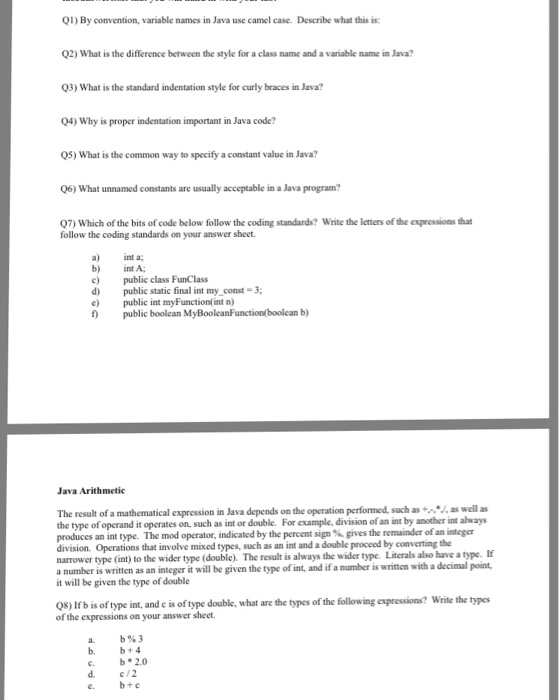
Q1) By convention, variable names in Java use camel case. Describe what this is 02) What is the difference between the style for a class name and a variable name in Java? Q3) What is the standard indentation style for curly braces in Java? 04) Why is proper indentation important in Java code? Q5) What is the common way to specify a constant value in Java? 06) What unnamed constants are usually acceptable in a Java program? Q7) Which of the bits of code below follow the coding standards? Write the letters of the expressions that follow the coding standards on your answer sheet a) int a; b) in A c) public class FunClass d) public static final int my const-3 e) public int myFunction int n) public boolean MyBooleanFunction boolean b) Java Arithmetic The result of a mathematical expression in Java depends on the operation performed, such asJ, as well as the type of operand it operates on, such as int or produces an int type. Them d operator, indicated by the percent sign% gives there under ofan integer division. Operations that involve mixed types, such as an int and a double proceed by converting the narrower type (int) to the wider type (double). The result is always the wider type. Literals also have a type. If a number is written as an integer it will be given the type of int, and if a number is written with a decimal point it will be given the type of double double. For example, division of an int by another int always 08) If b is of type int, and e is of type double, what are the types of the following espressions? Write the types of the expressions on your answer sheet. b%3 b. b+4 C.b2.0 e. b+e
Step by Step Solution
There are 3 Steps involved in it

Get step-by-step solutions from verified subject matter experts
 Study Help