



Question: Q1) chose the best answer. (Marks 5) 1. Which is a permanent account? a Revenue c. Accounts Receivable b. Advertising Expense d. Insurance Expenses. 2.
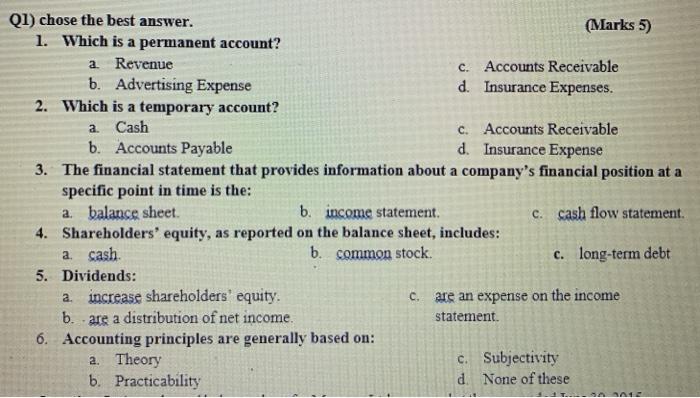
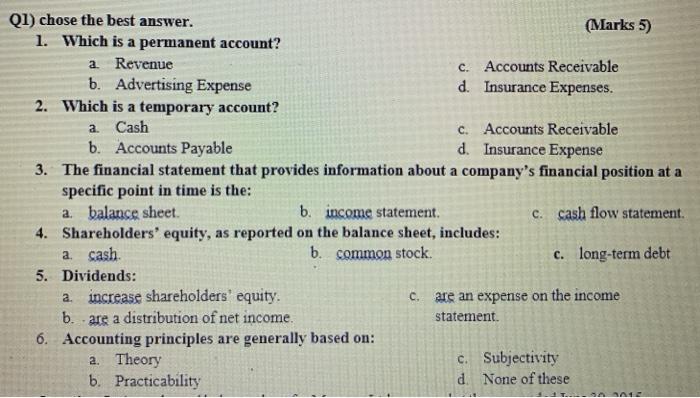
Q1) chose the best answer. (Marks 5) 1. Which is a permanent account? a Revenue c. Accounts Receivable b. Advertising Expense d. Insurance Expenses. 2. Which is a temporary account? a Cash c. Accounts Receivable b. Accounts Payable d. Insurance Expense 3. The financial statement that provides information about a company's financial position at a specific point in time is the: a. balance sheet b. income statement. c. cash flow statement 4. Shareholders' equity, as reported on the balance sheet, includes: a sash b. common stock c. long-term debt 5. Dividends: 2. increase shareholders' equity. are an expense on the income b. are a distribution of net income. 6. Accounting principles are generally based on: a. Theory c. Subjectivity b. Practicability d. None of these c. statement. BATE Q1) chose the best answer. (Marks 5) 1. Which is a permanent account? a Revenue c. Accounts Receivable b. Advertising Expense d. Insurance Expenses. 2. Which is a temporary account? a Cash c. Accounts Receivable b. Accounts Payable d. Insurance Expense 3. The financial statement that provides information about a company's financial position at a specific point in time is the: a. balance sheet b. income statement. c. cash flow statement 4. Shareholders' equity, as reported on the balance sheet, includes: a sash b. common stock c. long-term debt 5. Dividends: 2. increase shareholders' equity. are an expense on the income b. are a distribution of net income. 6. Accounting principles are generally based on: a. Theory c. Subjectivity b. Practicability d. None of these c. statement. BATE
Step by Step Solution
There are 3 Steps involved in it

Get step-by-step solutions from verified subject matter experts