







Question: q1. Inventory data for the new use case should be the following. a. Inventory data = Item Code + Item Name + Unit Price +
q1. Inventory data for the new use case should be the following.
a. Inventory data = Item Code + Item Name + Unit Price + Current Inventory + Reorder Level + Reorder Quantity b. Inventory data = Item Code + Item Name + Unit Price + {Purchase Lot # + Lot Unit Cost + Lot Current Inventory} + Current Inventory + Reorder Level + Reorder Quantity c. Inventory data = Item Code + Item Name + Unit Price + Purchase Lot # + Lot Unit Cost + Lot Current Inventory + Current Inventory + Reorder Level + Reorder Quantity d. Inventory data = Item Code + Item Name + {Unit Price + Purchase Lot # + Lot Unit Cost + Lot Current Inventory + Current Inventory} + Reorder Level + Reorder Quantity e. Inventory data = Item Code + Item Name + Purchase Lot # + Lot Unit Cost + Lot Current Inventory + Reorder Level + Reorder Quantity
q2. The computation of Item Inventory Value should be the following in the new use case.
a. Set Item Inventory Value = Unit Price*Current Inventory b. Set Item Inventory Value = Lot Unit Cost * Lot Current Inventory For Every Purchase Lot #, Set Item Inventory Value = 0 c. Set Item Inventory Value = Item Inventory Value + Lot Unit Cost * Lot Current Inventory End For For Every Purchase Lot #, Set Item Inventory Value = Item d. Inventory Value + Lot Unit Cost * Lot Current Inventory End For e. None of the above
q3. The trigger for the new use case should be the following.
a. End of each month b. When a new purchase is made c. When the current price of any item changes d. On demand e. None of the above
q4. In the new process, each Item Code should have one Unit Price but can have multiple Lot Unit Cost.
True or False?
q5. When only the above use case and the data dictionary are changed to meet the new requirement, the change would affect the rest of the model for the new system in the following way(s):
a. No impact on the rest of the model b. Only the context diagram would change c. Only the class diagram would change d. Both context diagram and class diagram would change e. The use case diagram would change
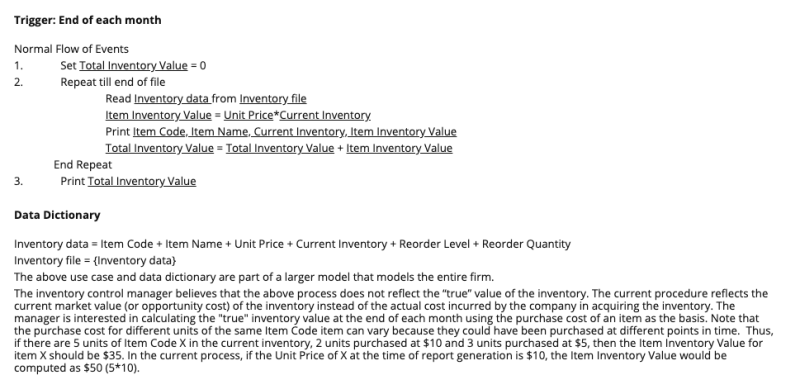
Trigger: End of each month Normal Flow of Events 1. Set Total Inventory Value = 0 2. Repeat till end of file Read Inventory data from Inventory file Item Inventory Value - Unit Price*Current Inventory Print Item Code. Item Name. Current Inventory. Item Inventory Value Total Inventory Value = Total Inventory Value + Item Inventory Value End Repeat 3. Print Total Inventory Value Data Dictionary Inventory data = Item Code + Item Name + Unit Price + Current Inventory + Reorder Level + Reorder Quantity Inventory file = {Inventory data} The above use case and data dictionary are part of a larger model that models the entire firm. The inventory control manager believes that the above process does not reflect the "true" value of the inventory. The current procedure reflects the current market value (or opportunity cost) of the inventory instead of the actual cost incurred by the company in acquiring the inventory. The manager is interested in calculating the "true" inventory value at the end of each month using the purchase cost of an item as the basis. Note that the purchase cost for different units of the same Item Code item can vary because they could have been purchased at different points in time. Thus, if there are 5 units of Item Code X in the current inventory, 2 units purchased at $10 and 3 units purchased at $5, then the item Inventory Value for item X should be $35. In the current process, if the Unit Price of X at the time of report generation is $10, the Item Inventory Value would be computed as $50 (5*10). Trigger: End of each month Normal Flow of Events 1. Set Total Inventory Value = 0 2. Repeat till end of file Read Inventory data from Inventory file Item Inventory Value - Unit Price*Current Inventory Print Item Code. Item Name. Current Inventory. Item Inventory Value Total Inventory Value = Total Inventory Value + Item Inventory Value End Repeat 3. Print Total Inventory Value Data Dictionary Inventory data = Item Code + Item Name + Unit Price + Current Inventory + Reorder Level + Reorder Quantity Inventory file = {Inventory data} The above use case and data dictionary are part of a larger model that models the entire firm. The inventory control manager believes that the above process does not reflect the "true" value of the inventory. The current procedure reflects the current market value (or opportunity cost) of the inventory instead of the actual cost incurred by the company in acquiring the inventory. The manager is interested in calculating the "true" inventory value at the end of each month using the purchase cost of an item as the basis. Note that the purchase cost for different units of the same Item Code item can vary because they could have been purchased at different points in time. Thus, if there are 5 units of Item Code X in the current inventory, 2 units purchased at $10 and 3 units purchased at $5, then the item Inventory Value for item X should be $35. In the current process, if the Unit Price of X at the time of report generation is $10, the Item Inventory Value would be computed as $50 (5*10)
Step by Step Solution
There are 3 Steps involved in it

Get step-by-step solutions from verified subject matter experts
 Study Help