



Question: Q1: Number Systems Representation/ Error Transmission a) Convert the Octal number 4378 to Decimal, and hex. b) Add in two's complement form the numbers -710
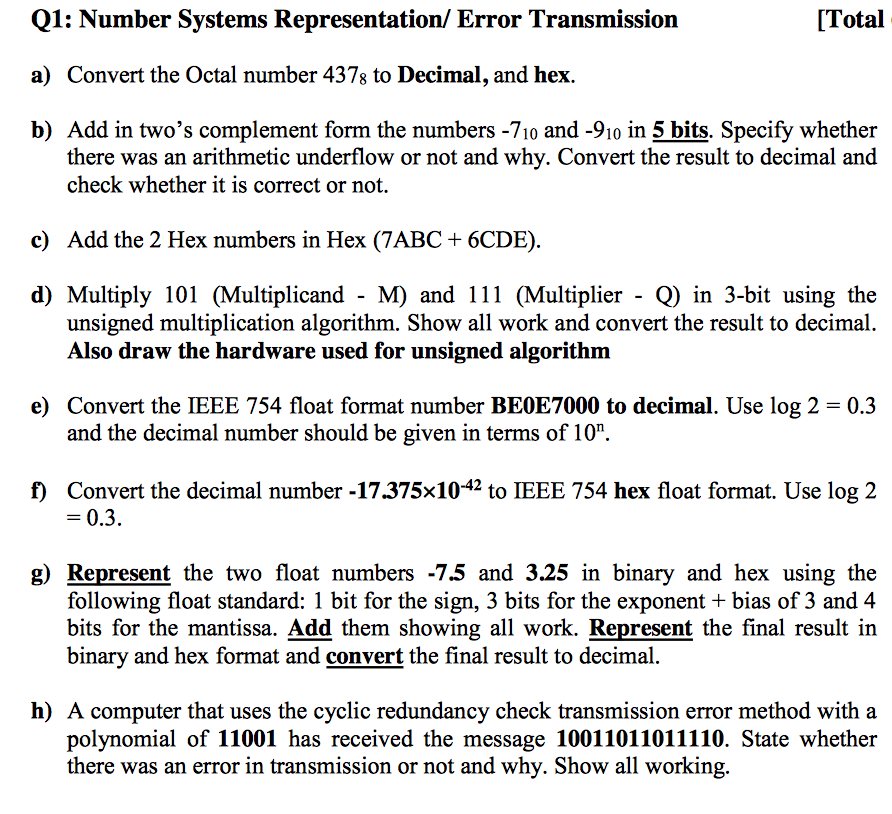
Q1: Number Systems Representation/ Error Transmission a) Convert the Octal number 4378 to Decimal, and hex. b) Add in two's complement form the numbers -710 and -910 in 5 bits, Specify whether [Total there was an arithmetic underflow or not and why. Convert the result to decimal and check whether it is correct or not. c) Add the 2 Hex numbers in Hex (7ABC 6CDE). d) Multiply 101 (Multiplicand - M) and 111 (Multiplier - Q in 3-bit using the unsigned multiplication algorithm. Show all work and convert the result to decimal. Also draw the hardware used for unsigned algorithnm e) Convert the IEEE 754 float format number BE0E7000 to decimal. Use log 2 0.3 and the decimal number should be given in terms of 10" f) Convert the decimal number -17.375x1042 to IEEE 754 hex float format. Use log 2 0.3. g) Represent the two float numbers -7.5 and 3.25 in binary and hex using the following float standard: 1 bit for the sign, 3 bits for the exponent +bias of 3 and 4 bits for the mantissa. Add them showing all work. Represent the final result in binary and hex format and convert the final result to decimal. h) A computer that uses the cyclic redundancy check transmission error method with a polynomial of 11001 has received the message 10011011011110. State whether there was an error in transmission or not and why. Show all working
Step by Step Solution
There are 3 Steps involved in it

Get step-by-step solutions from verified subject matter experts