







Question: Q1: Q2: Q3: TRUE OR FALSE A 1.00 liter solution contains 0.47M acetic acid and 0.35M potassium acetate. If 30mL of water are added to
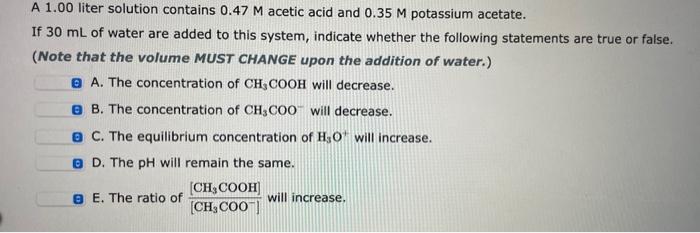
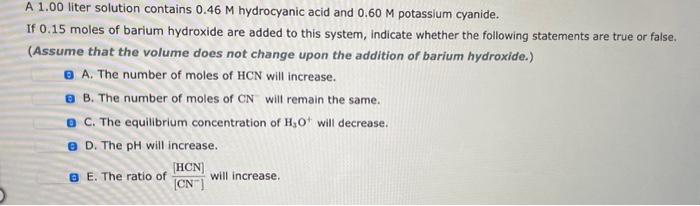
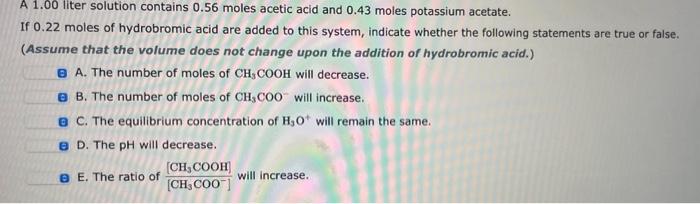
A 1.00 liter solution contains 0.47M acetic acid and 0.35M potassium acetate. If 30mL of water are added to this system, indicate whether the following statements are true or false. (Note that the volume MUST CHANGE upon the addition of water.) A. The concentration of CH3COOH will decrease. B. The concentration of CH3COOwill decrease. C. The equilibrium concentration of H3O+will increase. D. The pH will remain the same. E. The ratio of [CH3COO][CH3COOH]will increase. A 1.00 liter solution contains 0.46M hydrocyanic acid and 0.60M potassium cyanide. If 0.15 moles of barium hydroxide are added to this system, indicate whether the following statements are true or false. (Assume that the volume does not change upon the addition of barium hydroxide.) A. The number of moles of HCN will increase. B. The number of moles of CNwill remain the same. C. The equilibrium concentration of H3O+will decrease. D. The pH will increase. E. The ratio of [CN][HCN]will increase. A 1.00 liter solution contains 0.56 moles acetic acid and 0.43 moles potassium acetate. If 0.22 moles of hydrobromic acid are added to this system, indicate whether the following statements are true or false. (Assume that the volume does not change upon the addition of hydrobromic acid.) A. The number of moles of CH3COOH will decrease. B. The number of moles of CH3COOwill increase. C. The equilibrium concentration of H3O+will remain the same. D. The pH will decrease. E. The ratio of [CH3COO][CH3COOH]will increase
Step by Step Solution
There are 3 Steps involved in it

Get step-by-step solutions from verified subject matter experts
 Study Help