



Question: Q1. (True/False) For an NFA, there is always an equivalent NFA that has only one final state Q2. (True/False) A set of regular languages is
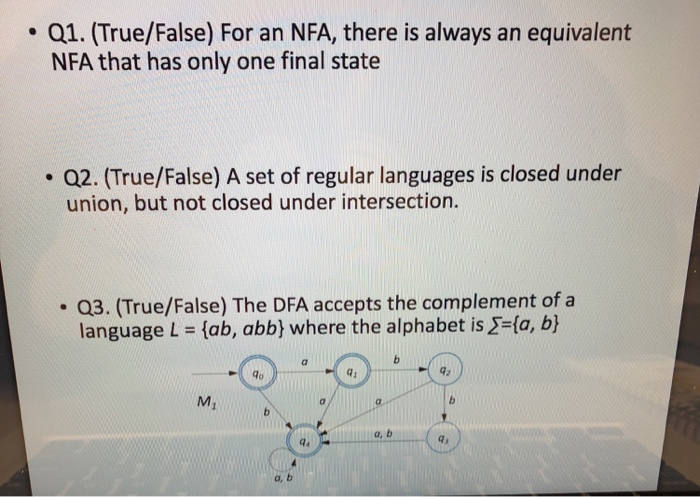
Q1. (True/False) For an NFA, there is always an equivalent NFA that has only one final state Q2. (True/False) A set of regular languages is closed under union, but not closed under intersection. . Q3. (True/False) The DFA accepts the complement of a language L - (ab, abb where the alphabet is 2 la, b a1 Mi a, b
Step by Step Solution
There are 3 Steps involved in it
1 Expert Approved Answer
Step: 1 Unlock

Question Has Been Solved by an Expert!
Get step-by-step solutions from verified subject matter experts
Step: 2 Unlock
Step: 3 Unlock