







Question: Q.1 What is sun cafe's value proposition? does the cafe a sustainable competitive advantage within the restaurant industries? Q.2 analyze the restaurant industry in Nepal.
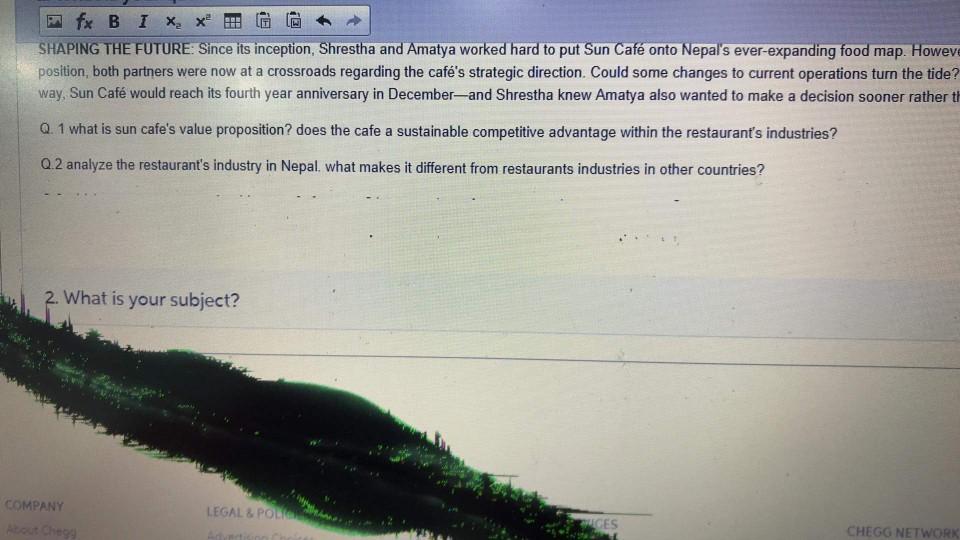
Q.1 What is sun cafe's value proposition? does the cafe a sustainable competitive advantage within the restaurant industries?
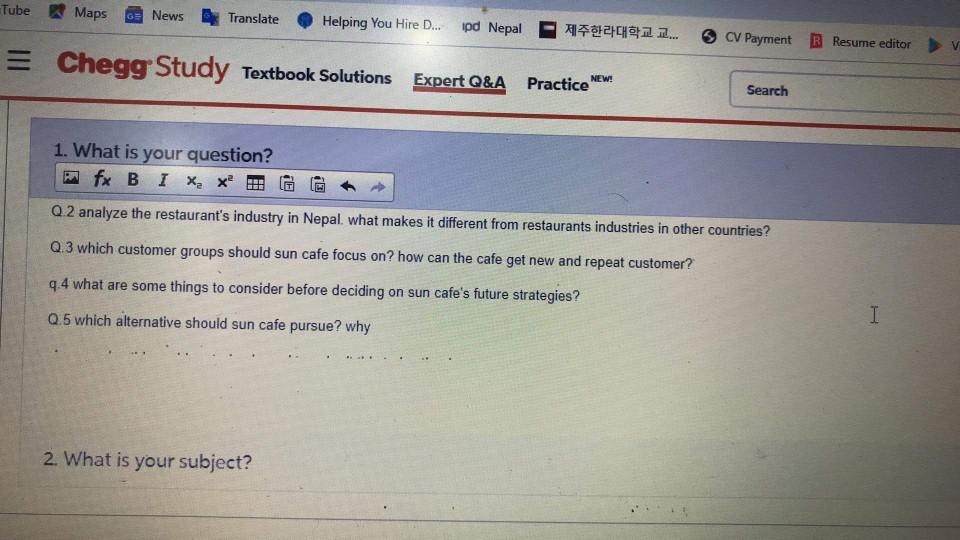
Q.2 analyze the restaurant industry in Nepal. what makes it's different from restaurants industries in other countries?
Q.3 which customer groups should sun cafe focus on? how can the cafe get new and repeat customer?
Q.4 What are some things to consider before deciding on sun cafe's future strategies?
Q.5 WHICH ALTERNATIVE SHOULD SUN CAFE PURSUES? WHY.
pleased answer this as soon as possible I need to submit this today I'm very thankful
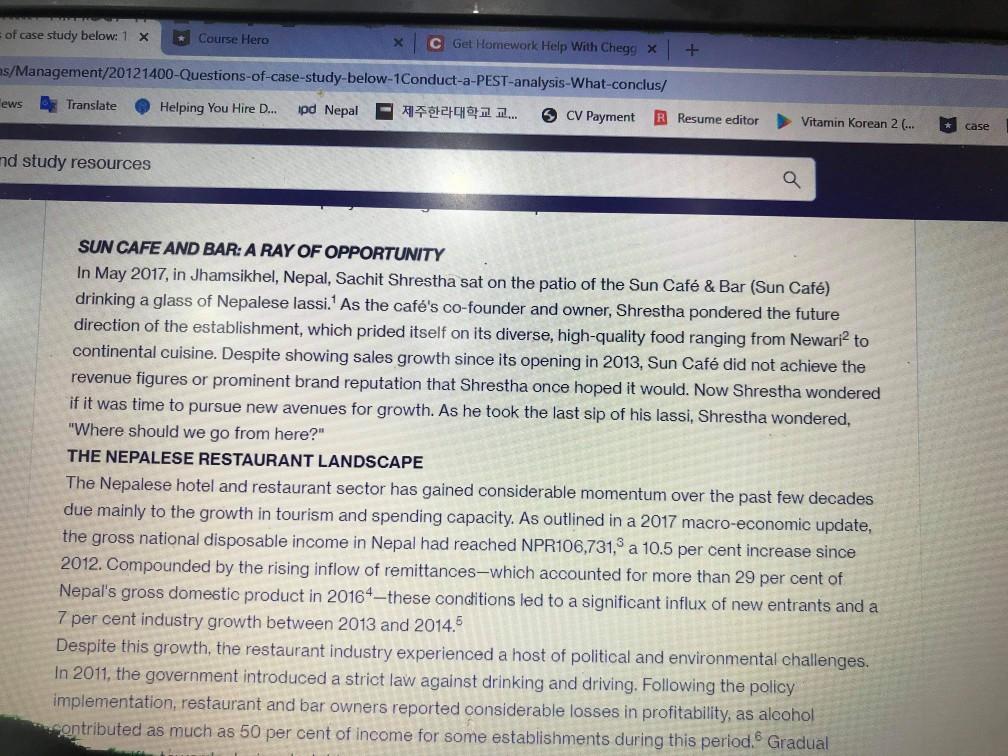
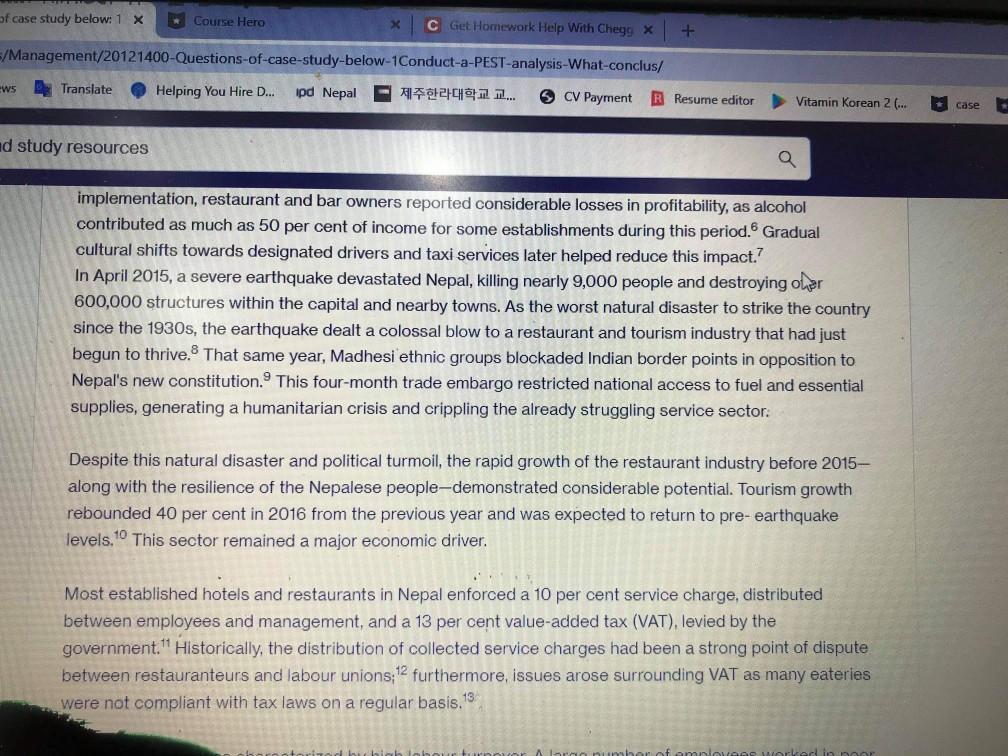
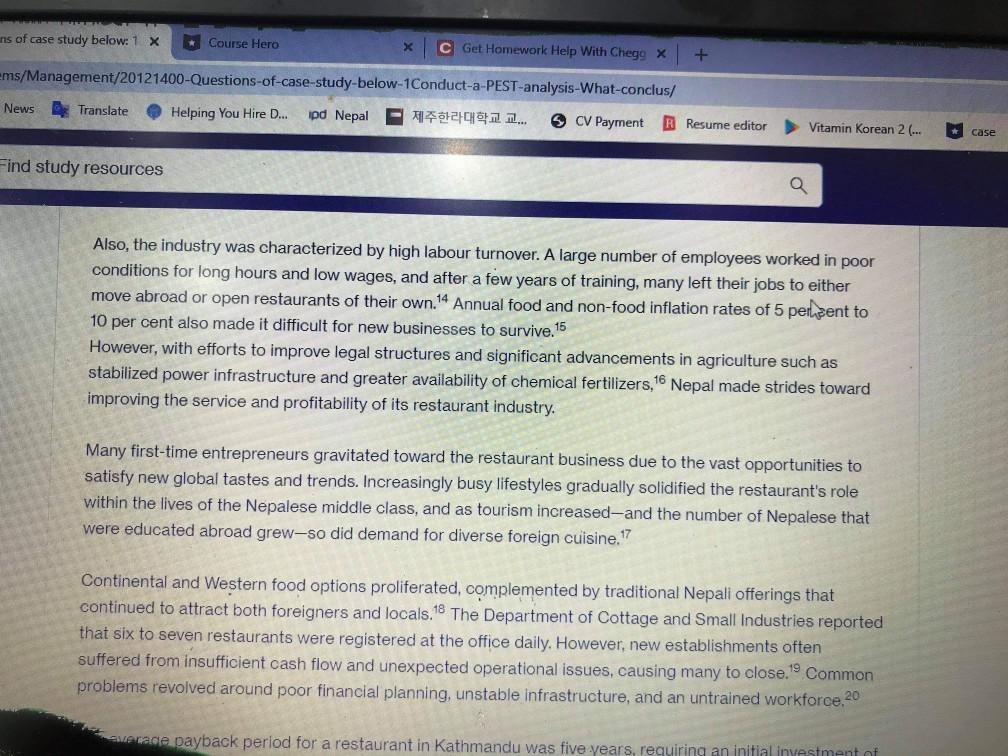
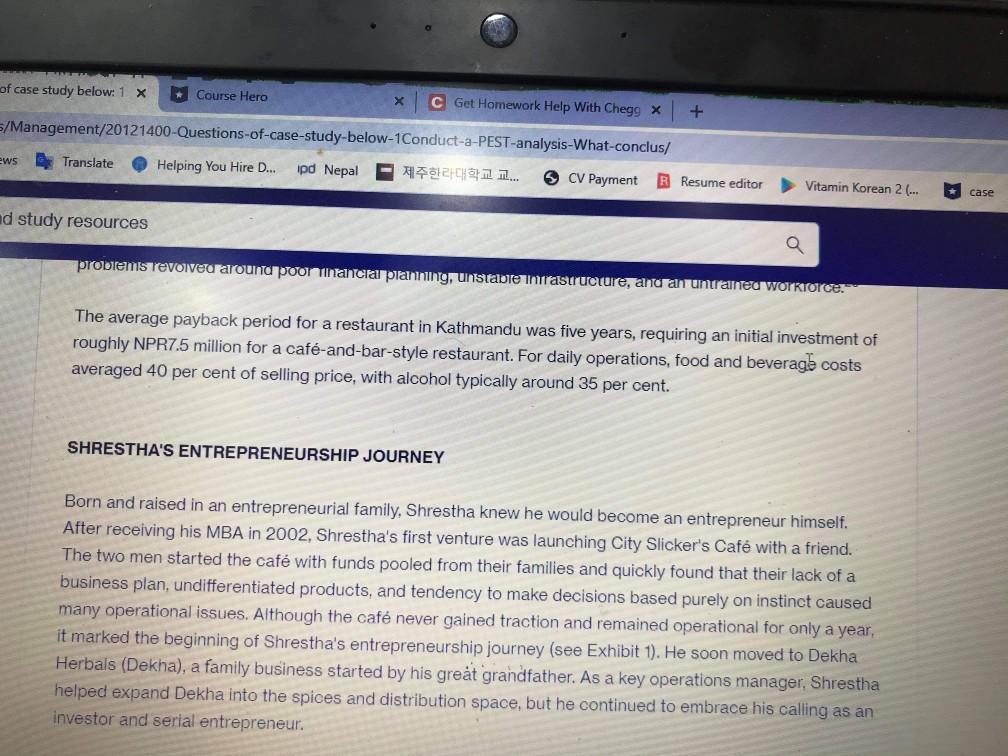
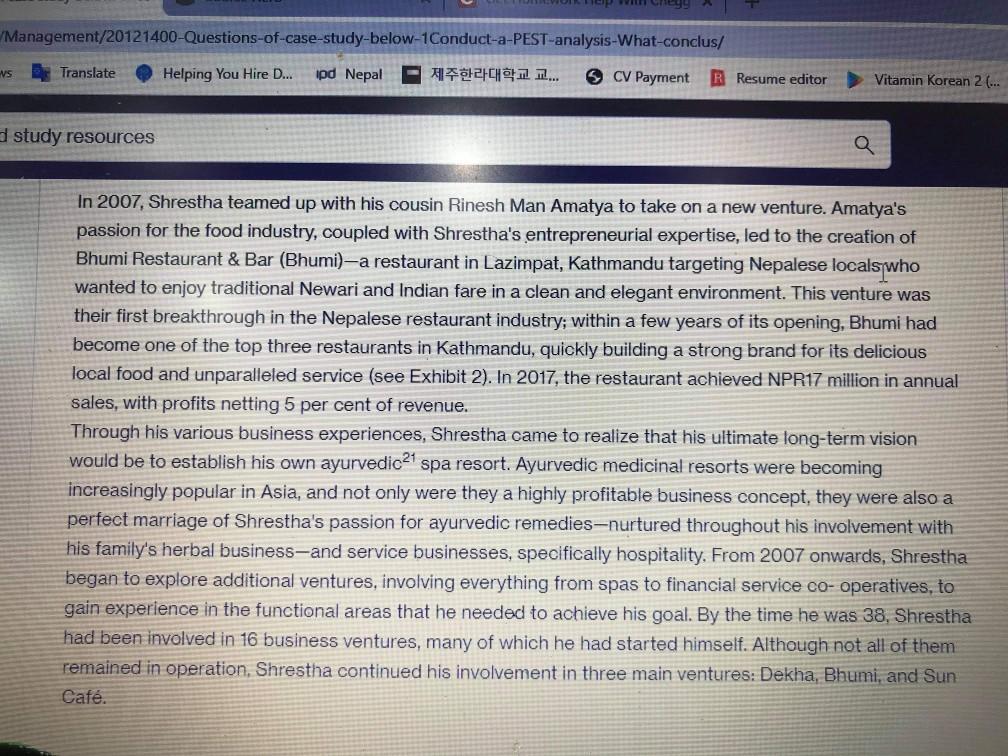
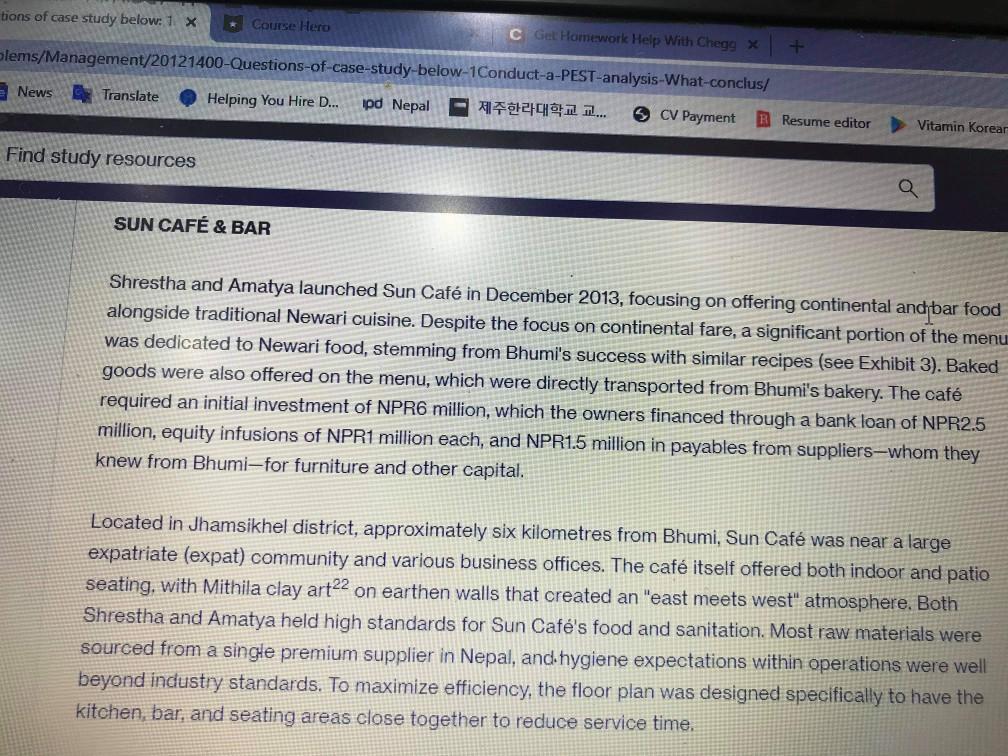
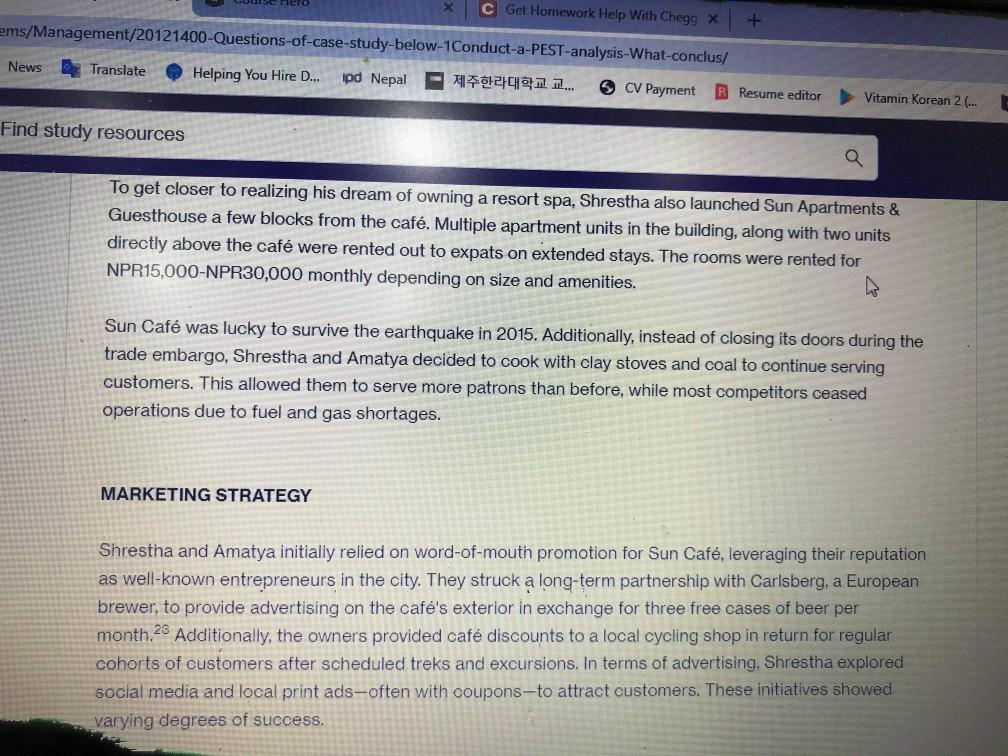
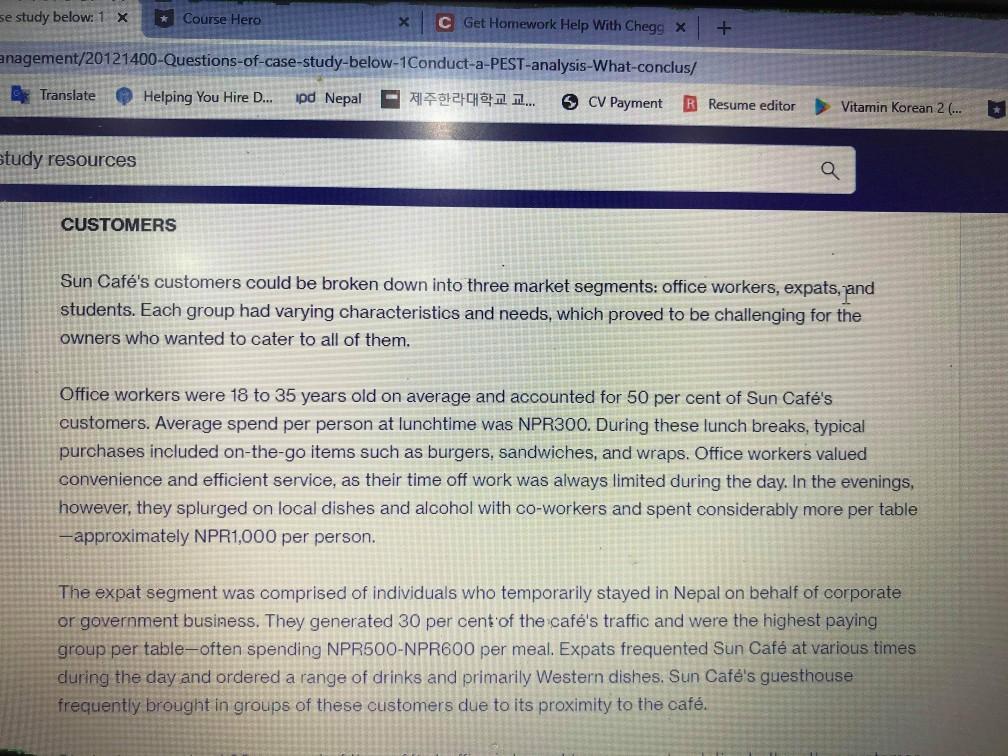
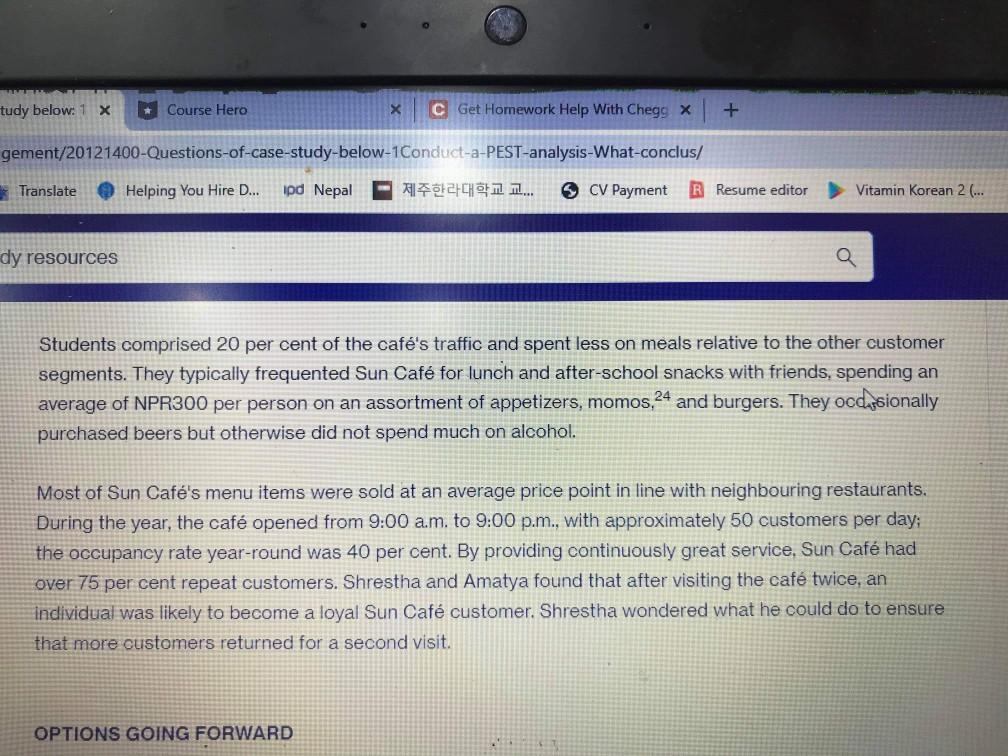
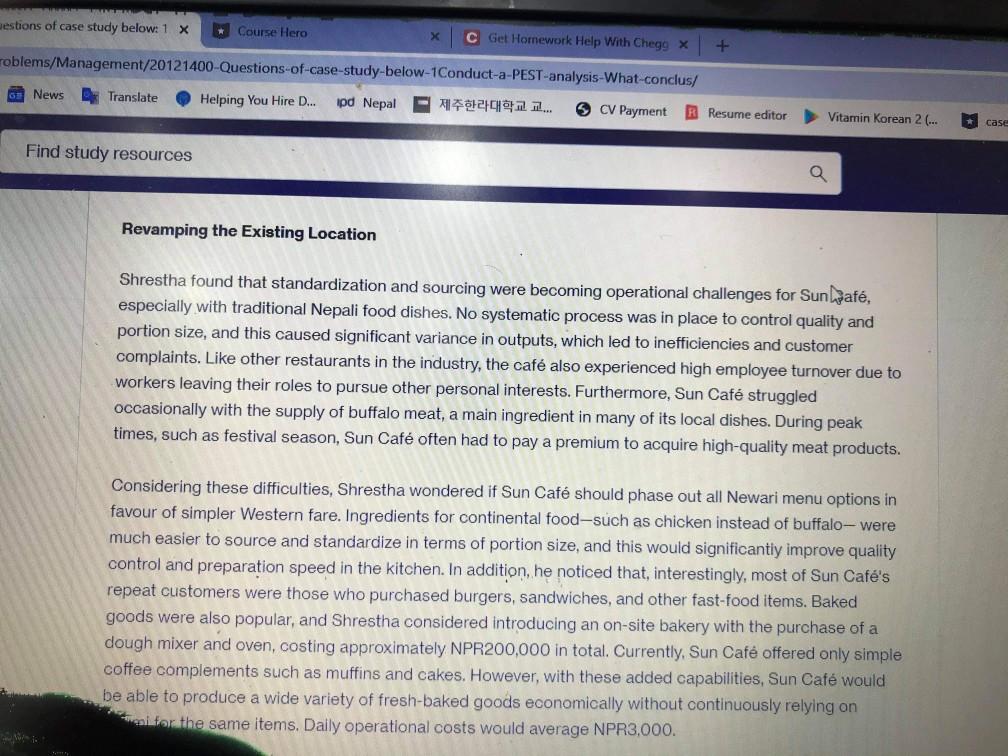
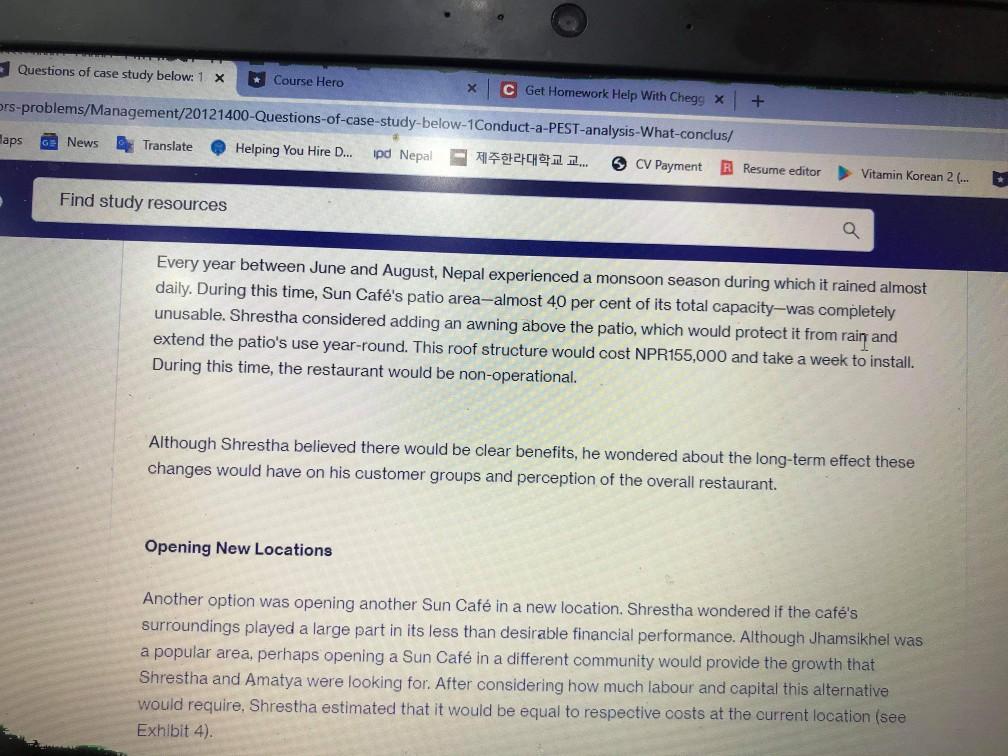
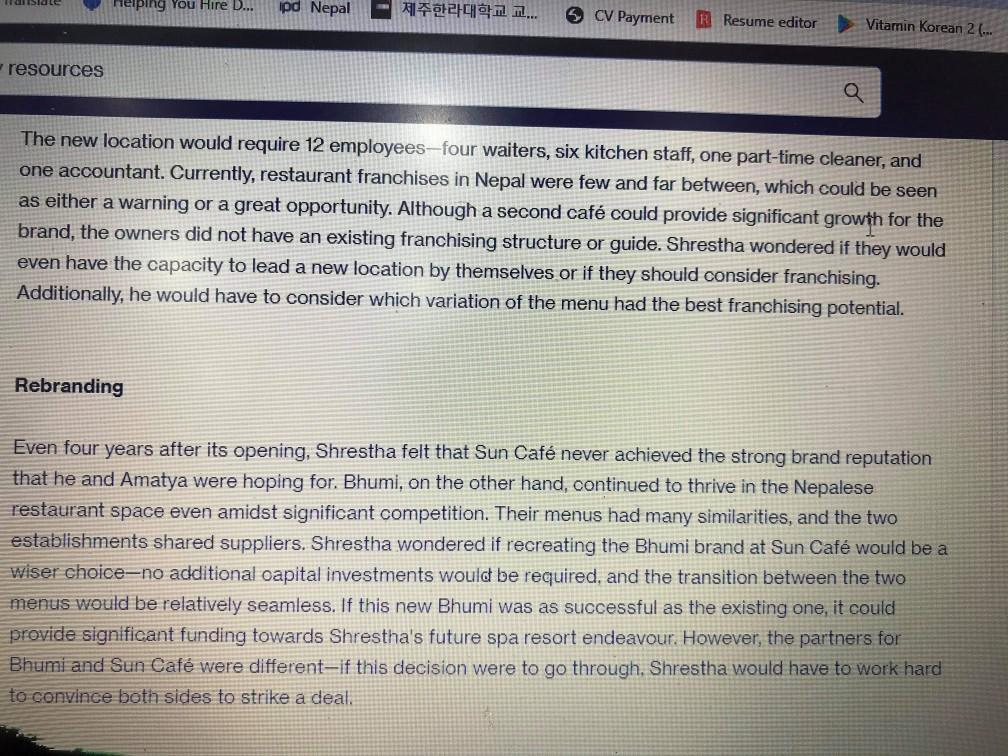
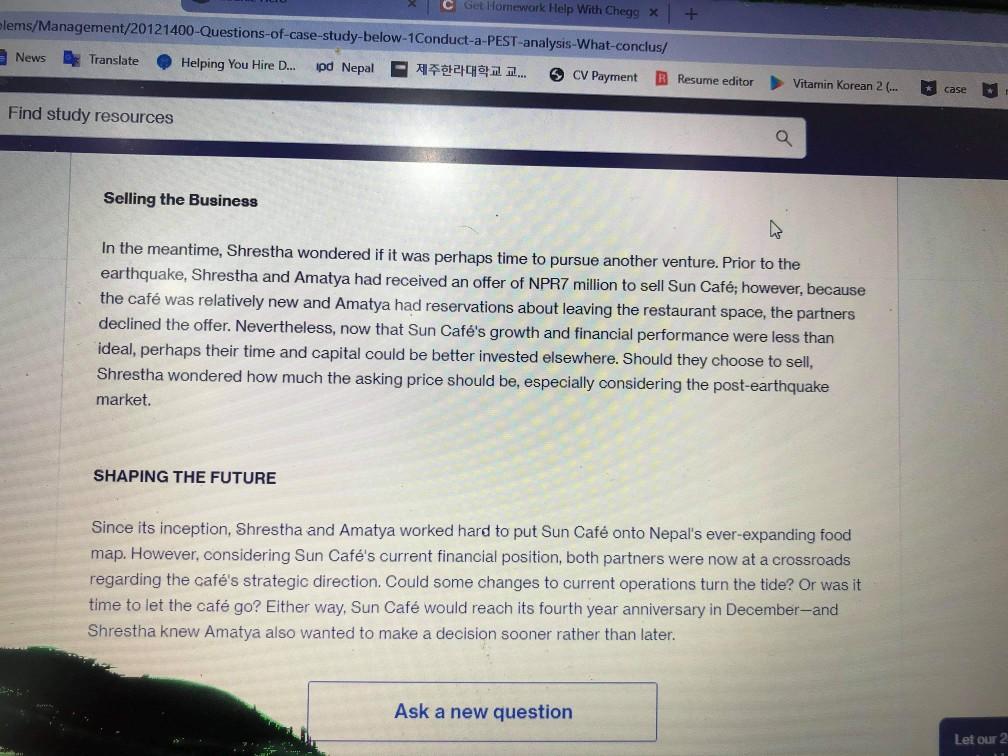
+ of case study below: 1 x * Course Hero C Get Homework Help With Chegg. * es/Management/20121400-Questions-of-case-study-below-1 Conduct-a-PEST-analysis-What-conclus/ ews Translate Helping You Hire D... pd Nepal .. CV Payment Resume editor Vitamin Korean 2... case md study resources Q SUN CAFE AND BAR: A RAY OF OPPORTUNITY In May 2017, in Jhamsikhel, Nepal, Sachit Shrestha sat on the patio of the Sun Caf & Bar (Sun Caf) drinking a glass of Nepalese lassi. As the caf's co-founder and owner, Shrestha pondered the future direction of the establishment, which prided itself on its diverse, high-quality food ranging from Newari2 to continental cuisine. Despite showing sales growth since its opening in 2013, Sun Caf did not achieve the revenue figures or prominent brand reputation that Shrestha once hoped it would. Now Shrestha wondered if it was time to pursue new avenues for growth. As he took the last sip of his lassi, Shrestha wondered, "Where should we go from here?" THE NEPALESE RESTAURANT LANDSCAPE The Nepalese hotel and restaurant sector has gained considerable momentum over the past few decades due mainly to the growth in tourism and spending capacity. As outlined in a 2017 macro-economic update, the gross national disposable income in Nepal had reached NPR106,731,9 a 10.5 per cent increase since 2012. Compounded by the rising inflow of remittances-which accounted for more than 29 per cent of Nepal's gross domestic product in 20164-these conditions led to a significant influx of new entrants and a 7 per cent industry growth between 2013 and 2014.5 Despite this growth, the restaurant industry experienced a host of political and environmental challenges. In 2011, the government introduced a strict law against drinking and driving. Following the policy implementation, restaurant and bar owners reported considerable losses in profitability, as alcohol contributed as much as 50 per cent of income for some establishments during this period. Gradual of case study below: 1 x * Course Hero C Get Homework Help With Chegg X + /Management/20121400-Questions-of-case-study-below-1 Conduct-a-PEST-analysis-What-conclus/ ws Translate Helping You Hire D... ipd Nepal ... CV Payment R Resume editor Vitamin Korean 2 (... Case ad study resources implementation, restaurant and bar owners reported considerable losses in profitability, as alcohol contributed as much as 50 per cent of income for some establishments during this period. Gradual cultural shifts towards designated drivers and taxi services later helped reduce this impact.? In April 2015, a severe earthquake devastated Nepal, killing nearly 9,000 people and destroying oher 600,000 structures within the capital and nearby towns. As the worst natural disaster to strike the country since the 1930s, the earthquake dealt a colossal blow to a restaurant and tourism industry that had just begun to thrive. That same year, Madhesi ethnic groups blockaded Indian border points in opposition to Nepal's new constitution. This four-month trade embargo restricted national access to fuel and essential supplies, generating a humanitarian crisis and crippling the already struggling service sector. Despite this natural disaster and political turmoil, the rapid growth of the restaura industry before 201 along with the resilience of the Nepalese people-demonstrated considerable potential. Tourism growth rebounded 40 per cent in 2016 from the previous year and was expected to return to pre-earthquake levels. 10 This sector remained a major economic driver. Most established hotels and restaurants in Nepal enforced a 10 per cent service charge, distributed between employees and management, and a 13 per cent value-added tax (VAT), levied by the government. Historically, the distribution of collected service charges had been a strong point of dispute between restauranteurs and labour unions: 12 furthermore, issues arose surrounding VAT as many eateries were not compliant with tax laws on a regular basis.18 ons of case study below: 1 x * Course Hero C Get Homework Help With Chegg X + ems/Management/20121400-Questions-of-case-study-below-1 Conduct-a-PEST-analysis-What-conclus/ News Translate Helping You Hire D... ipd Nepal .... CV Payment R Resume editor Vitamin Korean 2 (... * case Find study resources Also, the industry was characterized by high labour turnover. A large number of employees worked in poor conditions for long hours and low wages, and after a few years of training, many left their jobs to either move abroad or open restaurants of their own.14 Annual food and non-food inflation rates of 5 persent to 10 per cent also made it difficult for new businesses to survive.15 However, with efforts to improve legal structures and significant advancements in agriculture such as stabilized power infrastructure and greater availability of chemical fertilizers, 16 Nepal made strides toward improving the service and profitability of its restaurant industry. Many first-time entrepreneurs gravitated toward the restaurant business due to the vast opportunities to satisfy new global tastes and trends. Increasingly busy lifestyles gradually solidified the restaurant's role within the lives of the Nepalese middle class, and as tourism increased-and the number of Nepalese that were educated abroad grew-so did demand for diverse foreign cuisine. 17 Continental and Western food options proliferated, complemented by traditional Nepali offerings that continued to attract both foreigners and locals.18 The Department of Cottage and Small Industries reported that six to seven restaurants were registered at the office daily. However, new establishments often suffered from insufficient cash flow and unexpected operational issues, causing many to close.' Common problems revolved around poor financial planning, unstable infrastructure, and an untrained workforce.20 we made payback period for a restaurant in Kathmandu was five years, requiring an initial investment of of case study below: 1 x * Course Hero X C Get Homework Help With Chegg X + =/Management/20121400-Questions-of-case-study-below-1 Conduct-a-PEST-analysis-What-conclus/ ews B Translate Helping You Hire D... ipd Nepal ... CV Payment R Resume editor Vitamin Korean 2... case ad study resources a problems Tevolved around poominancial planning, unstable intrastructure, and an untiated Workidice. The average payback period for a restaurant in Kathmandu was five years, requiring an initial investment of roughly NPR7.5 million for a caf-and-bar-style restaurant. For daily operations, food and beverage costs averaged 40 per cent of selling price, with alcohol typically around 35 per cent. SHRESTHA'S ENTREPRENEURSHIP JOURNEY Born and raised in an entrepreneurial family, Shrestha knew he would become an entrepreneur himself. After receiving his MBA in 2002, Shrestha's first venture was launching City Slicker's Caf with a friend. The two men started the caf with funds pooled from their families and quickly found that their lack of a business plan, undifferentiated products, and tendency to make decisions based purely on instinct caused many operational issues. Although the caf never gained traction and remained operational for only a year, it marked the beginning of Shrestha's entrepreneurship journey (see Exhibit 1). He soon moved to Dekha Herbals (Dekha), a family business started by his great grandfather. As a key operations manager, Shrestha helped expand Dekha into the spices and distribution space, but he continued to embrace his calling as an investor and serial entrepreneur. /Management/20121400-Questions-of-case-study-below-1Conduct-a-PEST-analysis-What-conclus/ ws Translate Helping You Hire D... pd Nepal - ... CV Payment R Resume editor Vitamin Korean 2 (... study resources In 2007, Shrestha teamed up with his cousin Rinesh Man Amatya to take on a new venture. Amatya's passion for the food industry, coupled with Shrestha's entrepreneurial expertise, led to the creation of Bhumi Restaurant & Bar (Bhumi)a restaurant in Lazimpat, Kathmandu targeting Nepalese locals who wanted to enjoy traditional Newari and Indian fare in a clean and elegant environment. This venture was their first breakthrough in the Nepalese restaurant industry; within a few years of its opening, Bhumi had become one of the top three restaurants in Kathmandu, quickly building a strong brand for its delicious local food and unparalleled service (see Exhibit 2). In 2017, the restaurant achieved NPR17 million in annual sales, with profits netting 5 per cent of revenue. Through his various business experiences, Shrestha came to realize that his ultimate long-term vision would be to establish his own ayurvedic21 spa resort. Ayurvedic medicinal resorts were becoming increasingly popular in Asia, and not only were they a highly profitable business concept, they were also a perfect marriage of Shrestha's passion for ayurvedic remedies--nurtured throughout his involvement with his family's herbal business-and service businesses, specifically hospitality. From 2007 onwards, Shrestha began to explore additional ventures, involving everything from spas to financial service co-operatives, to gain experience in the functional areas that he needed to achieve his goal. By the time he was 38. Shrestha had been involved in 16 business ventures, many of which he had started himself. Although not all of them remained in operation, Shrestha continued his involvement in three main ventures: Dekha, Bhumi, and Sun Caf. tions of case study below: 1 x Course Hero C Get Homework Help With Chegg * Slems/Management/20121400-Questions-of-case-study-below-1Conduct-a-PEST-analysis-What conclus/ News Translate Helping You Hire D... ipd Nepal - ... S CV Payment R Resume editor Vitamin Korear Find study resources SUN CAF & BAR Shrestha and Amatya launched Sun Caf in December 2013, focusing on offering continental and bar food alongside traditional Newari cuisine. Despite the focus on continental fare, a significant portion of the menu was dedicated to Newari food, stemming from Bhumi's success with similar recipes (see Exhibit 3). Baked goods were also offered on the menu, which were directly transported from Bhumi's bakery. The caf required an initial investment of NPR6 million, which the owners financed through a bank loan of NPR2.5 million, equity infusions of NPR1 million each, and NPR1.5 million in payables from suppliers-whom they knew from Bhumi-for furniture and other capital. Located in Jhamsikhel district, approximately six kilometres from Bhumi, Sun Caf was near a large expatriate (expat) community and various business offices. The caf itself offered both indoor and patio seating, with Mithila clay art22 on earthen walls that created an "east meets west atmosphere. Both Shrestha and Amatya held high standards for Sun Caf's food and sanitation. Most raw materials were sourced from a single premium supplier in Nepal, and hygiene expectations within operations were well beyond industry standards. To maximize efficiency, the floor plan was designed specifically to have the kitchen, bar, and seating areas close together to reduce service time, C Get Homework Help With Chegg X + ems/Management/20121400-Questions-of-case-study-below-1Conduct-a-PEST-analysis-What-conclus/ News Translate Helping You Hire D... Ipd Nepal ... CV Payment R Resume editor Vitamin Korean 2 (... Find study resources To get closer to realizing his dream of owning a resort spa, Shrestha also launched Sun Apartments & Guesthouse a few blocks from the caf. Multiple apartment units in the building, along with two units directly above the caf were rented out to expats on extended stays. The rooms were rented for NPR15,000-NPR30,000 monthly depending on size and amenities. Sun Caf was lucky to survive the earthquake in 2015. Additionally, instead of closing its doors during the trade embargo, Shrestha and Amatya decided to cook with clay stoves and coal to continue serving customers. This allowed them to serve more patrons than before, while most competitors ceased operations due to fuel and gas shortages. MARKETING STRATEGY Shrestha and Amatya initially relied on word-of-mouth promotion for Sun Caf, leveraging their reputation as well-known entrepreneurs in the city. They struck a long-term partnership with Carlsberg, a European brewer, to provide advertising on the caf's exterior in exchange for three free cases of beer per month.28 Additionally, the owners provided caf discounts to a local cycling shop in return for regular cohorts of customers after scheduled treks and excursions. In terms of advertising, Shrestha explored social media and local print ads-often with coupons-to attract customers. These initiatives showed varying degrees of success. se study below: 1 x * Course Hero X C Get Homework Help With Chegg X + anagement/20121400-Questions-of-case-study-below-1 Conduct-a-PEST-analysis-What-conclus/ Translate Helping You Hire D... ipd Nepal | .... CV Payment R Resume editor Vitamin Korean 2 ... study resources CUSTOMERS Sun Caf's customers could be broken down into three market segments: office workers, expats, and students. Each group had varying characteristics and needs, which proved to be challenging for the owners who wanted to cater to all of them. Office workers were 18 to 35 years old on average and accounted for 50 per cent of Sun Caf's customers. Average spend per person at lunchtime was NPR300. During these lunch breaks, typical purchases included on-the-go items such as burgers, sandwiches, and wraps. Office workers valued convenience and efficient service, as their time off work was always limited during the day. In the evenings, however, they splurged on local dishes and alcohol with co-workers and spent considerably more per table -approximately NPR1,000 per person. The expat segment was comprised of individuals who temporarily stayed in Nepal on behalf of corporate or government business. They generated 30 per cent of the caf's traffic and were the highest paying group per table-often spending NPR500-NPR600 per meal. Expats frequented Sun Caf at various times during the day and ordered a range of drinks and primarily Western dishes. Sun Caf's guesthouse frequently brought in groups of these customers due to its proximity to the caf. tudy below: 1 x * Course Hero C Get Homework Help With Chegg X + gement/20121400-Questions-of-case-study-below-1Conduct-a-PEST-analysis-What-conclus/ Translate Helping You Hire D... pd Nepal | .... CV Payment R Resume editor Vitamin Korean 2 (... dy resources Students comprised 20 per cent of the caf's traffic and spent less on meals relative to the other customer segments. They typically frequented Sun Caf for lunch and after-school snacks with friends, spending an average of NPR300 per person on an assortment of appetizers, momos,24 and burgers. They occasionally purchased beers but otherwise did not spend much on alcohol. Most of Sun Caf's menu items were sold at an average price point in line with neighbouring restaurants, During the year, the caf opened from 9:00 am to 9:00 p.m., with approximately 50 customers per day; the occupancy rate year-round was 40 per cent. By providing continuously great service, Sun Caf had over 75 per cent repeat customers. Shrestha and Amatya found that after visiting the caf twice, an individual was likely to become a loyal Sun Caf customer. Shrestha wondered what he could do to ensure that more customers returned for a second visit. OPTIONS GOING FORWARD aestions of case study below: 1 x * Course Hero c Get Homework Help With Chegg X + roblems/Management/20121400-Questions-of-case-study-below-1Conduct-a-PEST-analysis-What-conclus/ News Translate Helping You Hire D... ipd Nepal .. CV Payment Resume editor Vitamin Korean 2 (... case Find study resources Q Revamping the Existing Location Shrestha found that standardization and sourcing were becoming operational challenges for Sun Waf, especially with traditional Nepali food dishes. No systematic process was in place to control quality and portion size, and this caused significant variance in outputs, which led to inefficiencies and customer complaints. Like other restaurants in the industry, the caf also experienced high employee turnover due to workers leaving their roles to pursue other personal interests. Furthermore, Sun Caf struggled occasionally with the supply of buffalo meat, a main ingredient in many of its local dishes. During peak times, such as festival season, Sun Caf often had to pay a premium to acquire high-quality meat products. Considering these difficulties, Shrestha wondered if Sun Caf should phase out all Newari menu options in favour of simpler Western fare. Ingredients for continental food-such as chicken instead of buffalo-were much easier to source and standardize in terms of portion size, and this would significantly improve quality control and preparation speed in the kitchen. In addition, he noticed that, interestingly, most of Sun Caf's repeat customers were those who purchased burgers, sandwiches, and other fast-food items. Baked goods were also popular, and Shrestha considered introducing an on-site bakery with the purchase of a dough mixer and oven, costing approximately NPR200,000 in total. Currently, Sun Caf offered only simple coffee complements such as muffins and cakes. However, with these added capabilities, Sun Caf would be able to produce a wide variety of fresh-baked goods economically without continuously relying on for the same items. Daily operational costs would average NPR3,000. Questions of case study below: 1 X * Course Hero X C Get Homework Help With Chegy X + ors-problems/Management/20121400-Questions-of-case-study-below-1Conduct-a-PEST-analysis-What-conclus/ Maps G News E Translate Helping You Hire D... Ipd Nepal - ... 3 CV Payment R Resume editor Vitamin Korean 2 (... Find study resources Q Every year between June and August, Nepal experienced a monsoon season during which it rained almost daily. During this time, Sun Caf's patio area-almost 40 per cent of its total capacity-was completely unusable. Shrestha considered adding an awning above the patio, which would protect it from rain and extend the patio's use year-round. This roof structure would cost NPR155,000 and take a week to install. During this time, the restaurant would be non-operational. Although Shrestha believed there would be clear benefits, he wondered about the long-term effect these changes would have on his customer groups and perception of the overall restaurant. Opening New Locations Another option was opening another Sun Caf in a new location. Shrestha wondered if the caf's surroundings played a large part in its less than desirable financial performance. Although Jhamsikhel was a popular area, perhaps opening a Sun Caf in a different community would provide the growth that Shrestha and Amatya were looking for. After considering how much labour and capital this alternative would require. Shrestha estimated that it would be equal to respective costs at the current location (see Exhibit 4). helping you Hire D... pd Nepal ... CV Payment R Resume editor Vitamin Korean 2 ... resources a The new location would require 12 employees-four waiters, six kitchen staff, one part-time cleaner, and one accountant. Currently, restaurant franchises in Nepal were few and far between, which could be seen as either a warning or a great opportunity. Although a second caf could provide significant growth for the brand, the owners did not have an existing franchising structure or guide. Shrestha wondered if they would even have the capacity to lead a new location by themselves or if they should consider franchising. Additionally, he would have to consider which variation of the menu had the best franchising potential. Rebranding Even four years after its opening, Shrestha felt that Sun Caf never achieved the strong brand reputation that he and Amatya were hoping for. Bhumi, on the other hand, continued to thrive in the Nepalese restaurant space even amidst significant competition. Their menus had many similarities, and the two establishments shared suppliers. Shrestha wondered if recreating the Bhumi brand at Sun Caf would be a wiser choice-no additional capital investments would be required, and the transition between the two menus would be relatively seamless. If this new Bhumi was as successful as the existing one, it could provide significant funding towards Shrestha's future spa resort endeavour. However, the partners for Bhumi and Sun Caf were different-if this decision were to go through. Shrestha would have to work hard to convince both sides to strike a deal. Get Homework Help With Chegg X + blems/Management/20121400-Questions-of-case-study-below-1Conduct-a-PEST-analysis-What-conclus/ News Translate Helping You Hire D.. ipd Nepal ... CV Payment B Resume editor Vitarnin Korean 2 (... case Find study resources Q Selling the Business In the meantime, Shrestha wondered if it was perhaps time to pursue another venture. Prior to the earthquake, Shrestha and Amatya had received an offer of NPR7 million to sell Sun Caf; however, because the caf was relatively new and Amatya had reservations about leaving the restaurant space, the partners declined the offer. Nevertheless, now that Sun Caf's growth and financial performance were less than ideal, perhaps their time and capital could be better invested elsewhere. Should they choose to sell, Shrestha wondered how much the asking price should be, especially considering the post-earthquake market. SHAPING THE FUTURE Since its inception, Shrestha and Amatya worked hard to put Sun Caf onto Nepal's ever-expanding food map. However, considering Sun Caf's current financial position, both partners were now at a crossroads regarding the caf's strategic direction. Could some changes to current operations turn the tide? Or was it time to let the caf go? Either way, Sun Caf would reach its fourth year anniversary in December-and Shrestha knew Amatya also wanted to make a decision sooner rather than later. Ask a new question Let our 2 PI fx BI X X SHAPING THE FUTURE: Since its inception, Shrestha and Amatya worked hard to put Sun Caf onto Nepal's ever-expanding food map. Howeve position, both partners were now at a crossroads regarding the caf's strategic direction. Could some changes to current operations turn the tide? way, Sun Caf would reach its fourth year anniversary in December-and Shrestha knew Amatya also wanted to make a decision sooner rather th Q. 1 what is sun cafe's value proposition? does the cafe a sustainable competitive advantage within the restaurant's industries? Q.2 analyze the restaurant's industry in Nepal. what makes it different from restaurants industries in other countries? 2. What is your subject? COMPANY LEGAL & POLOS UCES CHEGG NETWORK Tube Maps G News Translate Helping You Hire D... ipd Nepal .... CV Payment R Resume editor V = Chegg Study Textbook Solutions Expert Q&A Practice NEW! Search 1. What is your question? fx B I x x Q.2 analyze the restaurant's industry in Nepal. what makes it different from restaurants industries in other countries? Q.3 which customer groups should sun cafe focus on? how can the cafe get new and repeat customer? 9.4 what are some things to consider before deciding on sun cafe's future strategies? Q.5 which alternative should sun cafe pursue? why I 2. What is your subjectStep by Step Solution
There are 3 Steps involved in it
1 Expert Approved Answer
Step: 1 Unlock

Question Has Been Solved by an Expert!
Get step-by-step solutions from verified subject matter experts
Step: 2 Unlock
Step: 3 Unlock
 Study Help