







Question: Q1. WiFi Timing (20 points) Node A is sending frames to Node B using the IEEE 802.11 DCF. Node B has no data to
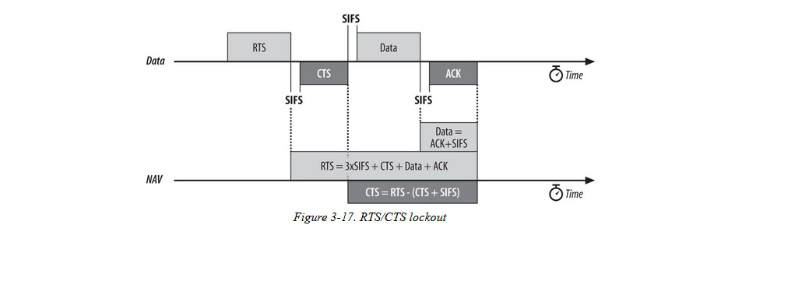
Q1. WiFi Timing (20 points) Node A is sending frames to Node B using the IEEE 802.11 DCF. Node B has no data to send. Node A has many MAC frames to send. Assume that receipt of the acknowledgement from sending a previous frame has just been completed, and this is at time t = 0. The length of the data portion of each MAC frame is 750 octets (6000 bits) Transmit over an 802.11n physical link at 600 Mbps. Only a single source is transmitting and never encounters a busy medium, so never uses exponential backoff. This single source is backlogged, so it always has a packet to send. SIFS = 16 s, PIFS = 25 s, and DIFS = 34 s Acknowledgement packets have no data in the frame body. Propagation delay is negligible enough to be ignored. Ignore physical layer headers. Use the frame format that only uses the fields that are always present, 14 octets. a. (10 points) Assume that when Node A tries to send its frames that it always finds the medium to be idle. Node A is using RTS/CTS. Give the time when the acknowledgement will be completed being received for Frame #1. Time when acknowledgement is received for Frame #1: b. (5 points) Now assume there is a proposal to reduce the SIFS times in part (a). What duration of the SIFS would produce a throughput of more than 80 Mbps? New SIFS time: c. (5 points) For the system in (a) (back to SIFS = 16 s), what is the throughput? And if the transmission speed for the system is increased to a number that is so large to be approximated as infinite. What is the new throughput? (Hint: We define the throughput as the number of user data bits transmitted per second, not including the data in the management and control frames.) Throughput with given transmission speed in (a): Throughput with infinite transmission speed: RTS Data CTS SIFS NAV SIFS Data SIFS ACK Data= ACK+SIFS RTS=3XSIFS+CTS + Data + ACK CTS =RTS - (CTS + SIFS) Figure 3-17. RTS/CTS lockout Time Time
Step by Step Solution
There are 3 Steps involved in it

Get step-by-step solutions from verified subject matter experts
 Study Help