







Question: Q1.1. Convert the following decimal numbers to equivalent binary, base-5, octal and Hexadecimal Numbers (i) (ii) 4096 131.5625 (iii) (iv) 0.475 2048.0625 Q1.2. Convert
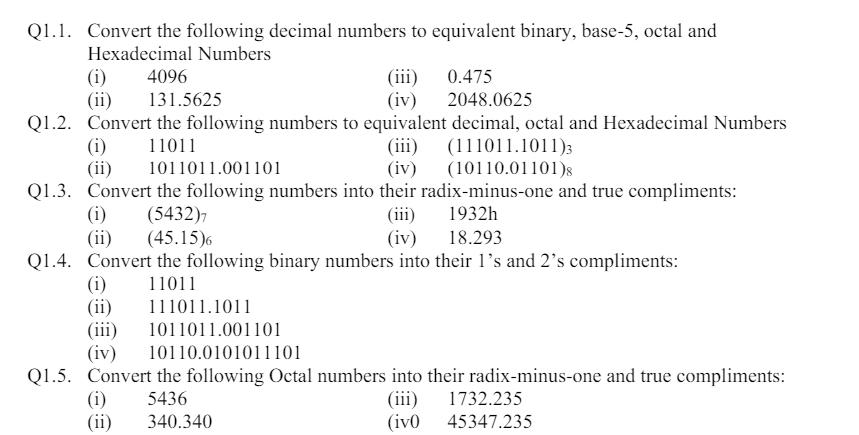
Q1.1. Convert the following decimal numbers to equivalent binary, base-5, octal and Hexadecimal Numbers (i) (ii) 4096 131.5625 (iii) (iv) 0.475 2048.0625 Q1.2. Convert the following numbers to equivalent decimal, octal and Hexadecimal Numbers (i) (ii) 11011 1011011.001101 (iii) (iv) (111011.1011)3 (10110.01101)s Q1.3. Convert the following numbers into their radix-minus-one and true compliments: (i) (ii) (5432)7 (45.15)6 (iii) 1932h (iv) 18.293 Q1.4. Convert the following binary numbers into their 1's and 2's compliments: (i) (ii) (iii) (iv) 11011 111011.1011 1011011.001101 10110.0101011101 Q1.5. Convert the following Octal numbers into their radix-minus-one and true compliments: (i) (ii) 5436 340.340 (iii) (iv0 45347.235 1732.235
Step by Step Solution
There are 3 Steps involved in it

Get step-by-step solutions from verified subject matter experts
 Study Help