







Question: Q17 The problem with measuring variability by merely averaging all the deviations between each score and the overall mean is that positive and negative deviations
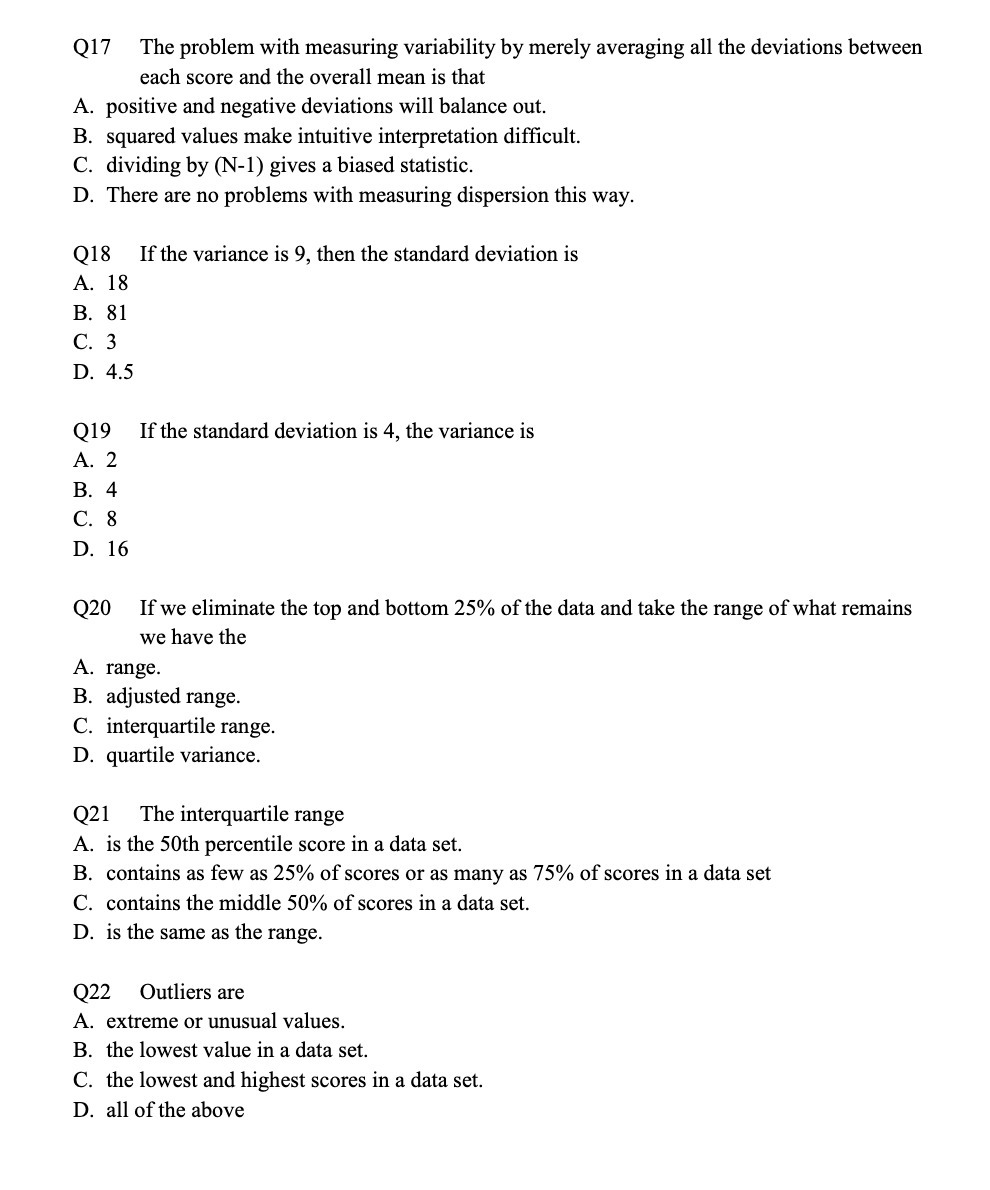
Q17 The problem with measuring variability by merely averaging all the deviations between each score and the overall mean is that positive and negative deviations will balance out. squared values make intuitive interpretation difcult. dividing by (N-l) gives a biased statistic. There are no problems with measuring dispersion this way. was? 18 If the variance is 9, then the standard deviation is Q19 If the standard deviation is 4, the variance is A. 2 B. 4 C. 8 D. 16 020 If we eliminate the top and bottom 25% of the data and take the range of what remains we have the A. range. B. adjusted range. C. interquartile range. D. quartile variance. 21 The interquartile range is the 50th percentile score in a data set. contains as few as 25% of scores or as many as 75% of scores in a data set contains the middle 50% of scores in a data set. is the same as the range. posse Q22 Outliers are A. extreme or unusual values. B. the lowest value in a data set. C. the lowest and highest scores in a data set. D. all of the above
Step by Step Solution
There are 3 Steps involved in it

Get step-by-step solutions from verified subject matter experts
 Study Help