







Question: Q1-Please don't do this question if you don't know the solution. I need detail solution with theory explanation. I will downvote if you do any
Q1-Please don't do this question if you don't know the solution. I need detail solution with theory explanation. I will downvote if you do any mistake in this problem. I need the solution in table format also.
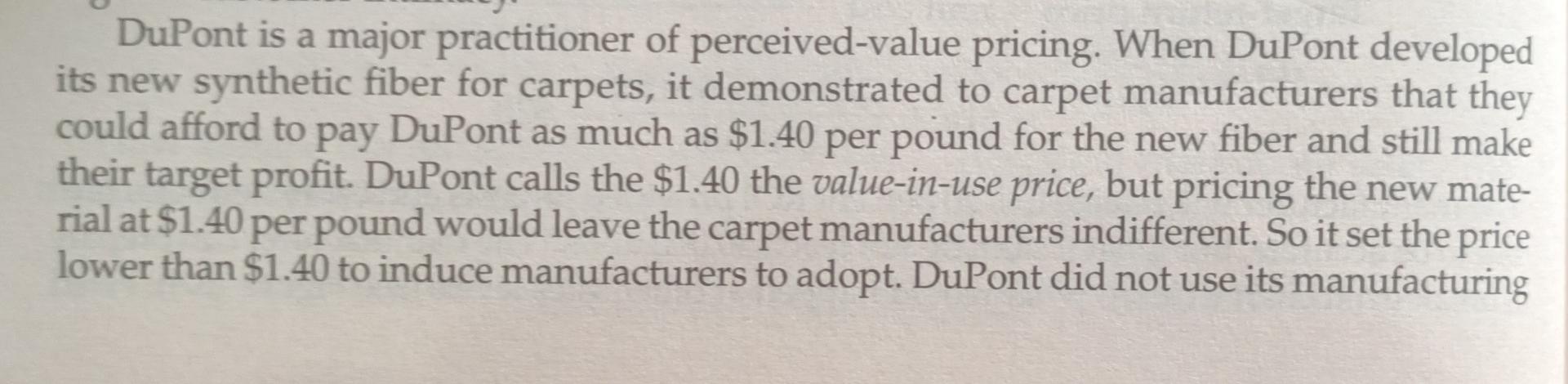

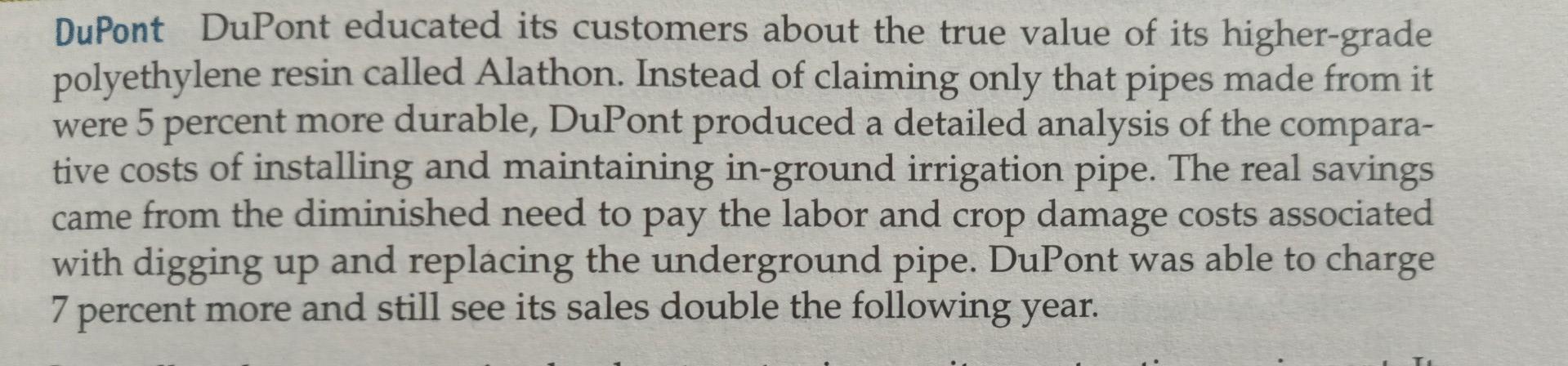
DuPont is a major practitioner of perceived-value pricing. When DuPont developed its new synthetic fiber for carpets, it demonstrated to carpet manufacturers that they could afford to pay DuPont as much as $1.40 per pound for the new fiber and still make their target profit. DuPont calls the $1.40 the value-in-use price, but pricing the new mate- rial at $1.40 per pound would leave the carpet manufacturers indifferent. So it set the price lower than $1.40 to induce manufacturers to adopt. DuPont did not use its manufacturing cost to set the price, but only to judge whether there was enough profit to go ahead in the first place. DuPont also embeds each chemical into a larger offering so that it is not seen as a commodity but rather as a solution to a customer's problem. Consider the following: DuPont DuPont educated its customers about the true value of its higher-grade polyethylene resin called Alathon. Instead of claiming only that pipes made from it were 5 percent more durable, DuPont produced a detailed analysis of the compara- tive costs of installing and maintaining in-ground irrigation pipe. The real savings came from the diminished need to pay the labor and crop damage costs associated with digging up and replacing the underground pipe. DuPont was able to charge 7 percent more and still see its sales double the following year. DuPont is a major practitioner of perceived-value pricing. When DuPont developed its new synthetic fiber for carpets, it demonstrated to carpet manufacturers that they could afford to pay DuPont as much as $1.40 per pound for the new fiber and still make their target profit. DuPont calls the $1.40 the value-in-use price, but pricing the new mate- rial at $1.40 per pound would leave the carpet manufacturers indifferent. So it set the price lower than $1.40 to induce manufacturers to adopt. DuPont did not use its manufacturing cost to set the price, but only to judge whether there was enough profit to go ahead in the first place. DuPont also embeds each chemical into a larger offering so that it is not seen as a commodity but rather as a solution to a customer's problem. Consider the following: DuPont DuPont educated its customers about the true value of its higher-grade polyethylene resin called Alathon. Instead of claiming only that pipes made from it were 5 percent more durable, DuPont produced a detailed analysis of the compara- tive costs of installing and maintaining in-ground irrigation pipe. The real savings came from the diminished need to pay the labor and crop damage costs associated with digging up and replacing the underground pipe. DuPont was able to charge 7 percent more and still see its sales double the following year
Step by Step Solution
There are 3 Steps involved in it

Get step-by-step solutions from verified subject matter experts
 Study Help