







Question: Q.2. A six-station automatic assembly machine has an ideal cycle time of 6 seconds. At stations 2 through 6, parts feeders deliver components to
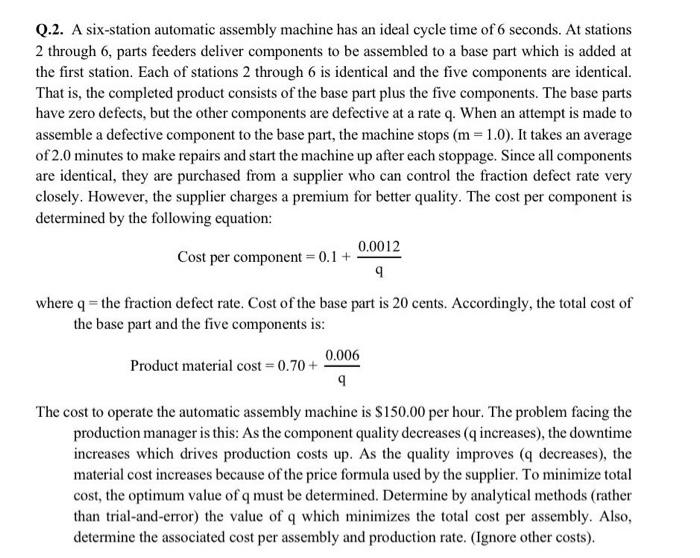
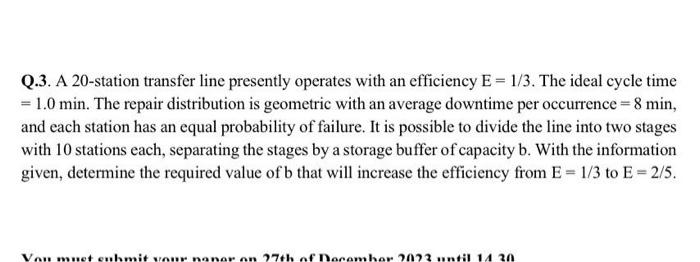
Q.2. A six-station automatic assembly machine has an ideal cycle time of 6 seconds. At stations 2 through 6, parts feeders deliver components to be assembled to a base part which is added at the first station. Each of stations 2 through 6 is identical and the five components are identical. That is, the completed product consists of the base part plus the five components. The base parts have zero defects, but the other components are defective at a rate q. When an attempt is made to assemble a defective component to the base part, the machine stops (m = 1.0). It takes an average of 2.0 minutes to make repairs and start the machine up after each stoppage. Since all components are identical, they are purchased from a supplier who can control the fraction defect rate very closely. However, the supplier charges a premium for better quality. The cost per component is determined by the following equation: Cost per component = 0.1+ 0.0012 q where q = the fraction defect rate. Cost of the base part is 20 cents. Accordingly, the total cost of the base part and the five components is: Product material cost = 0.70+ 0.006 q The cost to operate the automatic assembly machine is $150.00 per hour. The problem facing the production manager is this: As the component quality decreases (q increases), the downtime increases which drives production costs up. As the quality improves (q decreases), the material cost increases because of the price formula used by the supplier. To minimize total cost, the optimum value of q must be determined. Determine by analytical methods (rather than trial-and-error) the value of q which minimizes the total cost per assembly. Also, determine the associated cost per assembly and production rate. (Ignore other costs). Q.3. A 20-station transfer line presently operates with an efficiency E = 1/3. The ideal cycle time = 1.0 min. The repair distribution is geometric with an average downtime per occurrence = 8 min, and each station has an equal probability of failure. It is possible to divide the line into two stages with 10 stations each, separating the stages by a storage buffer of capacity b. With the information given, determine the required value of b that will increase the efficiency from E = 1/3 to E = 2/5. Von muet enhmit your nanor on 27th of December 2073 until 14 30
Step by Step Solution
There are 3 Steps involved in it

Get step-by-step solutions from verified subject matter experts
 Study Help