Question: Q3: Plant operations plan (7 points) (LP formulation for this problem is provided. You need to use Solver to find out the optimal solutions. Write
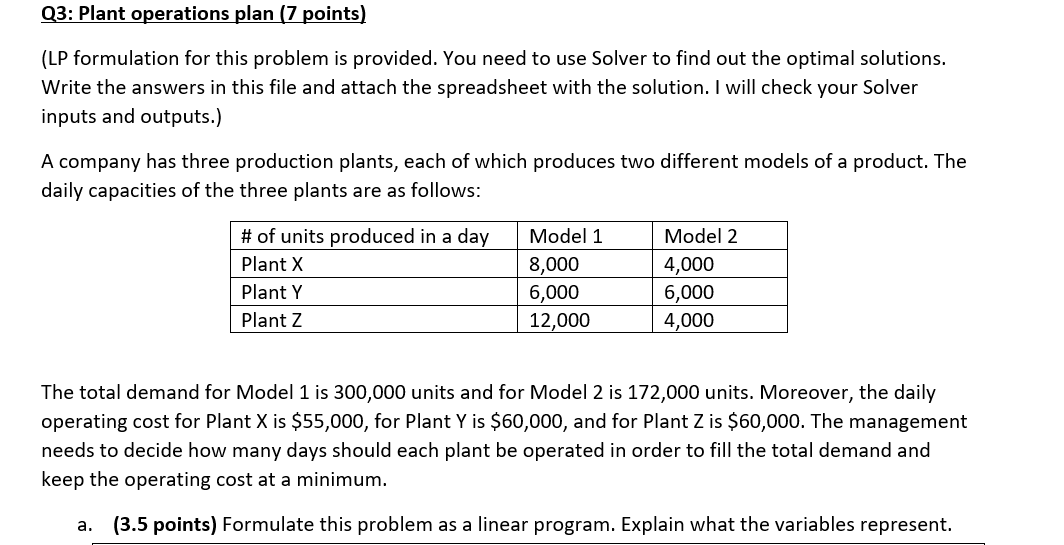
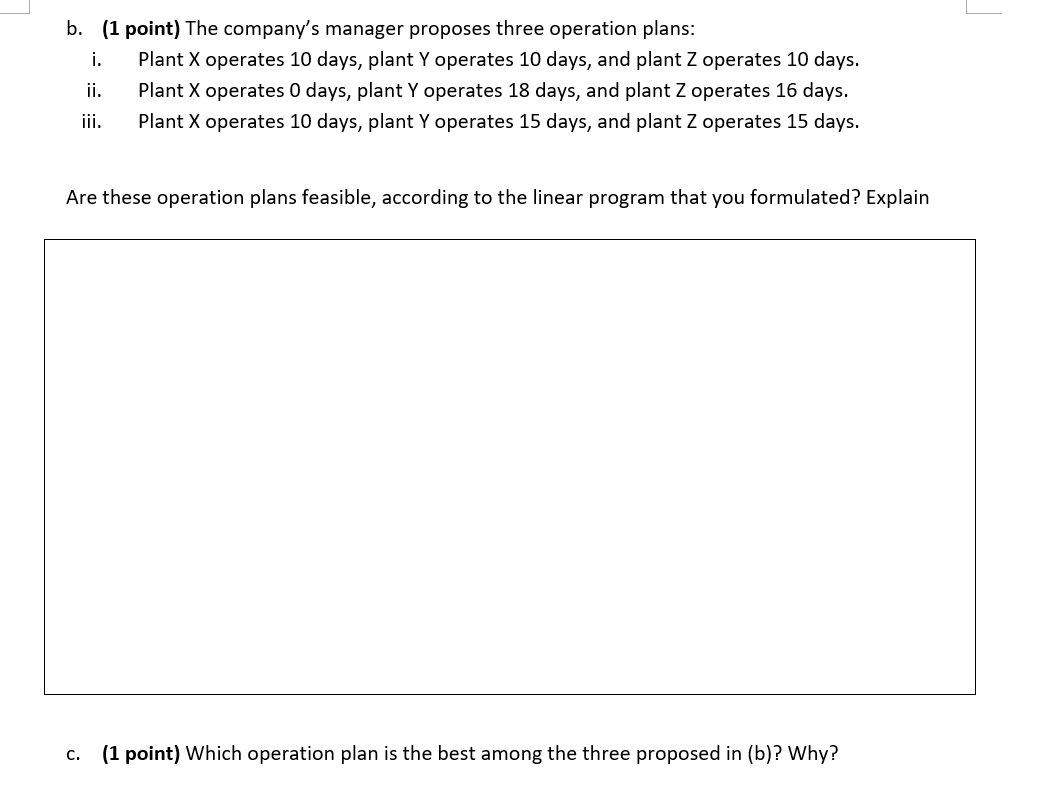
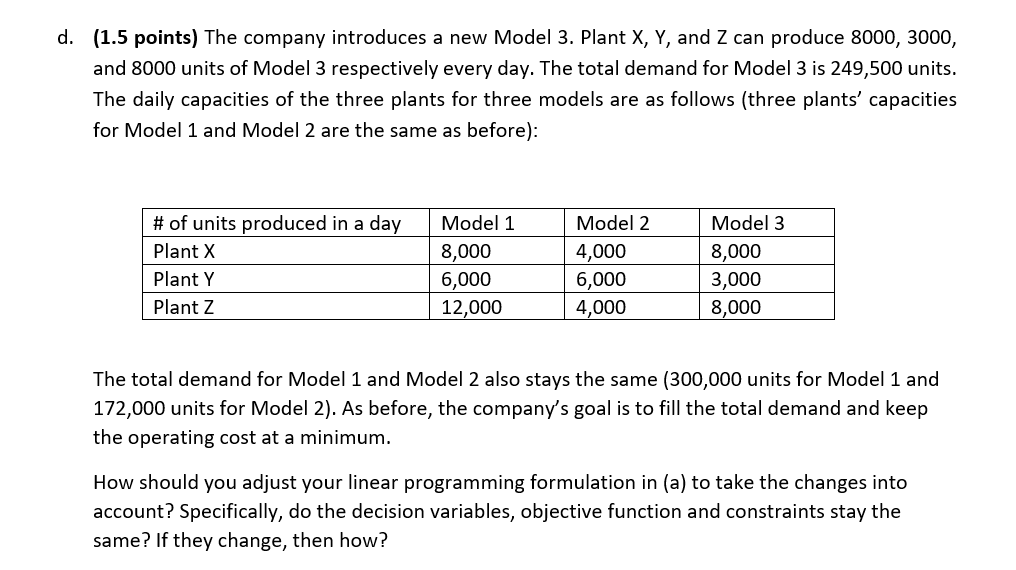
Q3: Plant operations plan (7 points) (LP formulation for this problem is provided. You need to use Solver to find out the optimal solutions. Write the answers in this file and attach the spreadsheet with the solution. I will check your Solver inputs and outputs.) A company has three production plants, each of which produces two different models of a product. The daily capacities of the three plants are as follows: # of units produced in a day Plant X Plant Y Plant Z Model 1 8,000 6,000 12,000 Model 2 4,000 6,000 4,000 The total demand for Model 1 is 300,000 units and for Model 2 is 172,000 units. Moreover, the daily operating cost for Plant X is $55,000, for Plant Y is $60,000, and for Plant Z is $60,000. The management needs to decide how many days should each plant be operated in order to fill the total demand and keep the operating cost at a minimum. a. (3.5 points) Formulate this problem as a linear program. Explain what the variables represent. b. (1 point) The company's manager proposes three operation plans: i. Plant X operates 10 days, plant Y operates 10 days, and plant Z operates 10 days. ii. Plant X operates 0 days, plant Y operates 18 days, and plant Z operates 16 days. iii. Plant X operates 10 days, plant Y operates 15 days, and plant Z operates 15 days. Are these operation plans feasible, according to the linear program that you formulated? Explain c. (1 point) Which operation plan is the best among the three proposed in (b)? Why? d. (1.5 points) The company introduces a new Model 3. Plant X, Y, and Z can produce 8000, 3000, and 8000 units of Model 3 respectively every day. The total demand for Model 3 is 249,500 units. The daily capacities of the three plants for three models are as follows (three plants' capacities for Model 1 and Model 2 are the same as before): # of units produced in a day Plant X Plant Y Plant Z Model 1 8,000 6,000 12,000 Model 2 4,000 6,000 4,000 Model 3 8,000 3,000 8,000 The total demand for Model 1 and Model 2 also stays the same (300,000 units for Model 1 and 172,000 units for Model 2). As before, the company's goal is to fill the total demand and keep the operating cost at a minimum. How should you adjust your linear programming formulation in (a) to take the changes into account? Specifically, do the decision variables, objective function and constraints stay the same? If they change, then how









 Study Help