







Question: Q4. (12 points) Consider the problem x = remainder(A*B)/C), where A, B and C are integer numbers stored at decimal addresses 900, 901 and 902,
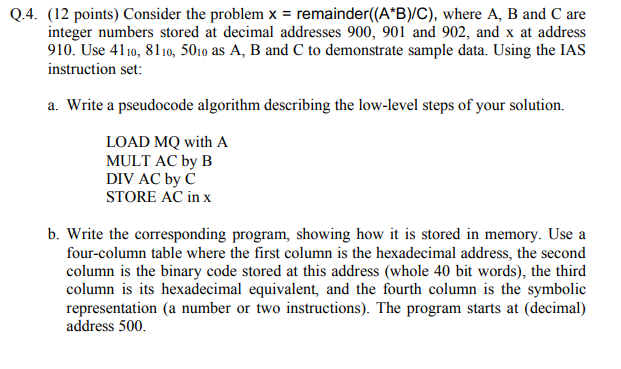
Q4. (12 points) Consider the problem x = remainder(A*B)/C), where A, B and C are integer numbers stored at decimal addresses 900, 901 and 902, and x at address 910. Use 41io, 81io, 50io as A, B and C to demonstrate sample data. Using the IAS instruction set: a. Write a pseudocode algorithm describing the low-level steps of your solution. LOAD MQ with A MULT AC by B DIV AC by C STORE AC in x b. Write the corresponding program, showing how it is stored in memory. Use a four-column table where the first column is the hexadecimal address, the second column is the binary code stored at this address (whole 40 bit words), the third column is its hexadecimal equivalent, and the fourth column is the symbolic representation (a number or two instructions). The program starts at (decimal) address 500. Q4. (12 points) Consider the problem x = remainder(A*B)/C), where A, B and C are integer numbers stored at decimal addresses 900, 901 and 902, and x at address 910. Use 41io, 81io, 50io as A, B and C to demonstrate sample data. Using the IAS instruction set: a. Write a pseudocode algorithm describing the low-level steps of your solution. LOAD MQ with A MULT AC by B DIV AC by C STORE AC in x b. Write the corresponding program, showing how it is stored in memory. Use a four-column table where the first column is the hexadecimal address, the second column is the binary code stored at this address (whole 40 bit words), the third column is its hexadecimal equivalent, and the fourth column is the symbolic representation (a number or two instructions). The program starts at (decimal) address 500
Step by Step Solution
There are 3 Steps involved in it

Get step-by-step solutions from verified subject matter experts
 Study Help