







Question: Quadratic Model for free-falling objects on Earth: The general ' ' nf n ti for a free-falling object, _ 2 neglecting air resistance, is t)
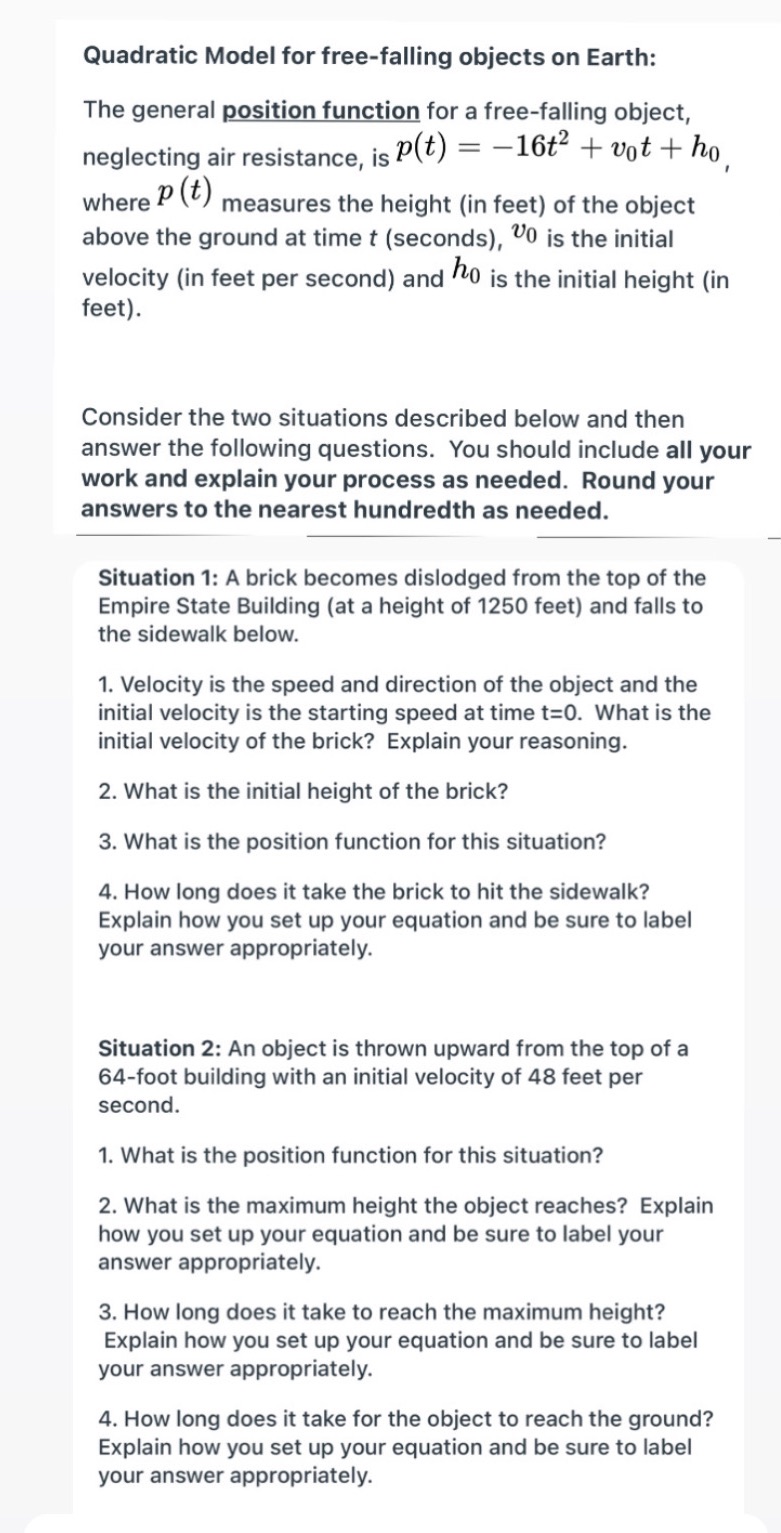
Quadratic Model for free-falling objects on Earth: The general ' ' nf n ti for a free-falling object, _ 2 neglecting air resistance, is t) "Kit + \"at + hto. where p (t) measures the height (in feet) of the object above the ground at time t (seconds), \"0 is the initial velocity (in feet per second) and ho is the initial height (in feet). Consider the two situations described below and then answer the following questions. You should include all your work and explain your process as needed. Round your answers to the nearest hundredth as needed. Situation 1: A brick becomes dislodged from the top of the Empire State Building (at a height of 1250 feet) and falls to the sidewalk below. 1. Velocity is the speed and direction of the object and the initial velocity is the starting speed at time t=0. What is the initial velocity of the brick? Explain your reasoning. 2. What is the initial height of the brick? 3. What is the position function for this situation? 4. How long does it take the brick to hit the sidewalk? Expiain how you set up your equation and be sure to label your answer appropriately. Situation 2: An object is thrown upward from the top of a 64-foot building with an initial velocity of 48 feet per second. 1. What is the position function for this situation? 2. What is the maximum height the object reaches? Explain how you set up your equation and be sure to label your answer appropriately. 3. How long does it take to reach the maximum height? Explain how you set up your equation and be sure to label your answer appropriately. 4. How long does it take for the object to reach the ground? Explain how you set up your equation and be sure to label your answer appropriately
Step by Step Solution
There are 3 Steps involved in it

Get step-by-step solutions from verified subject matter experts
 Study Help