







Question: .Quantified Statements, Existential Statements, Universal Statements; Universal Instantiation, Existence Instantiation; . Sets, Subsets, Proper Subsets, Empty set, Cartesian Products; Relations, Functions, Domain, Range; 1. Determine
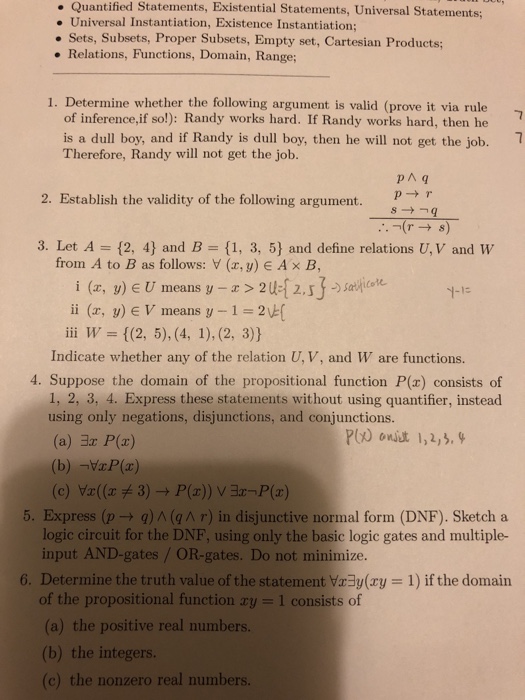
.Quantified Statements, Existential Statements, Universal Statements; Universal Instantiation, Existence Instantiation; . Sets, Subsets, Proper Subsets, Empty set, Cartesian Products; Relations, Functions, Domain, Range; 1. Determine whether the following argument is valid (prove it via rule of inference,if so!): Randy works hard. If Randy works hard, then he is a dull boy, and if Randy is dull boy, then he will not get the job. Therefore, Randy will not get the job 7 2. Establish the validity of the following argument. 3, Let A = {2, 4} and B = {1, 3, 5} and define relations U,V and W from A to B as follows: (z, y) e A B, ii (x, y) E V means y-1 = 2t( iii W= {(2, 5), (4, 1), (2, 3)) Indicate whether any of the relation U, V, and W are functions. 4. Suppose the domain of the propositional function P(x) consists of 1, 2, 3, 4. Express these statements without using quantifier, instead using only negations, disjunctions, and conjunctions (a) 3r P() Ph) onist 1,2,3,9 (b) P(a) 5. Express (p q)^ (on r) in disjunctive normal form (DNF). Sketch a logic circuit for the DNF, using only the basic logic gates and multiple- input AND-gates /OR-gates. Do not minimize Determine the truth value of the statementVa3y(xy=l) if the domain 6. of the propositional function ry1 consists of (a) the positive real numbers. (b) the integers. (c) the nonzero real numbers
Step by Step Solution
There are 3 Steps involved in it

Get step-by-step solutions from verified subject matter experts
 Study Help