







Question: 1. In this question, you'll define and work with predicates over the set of binary strings of length 3, which we'll call B3. For reference,
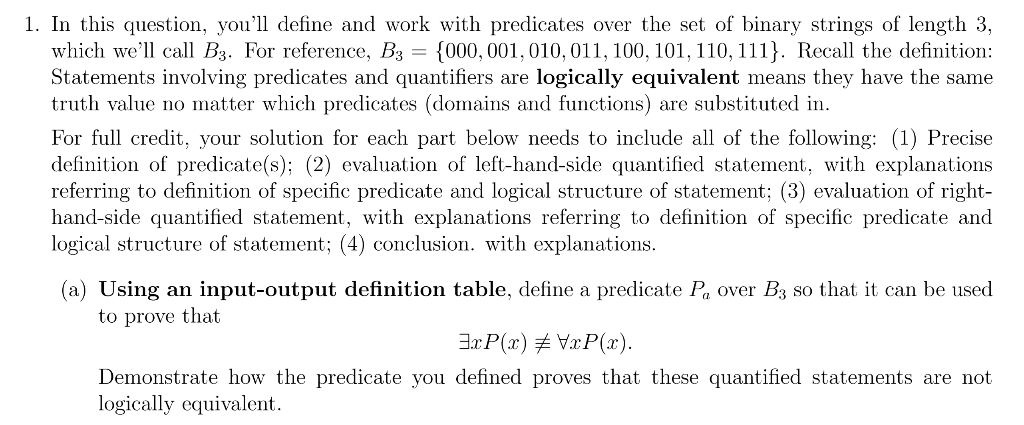
1. In this question, you'll define and work with predicates over the set of binary strings of length 3, which we'll call B3. For reference, B3 = {000,001,010,011, 100, 101, 110, 111}. Recall the definition: Statements involving predicates and quantifiers are logically equivalent means they have the same truth value no matter which predicates (domains and functions) are substituted in. For full credit, your solution for each part below needs to include all of the following: (1) Precise definition of predicate(s); (2) evaluation of left-hand-side quantified statement, with explanations referring to definition of specific predicate and logical structure of statement; (3) evaluation of right- hand-side quantified statement, with explanations referring to definition of specific predicate and logical structure of statement; (4) conclusion, with explanations. (a) Using an input-output definition table, define a predicate P, over B3 so that it can be used to prove that 3.x P() # VxP(). Demonstrate how the predicate you defined proves that these quantified statements are not logically equivalent. 1. In this question, you'll define and work with predicates over the set of binary strings of length 3, which we'll call B3. For reference, B3 = {000,001,010,011, 100, 101, 110, 111}. Recall the definition: Statements involving predicates and quantifiers are logically equivalent means they have the same truth value no matter which predicates (domains and functions) are substituted in. For full credit, your solution for each part below needs to include all of the following: (1) Precise definition of predicate(s); (2) evaluation of left-hand-side quantified statement, with explanations referring to definition of specific predicate and logical structure of statement; (3) evaluation of right- hand-side quantified statement, with explanations referring to definition of specific predicate and logical structure of statement; (4) conclusion, with explanations. (a) Using an input-output definition table, define a predicate P, over B3 so that it can be used to prove that 3.x P() # VxP(). Demonstrate how the predicate you defined proves that these quantified statements are not logically equivalent
Step by Step Solution
There are 3 Steps involved in it

Get step-by-step solutions from verified subject matter experts
 Study Help