





Question: Quantitative Method Analysis network distribution Please solve using solver on Excel solve please using the Values in the problem like Problem 10-07 (Algorithmic) Aggle Power
Quantitative Method Analysis network distribution
Please solve using solver on Excel
solve please using the Values in the problem like
Quantitative Method Analysis network distribution
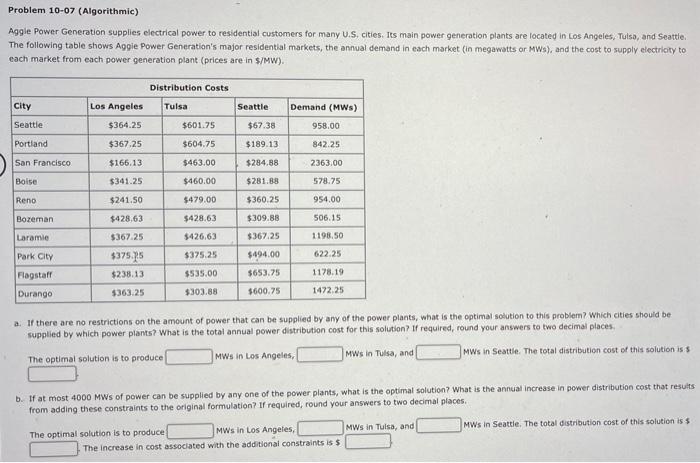
Problem 10-07 (Algorithmic) Aggle Power Generation supplies electrical power to residential customers for many U.S. cities. Its main power generation plants are located in Los Angeles, Tulsa, and Seattle. The following table shows Aggie Power Generation's major residential markets, the annual demand in each market (in megawatts or MWS), and the cost to supply electricity to each market from each power generation plant (prices are in $/MW). Distribution Costs City Los Angeles Tulsa Seattle Demand (MWs) Seattle $364.25 $601.75 $67.38 958.00 Portland $367.25 $604.75 $189.13 842.25 San Francisco. $166.13 $463.00 $284.88 2363.00 Boise $341.25 $460.00 $281.88 578.75 Reno $241.50 $479.00 $360.25 954.00 Bozeman $428,63 $428.63 $309.88 506.15 Laramie $367.25 $426.63 $367.25 1198.50 Park City $375.25 $375.25 $494.00 622.25 Flagstaff $238.13 $535.00 $653.75 1178.19 $363.25 Durango $303.88 $600.75 1472.25 a. If there are no restrictions on the amount of power that can be supplied by any of the power plants, what is the optimal solution to this problem? Which cities should be supplied by which power plants? What is the total annual power distribution cost for this solution? If required, round your answers to two decimal places. MWS in Tulsa, and MWS in Seattle. The total distribution cost of this solution is $ The optimal solution is to produce MWs in Los Angeles, b. If at most 4000 MWs of power can be supplied by any one of the power plants, what is the optimal solution? What is the annual increase in power distribution cost that results from adding these constraints to the original formulation? If required, round your answers to two decimal places. MWs in Los Angeles, MWs in Tulsa, and MWs in Seattle. The total distribution cost of this solution is s The optimal solution is to produce The increase in cost associated with the additional constraints is $

Step by Step Solution

There are 3 Steps involved in it

1 Expert Approved Answer
Step: 1 Unlock blur-text-image

Question Has Been Solved by an Expert!

Get step-by-step solutions from verified subject matter experts

Step: 2 Unlock
Step: 3 Unlock

Students Have Also Explored These Related General Management Questions!